
Canada’s Northwest Territories Witness First-Ever 'Permafrost Detachment Slides' Triggered by Wildfire and Warming
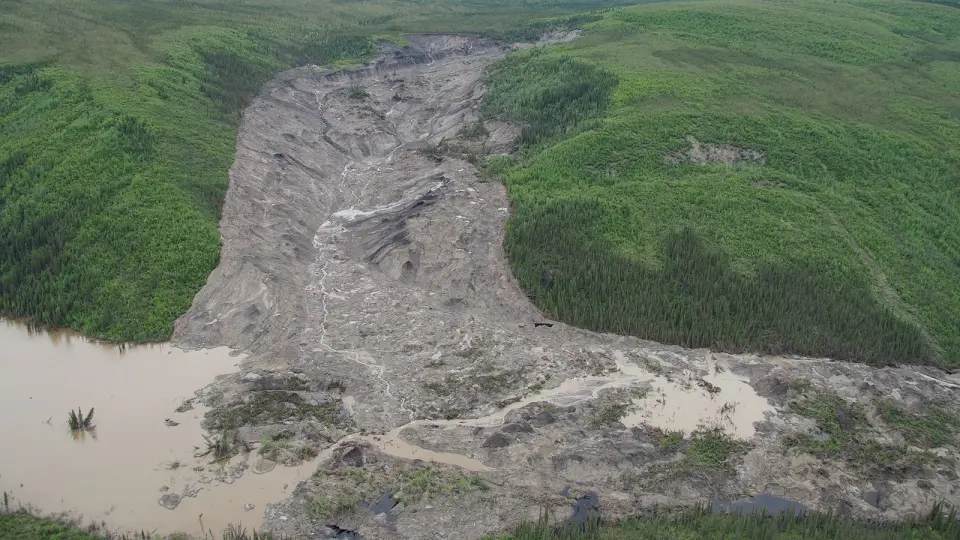
Researchers have identified a new type of landslide in Canada's Northwest Territories, termed 'permafrost detachment slides.' Unlike standard thawing, these events involve large blocks of frozen ice moving downslope. The phenomenon, linked to long-term warming and past wildfires, has occurred over 150 times in the region and may be unprecedented in the last 10,000 years.
Key points
- A new study published in Geophysical Research Letters identifies 'permafrost detachment slides' as a distinct mass wasting process in Canada's Northwest Territories.
- These slides involve the movement of large, frozen blocks of material, some up to 33 feet (10 meters) tall, rather than the typical slurry of thawing mud.
- The mechanism involves a 20-year lag time where fire-related thaw and warming create cracks that allow heat to penetrate deep into the permafrost layer, eventually melting the bottom and triggering a slide.
- Two major slides were documented: one in the Johnson River Valley in 2017 moving 18 million cubic meters of debris, and another in the Redstone River Valley in 2018 moving 4.5 million cubic meters.
- Over 150 such slides have been identified in the area, with the two largest creating new lakes by damming rivers and dumping sediment into waterways.
- The phenomenon is linked to permafrost warming at a rate of 0.3 degrees Celsius per decade since 1980 and severe wildfires in 1995.
Background
Recent archival reports highlight the accelerating instability of Arctic permafrost. In October 2026, Longyearbyen, Norway, faced a drinking water crisis due to heavy metals leaching from thawing permafrost. Additionally, a September 2026 study confirmed the permanent loss of Canada's last epishelf lake in Nunavut following an ice shelf collapse, illustrating the rapid disappearance of stable Arctic features. Broader research indicates that thawing permafrost is releasing significant methane and carbon dioxide, creating feedback loops that alter global climate projections. A separate study noted that scientific attention has historically under-prioritized high-risk tipping points like boreal permafrost compared to other systems.
Why it matters
The discovery of permafrost detachment slides reveals a new, potentially irreversible mechanism of landscape change in the Arctic. Unlike gradual thawing, these slides can rapidly alter river systems and create new lakes, posing risks to infrastructure in vulnerable regions. As wildfires become more intense at northern latitudes, the combination of fire and warming may trigger widespread instability in areas with deep permafrost, offering a 'glimpse into the future' of climate-driven geological hazards.
What to watch
Researchers will continue to monitor the over 150 identified slides in the Northwest Territories to understand their long-term impacts on hydrology and sediment transport. Further studies are expected to assess the vulnerability of other regions in Canada and Alaska with similar permafrost depths. The findings may inform future infrastructure planning and climate risk assessments in northern latitudes, where the interaction between wildfire and permafrost thaw is intensifying.
Want the full story? Read the original reporting
Read on Live Science