
Satellite imagery reveals recurring turquoise plankton blooms around Chatham Islands
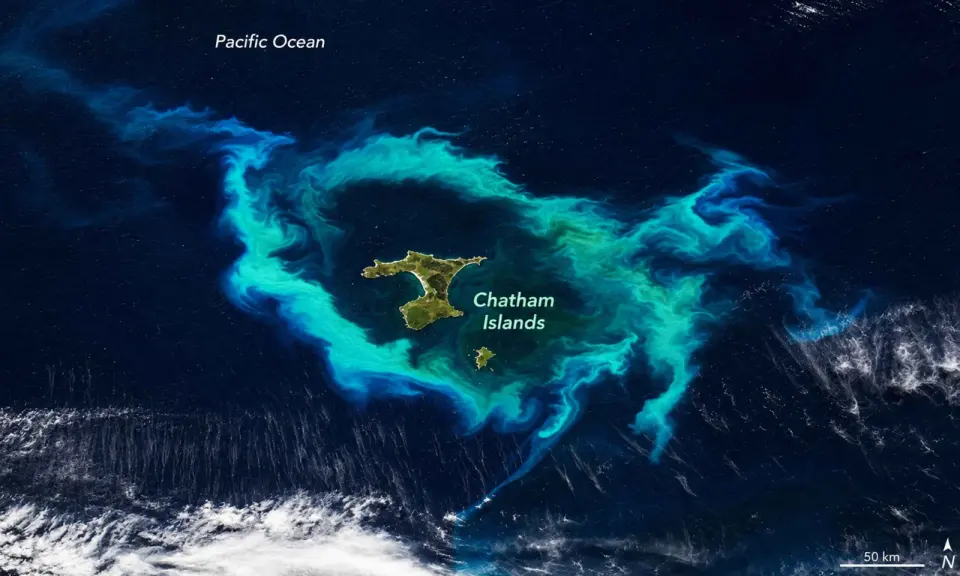
A January 2026 satellite image captured a distinct turquoise ring of phytoplankton surrounding New Zealand’s Chatham Islands. The phenomenon is driven by the Chatham Rise, a massive underwater plateau that mixes nutrient-rich Antarctic waters with sunlight, creating ideal conditions for massive algal blooms.
Key points
- NOAA-20 satellite captured a vivid turquoise halo around the Chatham Islands on January 10, 2026.
- The coloration is caused by a massive phytoplankton bloom, visible from orbit due to high chlorophyll levels.
- The Chatham Rise, an underwater plateau 500 miles long and 185 miles wide, facilitates the mixing of cold, nutrient-rich Antarctic water with warmer subtropical water.
- Surface currents and eddies stretched the bloom into spirals and filaments around the remote archipelago.
- Similar blooms were recorded in 2008, 2009, and 2010, suggesting this is a recurring seasonal feature rather than a one-time anomaly.
Background
The Chatham Islands, located approximately 500 miles east of New Zealand’s South Island, support a diverse marine ecosystem including pāua, rock lobster, and various seal and whale species. A 2011 food-web model by the National Institute of Water and Atmospheric Research identified 28 major groups in the Chatham Rise ecosystem, highlighting the critical role of phytoplankton as the base of the marine food web. Previous satellite observations of similar blooms in 2008 and 2009 suggested the presence of coccolithophores, though the 2026 event has not yet been confirmed at the species level.
Why it matters
Phytoplankton are foundational to the marine food web, supporting zooplankton, fish, and larger marine mammals. Monitoring these blooms helps scientists understand nutrient cycling and ecosystem health. While a single image cannot predict long-term climate shifts or fishing yields, repeated satellite observations provide valuable data on seasonal patterns and ocean dynamics in the Southern Hemisphere.
What to watch
Scientists will continue to monitor the Chatham Islands region via satellite to track the frequency and spread of these blooms. Direct water sampling remains necessary to identify specific species and measure local conditions, as satellite color data alone cannot confirm the exact composition of the phytoplankton population.
Want the full story? Read the original reporting
Read on Earth.com