
Physicists Propose Lorentz Violation to Explain Arrival of 'Impossible' BOAT Photon
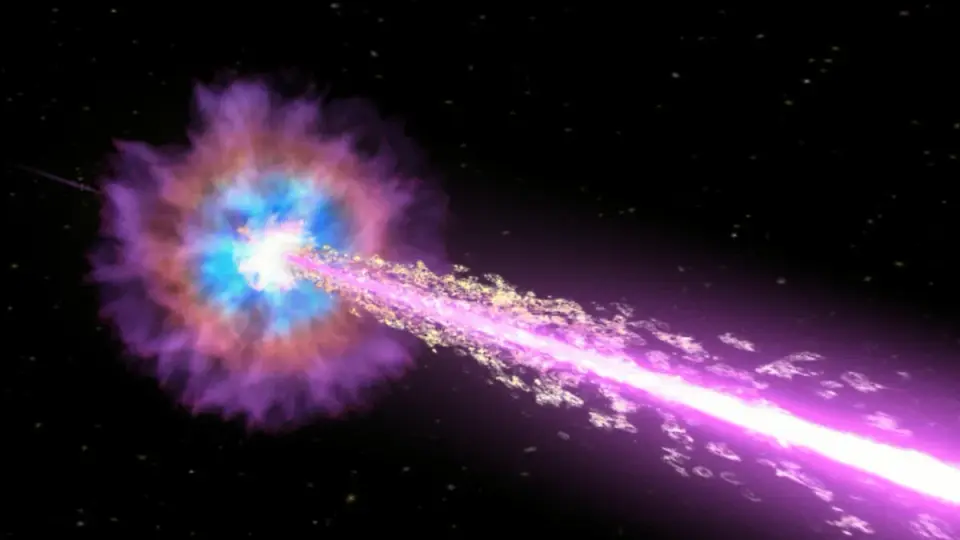
A new study suggests that a high-energy photon from the 2022 gamma-ray burst GRB 221009A, nicknamed 'BOAT,' survived its two-billion-light-year journey to Earth by temporarily transforming into an axion-like particle. This mechanism, combined with a slight violation of Lorentz invariance, allows the photon to bypass interactions with the cosmic microwave background that would otherwise annihilate it. The theory predicts a one-hour delay between lower-energy photons and the 300 TeV photon, a timing that matches observations from a Chinese observatory. If confirmed, this would provide the first empirical evidence for quantum gravity effects at energies far exceeding those achievable by terrestrial accelerators.
Key points
- GRB 221009A, detected in 2022, was the brightest gamma-ray burst ever recorded, originating roughly two billion light-years away with energies reaching 300 teraelectronvolts (TeV).
- Standard physics predicts that photons at this energy level should have been annihilated by the cosmic microwave background during their journey, making their arrival on Earth theoretically impossible.
- Researchers Giorgio Galanti and Marco Roncadelli propose that the photon converted into an axion-like particle, allowing it to travel through a 'fast lane' without interacting with background radiation.
- The model requires a minor violation of Lorentz invariance, a core principle of Einstein's special relativity, to account for the photon's behavior at extreme energies.
- The theory predicts a one-hour gap between the arrival of lower-energy photons and the 300 TeV photon, a prediction that aligns with data recorded by a Chinese observatory.
- The authors acknowledge that axion-like particles are hypothetical and that this is one of several proposed explanations, but the empirical match provides strong support for the model.
Background
This development follows earlier discussions about the nature of light and time dilation, where photons experience no elapsed time during their journey, a consequence of special relativity. The current study challenges the strict adherence to Lorentz invariance at extreme energy levels, potentially opening a new avenue for testing quantum gravity theories using cosmic events rather than particle accelerators.
Why it matters
If the proposed mechanism is confirmed, it would mark the first observational evidence for quantum gravity effects at energies vastly higher than those achievable in any Earth-based accelerator. This could transform the universe into a natural laboratory for studying fundamental physics, potentially resolving long-standing questions about the behavior of matter and energy at the highest scales.
What to watch
Future observations of similar high-energy gamma-ray bursts will be critical to testing the predictions of this model. If additional events confirm the predicted timing gaps and the behavior of axion-like particles, it could lead to a new understanding of the fundamental symmetries of the universe and the nature of quantum gravity.
Want the full story? Read the original reporting
Read on Gizmodo