Tag

Gamma Ray Bursts

All articles tagged with #gamma ray bursts

Black Hole Merger in Galactic Nucleus May Have Lit Up the Sky
science24 days ago

Black Hole Merger in Galactic Nucleus May Have Lit Up the Sky

Astronomers connecting the November 2024 gravitational-wave event S241125n with a brief gamma-ray and X-ray flash propose the merger happened inside the accretion disk of a supermassive black hole at the center of a galaxy. If true, the environment would feed rapid accretion and jets, producing light from an event usually expected to be dark, offering a new scenario for how black hole mergers in galactic nuclei might be observed. Further observations and modeling are needed to confirm this explanation.

Breakthrough Neutron-Star Collision in Tiny Galaxy Reframes GRB Origins
space1 month ago

Breakthrough Neutron-Star Collision in Tiny Galaxy Reframes GRB Origins

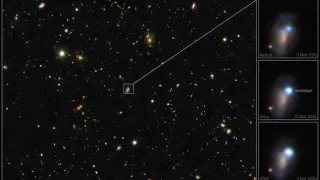
Astronomers detected a neutron-star collision in a tiny, faint galaxy inside a 600,000-light-year gas stream, about 4.7 billion light-years away, challenging where such events occur and linking them to gamma-ray bursts and the production of heavy elements like gold and platinum, with observations from Fermi, Chandra, Swift, and Hubble.

Radio Echo Unveils Hidden Gamma-Ray Burst in Distant Galaxy
science1 month ago

Radio Echo Unveils Hidden Gamma-Ray Burst in Distant Galaxy

Astronomers using the Australian SKA Pathfinder (ASKAP) detected the long‑lived radio afterglow of a powerful gamma‑ray burst that emitted little or no high‑energy light, revealing an orphan afterglow (ASKAP J005512-255834). The radio source brightened to about 10^32 watts of energy and faded over about 1,000 days, and lies in a distant, star‑forming galaxy ~1.7 billion light‑years away. This finding provides a clearer example of hidden GRB events and could help map the full gamma‑ray burst population, though an alternative explanation — a star torn apart by an intermediate‑mass black hole — remains possible.

NASA Puts Swift Observatory on Pause to Prevent Reentry, Seeks Rescue Mission
space-and-spaceflight1 month ago

NASA Puts Swift Observatory on Pause to Prevent Reentry, Seeks Rescue Mission

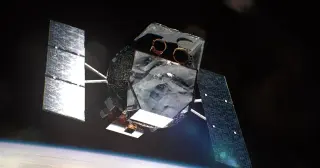
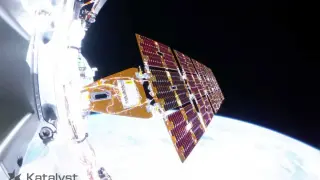
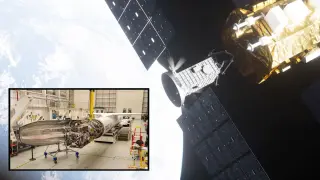
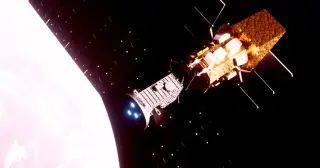
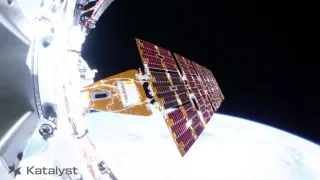
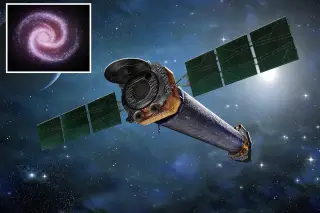
NASA has paused most Swift Observatory science operations to reduce atmospheric drag and slow its orbital decay, as the 21-year-old gamma-ray telescope faces a rising risk of uncontrolled reentry by mid-2026. To extend its life, NASA awarded a $30 million contract to Katalyst Space Technologies for a rescue mission to rendezvous with Swift and boost its orbit, with a launch aimed for June to keep the spacecraft above about 185 miles in altitude. The Burst Alert Telescope will still detect gamma-ray bursts, while other telescopes remain on hold to minimize drag.

Seven-Hour Gamma-Ray Burst Suggests a New Stellar Merger Engine
space2 months ago

Seven-Hour Gamma-Ray Burst Suggests a New Stellar Merger Engine

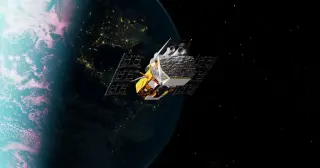
Astronomers using the Fermi Gamma-ray Space Telescope detected GRB 250702B, a gamma-ray burst lasting about seven hours—the longest on record—challenging standard GRB models. A helium-merger scenario, where a black hole accretes a helium star and transfers angular momentum to power an unusually long jet, offers a natural explanation. Future work with the COSI gamma-ray telescope, set to launch in 2027, aims to find more long-duration GRBs to unravel the underlying physics.

NASA supercomputer reveals magnetic chaos before neutron-star merger
science2 months ago

NASA supercomputer reveals magnetic chaos before neutron-star merger

A NASA Goddard-led study used the NASA Pleiades supercomputer to simulate the final orbits of a binary neutron-star system, showing magnetospheres continually reconnecting as the stars spiral in. The simulations indicate high-energy gamma-ray emission is largely trapped by electron-positron pair production, while lower-energy gamma-rays and X-rays may escape depending on the observer's viewpoint. The work helps predict pre-merger signals for future gamma-ray telescopes and gravitational-wave detectors like LISA.

Scientists Unveil Explanation for 'Impossible' Black Hole Mergers
science5 months ago

Scientists Unveil Explanation for 'Impossible' Black Hole Mergers

In 2023, astronomers observed a black hole merger that defied existing physics, involving black holes within a forbidden mass range and spinning at near light speed. New simulations incorporating magnetic fields reveal that these fields can eject mass during a star's collapse, producing lighter, fast-spinning black holes and potentially observable gamma-ray bursts, offering insights into these 'impossible' black holes.

Astronomers Discover Rare, Mysterious Repeating Gamma-Ray Bursts Beyond the Milky Way
science6 months ago

Astronomers Discover Rare, Mysterious Repeating Gamma-Ray Bursts Beyond the Milky Way

Astronomers have observed a rare series of repeating gamma-ray bursts, lasting much longer than typical bursts and originating outside our galaxy, which could reveal new insights into the death of stars and extreme cosmic events. The cause remains uncertain, with theories including unusual supernovae or star-black hole interactions, and ongoing observations aim to uncover more about these extraordinary phenomena.

Record-Breaking and Unprecedented Gamma-Ray Bursts Challenge Existing Theories
science7 months ago

Record-Breaking and Unprecedented Gamma-Ray Bursts Challenge Existing Theories

Astronomers have discovered a record-breaking, unusually long gamma-ray burst, GRB 250702B, which lasted about a day and originated from a galaxy billions of light-years away. Its peculiar duration and repeated signals challenge existing theories about such cosmic explosions, suggesting a possible involvement of an intermediate black hole and a white dwarf, but the exact cause remains unknown.

Black Holes Retain Magnetic Fields from Stellar Origins
science1 year ago

Black Holes Retain Magnetic Fields from Stellar Origins

Scientists at the Flatiron Institute have discovered that black holes inherit their magnetic fields from their parent stars, specifically from the collapsing proto-neutron stars. This finding, published in The Astrophysical Journal Letters, resolves a long-standing mystery about the origin of black hole magnetism, which is crucial for the formation of powerful jets and gamma ray bursts. The study suggests that the accretion disk of a neutron star can preserve its magnetic field, allowing the newly formed black hole to inherit it, thus enabling jet formation.

The Potential Threat of a Supernova to Earth
science1 year ago

The Potential Threat of a Supernova to Earth

A supernova, like the anticipated explosion of Betelgeuse, would be a spectacular sight but not a threat to Earth due to its distance of 650 light-years. For a supernova to cause significant harm, it would need to be within 25-30 light-years, which could strip Earth's ozone layer and lead to mass extinction. Fortunately, no such stars are currently close enough to pose a danger. However, the potential for future threats exists as our solar system moves through the Milky Way's Orion arm, increasing the likelihood of encountering a lethal supernova over millions of years.