
RHIC Data Suggests Gluons, Not Quarks, Carry the Proton's Baryon Number
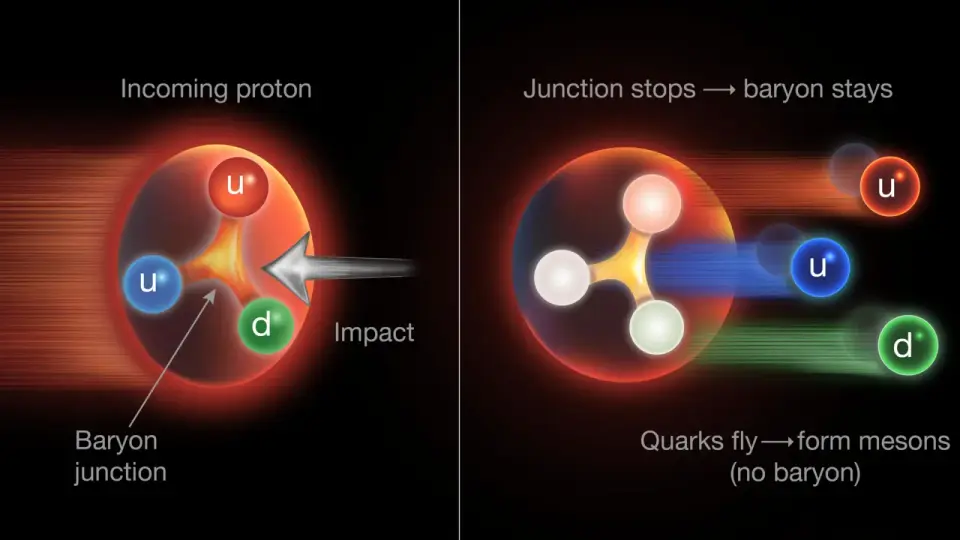
New data from the Relativistic Heavy Ion Collider (RHIC) suggests that the baryon number of a proton is carried by a Y-shaped gluon junction rather than its three valence quarks. Published in Science, the study challenges decades-old textbook models and offers a new perspective on matter stability and the matter-antimatter asymmetry.
Key points
- The STAR collaboration at RHIC found that baryon number is likely transported by a Y-shaped gluon junction, not just the three valence quarks.
- In high-energy collisions, the gluon junction is easier to stop than the quarks, leading to an excess of baryons perpendicular to the beam.
- The finding explains why protons remain stable and may help resolve the mystery of why the universe contains more matter than antimatter.
- The results align with Regge theory and challenge the standard 'naive quark model' used in physics textbooks.
Background
This discovery builds on earlier RHIC findings regarding gluon saturation and vacuum structure. In 2022, ALICE detected clues of gluon saturation inside nuclei, and in 2026, BESIII reported evidence for glueballs. These studies collectively suggest that gluons play a more dynamic role in subatomic structure than previously thought, moving beyond the simple quark model.
How outlets are covering it
ScienceDaily and Scientific American emphasize the fundamental shift in understanding proton stability and the cosmic matter-antimatter imbalance. ScienceAlert highlights the specific experimental methods, such as isobar and photonuclear collisions, that distinguished the gluon junction from quark behavior. While all outlets agree on the significance of the finding, Wenliang Li, writing for ScienceAlert, notes that the results are not a direct, tightly controlled measurement of the mechanism, suggesting further research is needed.
Why it matters
Understanding how baryon number is carried could explain why protons do not decay and why the universe is dominated by matter. It reshapes the fundamental description of atomic nuclei and may provide clues to the origin of the universe's current form.
What to watch
Researchers plan to use the upcoming Electron-Ion Collider at Brookhaven National Laboratory to further investigate the role of gluons in baryon number transport. The STAR collaboration also calls for more experiments to test alternative theories that can explain all observed phenomena.
- Physicists discover a hidden gluon structure inside protons that could rewrite textbooks ScienceDaily
- After 50 Years, Physicists Find Strong Evidence For What Really Holds Matter Together ScienceAlert
- A tiny mismatch built the universe. Physicists are one step closer to explaining how Scientific American
- The glue that binds a proton may be key to its identity Science News
- Scientists uncover new clue to how protons maintain their identity Rice University
Want the full story? Read the original reporting
Read on ScienceDaily