
Citizen astronomer’s map search uncovers 25-km impact crater in Quebec
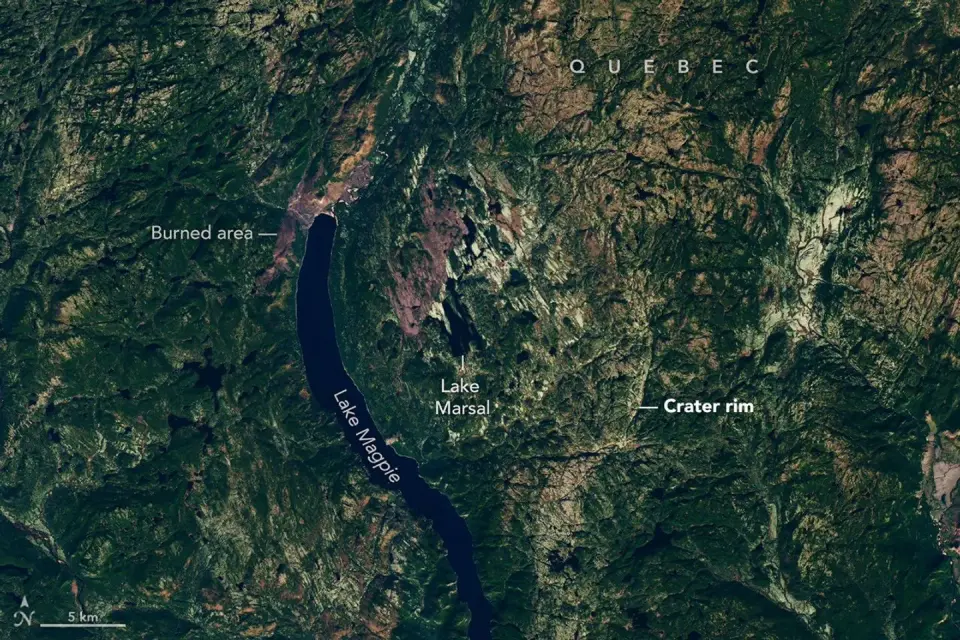
Amateur astronomer Joël Lapointe identified a circular feature near Lake Marsal in Quebec’s Côte-Nord region while planning a camping trip in 2024. His inquiry led to a 2025 expedition by planetary geologist Gordon Osinski and colleagues, who confirmed the site as a 25-kilometer impact crater formed approximately 390 million years ago. The discovery, provisionally named Uhackatik, is the largest confirmed impact structure found since 2018 and awaits formal recognition by the Meteoritical Society.
Key points
- Lapointe noticed the anomaly on satellite imagery in 2024 and contacted specialists, prompting French researchers to flag the site at a 2024 Meteoritical Society meeting.
- An October 2025 expedition found shatter cones and impact melt, overturning earlier volcanic interpretations of the local breccia.
- The crater, dated to the Devonian Period, is 25 km wide and would cause regional devastation if it occurred today.
- The site is too remote for astronaut training, unlike the more accessible Mistastin Lake structure in Labrador.
Background
This discovery adds to a growing list of terrestrial impact structures, of which only about 200 are currently confirmed. Previous archive coverage noted that many craters remain hidden by erosion or vegetation, and this find highlights how citizen observations can identify features missed by professional surveys. The site’s age predates a proposed increase in impact activity linked to asteroid belt collisions by roughly 100 million years.
How outlets are covering it
All four sources agree on the core facts: the 25-km size, 390-million-year age, and the role of shatter cones in confirming the impact origin. The Brighter Side of News emphasizes the 'citizen science' aspect, while ScienceDaily and SciTechDaily highlight the difficulty of the fieldwork and the shift from volcanic to impact interpretation. Dallas Express notes the site’s potential for global climate impact if it occurred today. No significant disagreements exist among the outlets, though The Brighter Side of News provides the most detailed account of the expedition’s physical challenges.
Why it matters
The discovery of Uhackatik demonstrates that significant geological features can still be identified through public observation of satellite imagery. It expands the known record of Earth’s impact history, providing new data for understanding planetary geology and the frequency of large impacts during the Devonian Period. The case also underscores the value of citizen science in identifying features that professional surveys may overlook due to remoteness or prior misinterpretation.
What to watch
The Meteoritical Society’s impact-cratering committee is expected to formally recognize the site when it next convenes. Researchers will continue to study the crater’s geological features, including its central uplift and columnar jointing, to better understand the impact event. The site is unlikely to become an astronaut training ground due to its inaccessibility, but it may serve as a reference for future impact studies.
- Amateur astronomer leads scientists to a massive 390-million-year-old impact crater in Quebec The Brighter Side of News
- A strange circle on satellite maps turned out to be a 390-million-year-old impact crater ScienceDaily
- He Was Looking for a Campsite. He Found a Massive Impact Crater SciTechDaily
- Amateur Astronomer Finds 25-Kilometer Impact Crater While Scouting Quebec Campsite Dallas Express
- A satellite map revealed a mysterious giant circle that was hiding in Canada for 390 million years. One am The Economic Times
Want the full story? Read the original reporting
Read on The Brighter Side of News