
Hunga Tonga Eruption Reveals Volcanic Ash as Natural Methane Destroyer
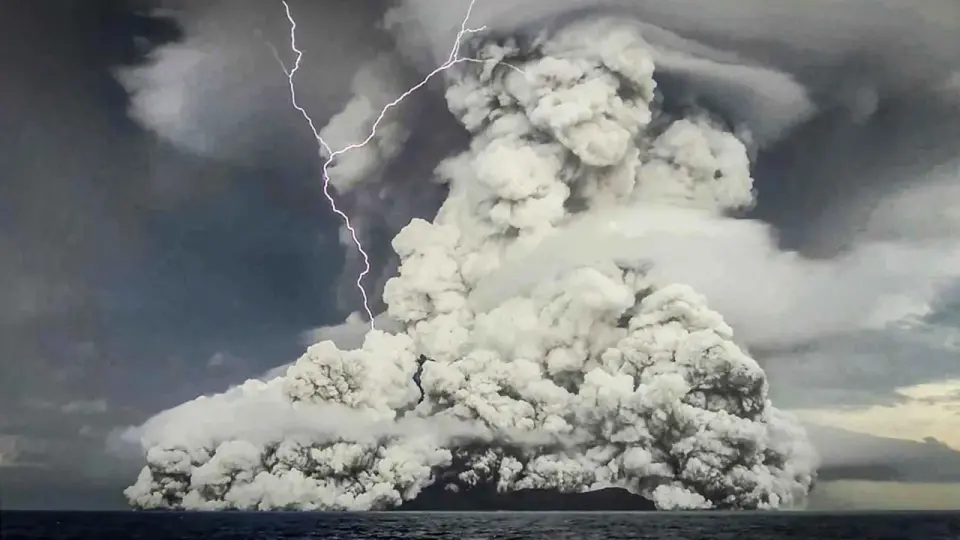
New research shows the 2022 Hunga Tonga eruption created a chemical reaction that destroyed methane, a potent greenhouse gas. Satellite data detected high formaldehyde levels, indicating rapid methane breakdown. This discovery suggests volcanic ash and seawater can accelerate methane removal, potentially informing future climate strategies.
Key points
- The January 2022 Hunga Tonga-Hunga Ha'apai eruption released approximately 300 gigagrams of methane, equivalent to the annual emissions of over two million cows.
- Satellite observations from the ESA's Sentinel-5P detected record-high formaldehyde levels in the volcanic plume, a chemical marker for active methane destruction.
- Researchers propose that sunlight reacting with volcanic ash and seawater aerosols produced chlorine atoms, which broke down methane in the stratosphere.
- The eruption displaced 8.9 cubic kilometers of material, deepening the caldera from 150 m to 850 m below sea level and generating a massive tsunami.
- The findings suggest atmospheric dust may have been undercounted in global methane budgets, requiring revisions to climate models.
Background
The Hunga Tonga eruption in January 2022 was one of the most powerful volcanic events of the modern era, generating a tsunami and injecting material into the stratosphere. Recent studies have focused on its geomorphic impacts, such as the rapid collapse of the submarine caldera, which displaced 8.9 cubic kilometers of material. This new research shifts focus to the atmospheric chemistry of the eruption, revealing an unexpected interaction between volcanic ash and greenhouse gases.
How outlets are covering it
ScienceDaily and the Nature Communications study emphasize the atmospheric chemistry, highlighting how the eruption's plume destroyed methane through a chlorine-mediated reaction. In contrast, the Nature Geoscience study and oceannews.com focus on the physical geomorphic changes, detailing the caldera's collapse and the displacement of 8.9 cubic kilometers of material. DongA Science highlights the scale of the seafloor flows, comparing the displaced volume to a 15-meter layer covering Seoul. While all sources agree on the eruption's magnitude, they diverge on the primary focus: atmospheric chemical consequences versus physical seafloor transformation and tsunami generation.
Why it matters
Methane is 80 times more potent than carbon dioxide over a 20-year period and has a short atmospheric lifetime, making it a key target for rapid climate action. Understanding natural mechanisms that destroy methane could inform strategies for reducing near-term warming. The discovery also indicates that global methane budgets may need adjustment to account for dust-driven destruction, potentially altering climate projections.
What to watch
Researchers are investigating whether the natural chemistry observed in the Hunga Tonga plume can be replicated safely for atmospheric methane removal. Satellite monitoring methods developed for this study may help verify the effectiveness of future geoengineering proposals. Additionally, scientists will likely revise global methane budgets to incorporate the role of atmospheric dust in methane destruction.
- Scientists stunned as volcano cloud starts destroying methane ScienceDaily
- Rapid submarine caldera collapse during the 2022 climactic eruption of Hunga volcano (Tonga) Nature
- KOPRI’s icebreaker Araon maps colossal seafloor flows from Tonga volcano blast DongA Science
- Bathymetric Surveys Reveal Hunga Volcano’s Seafloor Transformation oceannews.com
- Volcanic Tsunami Warning Systems Receive Collapse Signal; No Algorithm Converts It to Alert Tech Times
Want the full story? Read the original reporting
Read on ScienceDaily