
Weakening Earth Magnetic Field May Alter Climate via Cosmic Ray Ionization
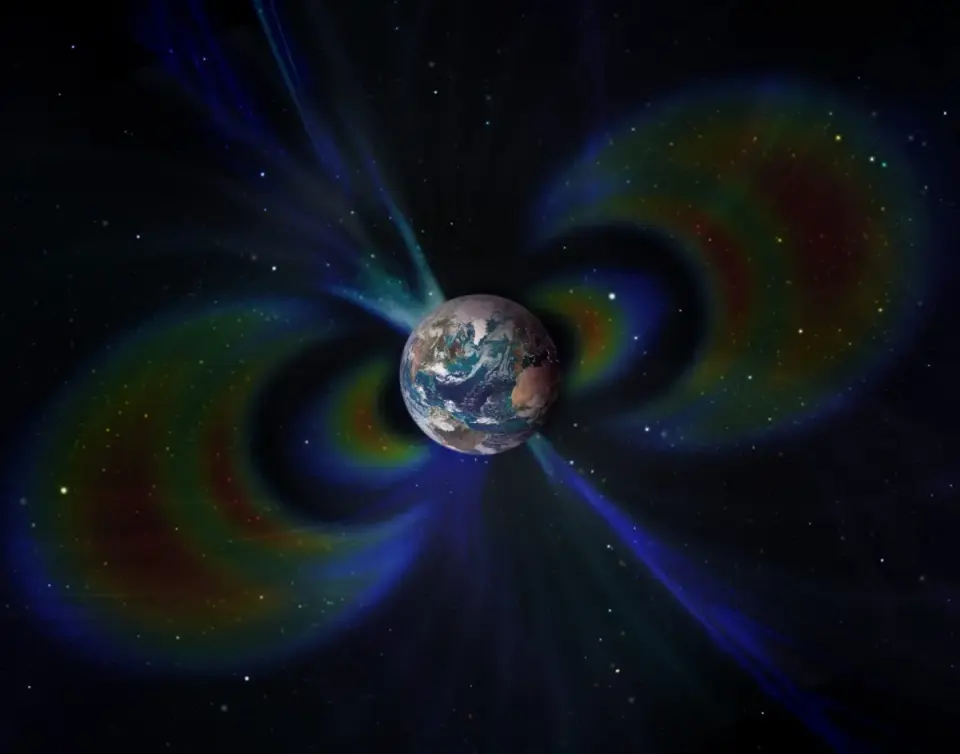
Earth's magnetic field has weakened by 9% over the last two centuries, potentially signaling an upcoming pole reversal. While this does not cause current global warming, a reversal could increase atmospheric ionization from cosmic rays by 13% at sea level, potentially influencing cloud formation and future climate patterns.
Key points
- Earth's magnetic field strength has declined by approximately 9% over the past 200 years, a trend that may indicate an approaching geomagnetic reversal.
- Cosmic rays, generated by solar events and distant supernovae, bombard Earth's atmosphere; the magnetic field currently shields the equator more effectively than the poles.
- During the Brunhes–Matuyama reversal 780,000 years ago, atmospheric ionization increased by 25% at the equator and over sixfold in the upper atmosphere, according to models by Jacob Svensmark.
- Global sea-level ionization rose by 13% during that historical reversal, while polar regions saw negligible change due to existing high cosmic ray access.
- Increased ionization may influence atmospheric water condensation and cloud formation, potentially impacting climate, though the exact mechanism remains unclear.
Background
Recent archival coverage notes that Earth's magnetic field is currently weakening, with the North Pole drifting and the South Atlantic Anomaly expanding. While a full reversal is not imminent, scientists are monitoring geomagnetic changes closely. This current weakening follows historical events like the Laschamps excursion 41,000 years ago, where the field dropped to 5% of normal strength. Concurrently, the 2026 Planetary Health Check reports that seven of nine critical Earth system boundaries are breached at record highs, including climate change and ocean acidification, highlighting the complex interplay between planetary systems.
Why it matters
Understanding the link between magnetic field strength and atmospheric ionization is crucial for predicting long-term climate variability. If cosmic ray flux influences cloud cover, a future pole reversal could introduce significant climatic shifts independent of greenhouse gas emissions. This underscores the need for integrated monitoring of space weather and climate systems to assess future environmental risks accurately.
What to watch
Researchers will continue refining computer models to better understand the mechanisms linking cosmic ray ionization to climate processes. Ongoing monitoring of geomagnetic changes and space weather will help determine if the current 9% decline in field strength precedes a reversal or is part of natural fluctuation. Further studies may clarify whether the 13% increase in ionization observed during past reversals translates to measurable climate impacts.
Want the full story? Read the original reporting
Read on skyatnightmagazine.com