
Mitochondrial Metabolism Controls Senescence Inflammation via Epigenetic Mechanisms
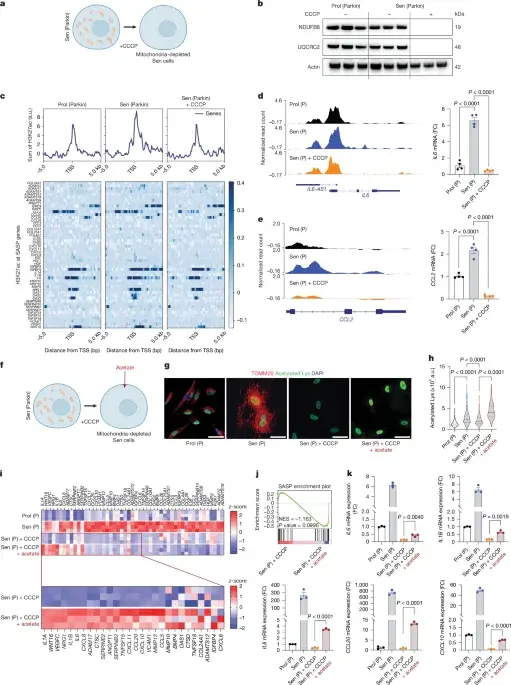
Researchers have identified a new metabolic checkpoint that controls the inflammatory output of senescent cells. By upregulating the mitochondrial pyruvate-citrate-acetyl-CoA axis, senescent cells increase histone acetylation, which is essential for expressing the senescence-associated secretory phenotype (SASP). Inhibiting the citrate exporter SLC25A1 reduces this inflammation without reversing cell cycle arrest, thereby improving healthspan in aged mice.
Key points
- Senescent cells upregulate the mitochondrial pyruvate-citrate-acetyl-CoA axis, increasing acetyl-CoA availability for histone acetylation at SASP gene loci.
- While mitochondrial DNA release activates innate immune signaling, acetyl-CoA is required for the robust transcription of SASP genes, acting as a distinct but complementary control layer.
- Inhibition of the mitochondrial citrate exporter SLC25A1 reduces histone acetylation and SASP gene expression without affecting cell cycle arrest markers like p16 or p21.
- In aged mice, pharmacological inhibition of SLC25A1 using CTPI2 reduced systemic inflammation, improved muscle function, and delayed frailty, demonstrating a selective suppression of SASP-driven tissue dysfunction.
- The study confirms that mitochondrial metabolic control and mtDNA-driven innate immune signaling operate independently but converge to enable full SASP gene expression.
Background
This research builds on prior understanding that cellular senescence contributes to aging and age-related diseases through chronic inflammation. While previous studies, such as those on mitochondrial weaknesses in mesothelioma or the role of fat metabolism in cancer, have explored mitochondrial functions in disease, this study specifically isolates the metabolic-epigenetic link in senescence. It clarifies how mitochondrial metabolism integrates with innate immune signaling to drive the SASP, offering a new therapeutic target for aging-related inflammation without eliminating senescent cells entirely.
Why it matters
This finding provides a precise mechanism for how senescent cells drive chronic inflammation, a key factor in aging and age-related diseases. By identifying SLC25A1 as a target that suppresses SASP without reversing senescence, it offers a potential therapeutic strategy to improve healthspan and tissue function in older individuals. This could lead to new treatments for age-related conditions that address inflammation directly rather than just clearing senescent cells, which may have unintended side effects.
What to watch
Future research will likely focus on translating these findings into clinical trials for aging-related diseases. The study suggests that targeting the mitochondrial citrate-acetyl-CoA axis could be a viable approach to dampen SASP-driven inflammation in humans. Further investigation is needed to determine the safety and efficacy of SLC25A1 inhibitors in human populations and to explore their impact on other age-related pathologies beyond muscle and liver function.
Want the full story? Read the original reporting
Read on Nature