
August 12: A Rare Double-Header of Partial Solar Eclipse and Perseid Meteor Shower Peaks
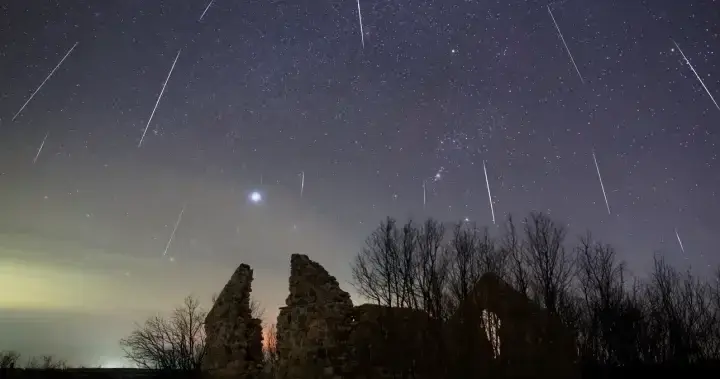
On August 12, 2026, a partial solar eclipse and the peak of the Perseid meteor shower will coincide, offering a rare astronomical double-header. The eclipse, visible as a partial event across Canada and much of the U.S., will be followed by the meteor shower, which peaks on the night of August 12-13. The new moon ensures dark skies, maximizing visibility for both events.
Key points
- The Perseid meteor shower peaks on the night of August 12-13, 2026, with the Canadian Space Agency calling it the 'best meteor shower of the year.'
- A partial solar eclipse occurs on August 12, visible across Canada and much of the U.S., with Newfoundland and Labrador getting the clearest view in Canada.
- The meteor shower is caused by Earth passing through debris from Comet Swift-Tuttle, with meteors entering the atmosphere at 59 km/s.
- The new moon on August 12 ensures dark skies, boosting visibility for both the eclipse and the meteor shower.
- Viewing tips include using eclipse glasses for the solar event and finding a dark location for the meteor shower, with peak activity between 10 p.m. and 2 a.m.
Background
This event follows previous coverage of August 2026's celestial activities, including a near-full lunar eclipse on August 27-28 and a six-planet alignment. The partial solar eclipse and Perseid meteor shower are part of a series of astronomical events that have drawn significant attention from space agencies and media outlets.
How outlets are covering it
Global News emphasizes the Canadian perspective, noting Newfoundland and Labrador's clear view of the eclipse and the CSA's recommendation for dark-sky locations. Sky & Telescope provides a detailed global view, highlighting the total eclipse in Greenland, Iceland, and northern Spain, and the partial eclipse's reach across North America. WBUR focuses on the U.S. perspective, particularly Massachusetts, and offers practical viewing tips, including the use of binoculars for safe eclipse viewing. WGME highlights the six-planet alignment on August 12, adding another layer to the celestial events.
Why it matters
The coincidence of a partial solar eclipse and the peak of the Perseid meteor shower is a rare opportunity for stargazers to witness two significant astronomical events in one night. The new moon ensures optimal viewing conditions, making this a notable event for both casual observers and astronomy enthusiasts.
What to watch
The next major celestial event is a near-full lunar eclipse on August 27-28, 2026, visible over Massachusetts. Additionally, the six-planet alignment on August 12 will be a notable event for skywatchers.
- Perseid meteor shower and partial solar eclipse to light up skies next week Global News
- This Week's Sky at a Glance, August 7 – 16 skyandtelescope.org
- What can you expect to see during this month's three major celestial events WBUR
- August skywatch: Planet parade and Perseids meteor shower WGME
- Get ready for 'meteor Christmas' with an added bonus: a partial solar eclipse CBC
Want the full story? Read the original reporting
Read on Global News