
Montana rancher's 2019 dinosaur find sells for $47.3 million, shattering auction estimates
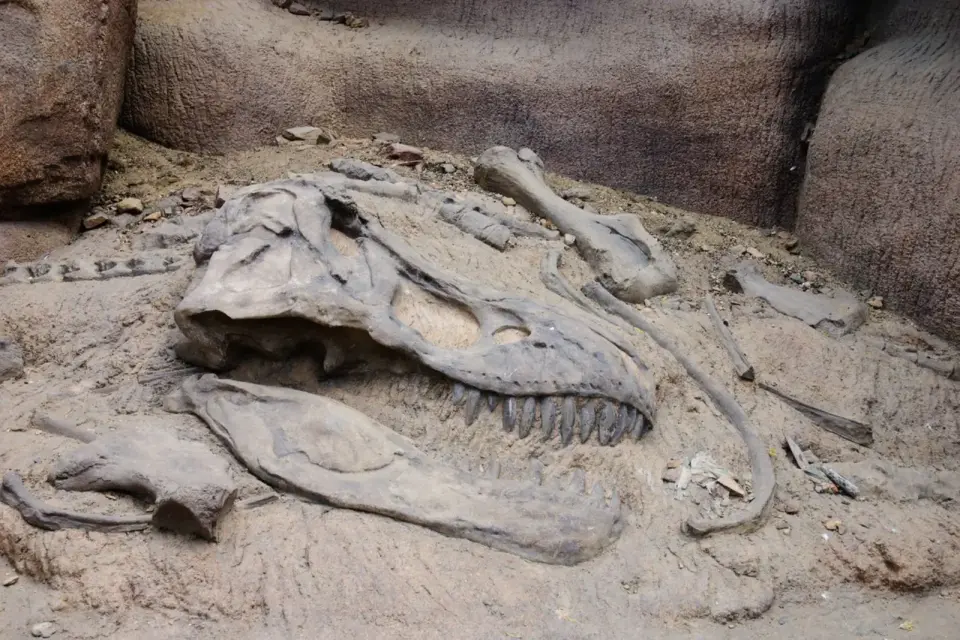
A nearly complete Nanotyrannus skeleton discovered in Montana in 2019 sold for $47.3 million at Sotheby's in New York, far exceeding its $6-9 million estimate. The fossil, named 'Jodi' after the rancher who found it, is one of only three known complete specimens of the genus. The sale highlights the tension between private fossil markets and scientific accessibility, as the buyer remains anonymous and the specimen's future availability for research is uncertain.
Key points
- Jodi, a 67-million-year-old Nanotyrannus skeleton, was discovered in 2019 on a ranch in Garfield County, Montana, within the Hell Creek Formation.
- The fossil is approximately 70% complete, containing 191 bone elements, and measures 19 feet 7 inches long and 9 feet 6 inches tall.
- It sold for $47.3 million on October 27, 2026, after six bidders competed for about 12 minutes, far exceeding the $6-9 million pre-auction estimate.
- The sale makes Jodi the second-most expensive dinosaur fossil ever sold at auction, behind a T. rex named Gus, which sold for $50.1 million in July 2026.
- A 2025 study in Nature confirmed Nanotyrannus is a distinct genus, not a juvenile T. rex, based on anatomical differences in limbs, teeth, and skull proportions.
- The Society of Vertebrate Paleontology criticized the sale, arguing important fossils should remain in public institutions for research, while supporters note private hunters help preserve fossils that might otherwise be lost.
Background
The sale of Jodi follows a trend of high-value fossil auctions, including the July 2026 sale of T. rex 'Gus' for $50.1 million. In October 2026, Jodi was displayed at Sotheby's with an estimated value of $6-9 million. The Paris National Museum of Natural History recently secured a rare 167-million-year-old dinosaur skeleton through a state-led agreement to prevent its auction, reflecting broader efforts to keep significant fossils in public institutions.
Why it matters
The $47.3 million sale underscores the growing commercial value of rare dinosaur fossils and the ongoing debate over their accessibility. While private collectors can fund preservation and discovery, scientists worry that private ownership restricts research. The recent reclassification of Nanotyrannus as a distinct genus highlights the importance of preserving complete specimens for understanding prehistoric biodiversity.
What to watch
The identity of the winning bidder is unknown, and it is unclear whether Jodi will be displayed in a museum or kept in a private collection. The sale may influence future policies on fossil ownership and access, as the scientific community continues to debate the balance between private preservation and public research.
Want the full story? Read the original reporting
Read on Futura, le média qui explore le monde