
Nanotyrannus 'Jodi' Shatters Auction Estimates, Becoming Second-Most Expensive Dinosaur Fossil Ever Sold
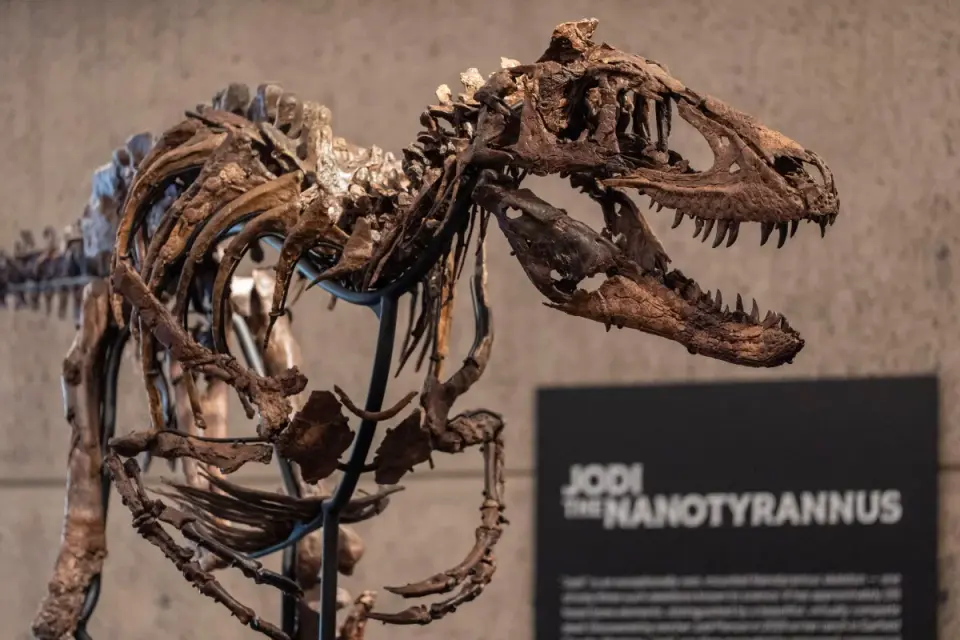
A rare Nanotyrannus skeleton nicknamed 'Jodi' sold for $47.3 million at Sotheby's in New York, far exceeding the $6-9 million estimate and becoming the second-most expensive dinosaur fossil ever sold. The specimen, discovered in Montana in 2019, is one of only three known complete skeletons of this species, which was recently reclassified as a distinct genus rather than a juvenile T. rex. While the sale highlights the high value of rare fossils, it has sparked debate among scientists who argue such specimens should remain in public museums for research and education.
Key points
- The Nanotyrannus skeleton 'Jodi' sold for $47.3 million at Sotheby's on October 27, 2026, significantly exceeding the pre-auction estimate of $6-9 million.
- The sale makes 'Jodi' the second-most expensive dinosaur fossil ever sold, behind only the T. rex 'Gus,' which sold for $50.1 million earlier this year.
- The buyer remained anonymous after outbidding five other prospective buyers during a 12-minute auction.
- Nanotyrannus was recently confirmed as a distinct genus, not a juvenile T. rex, based on research published in 2025.
- The skeleton, discovered in 2019 by Montana rancher Jodi Pierson, is approximately 70% complete and measures 9 feet 6 inches tall and nearly 20 feet long.
- Some scientists have criticized the private sale, arguing that significant fossils should be accessible to researchers and the public through museums.
Background
The sale of 'Jodi' follows a 2025 study that reclassified Nanotyrannus as a distinct genus, separate from Tyrannosaurus rex. This reclassification was a significant development in paleontology, as scientists had long debated whether Nanotyrannus was a separate species or merely a juvenile T. rex. The auction also highlights ongoing debates in the scientific community about the ethics of selling rare fossils to private buyers, with some arguing that such specimens should be preserved in public institutions for research and education. This sale is part of a broader trend of high-value fossil auctions, including the record-breaking sale of T. rex 'Gus' for $50.1 million earlier in 2026.
Why it matters
The sale of 'Jodi' for $47.3 million underscores the immense value placed on rare and well-preserved dinosaur fossils, particularly those that have been reclassified as distinct species. The high price tag reflects the scarcity of such specimens, with only three known complete Nanotyrannus skeletons. The sale also highlights the tension between private collectors and the scientific community, as some argue that such fossils should be accessible to researchers and the public through museums. The reclassification of Nanotyrannus as a distinct genus has also contributed to its value, as it represents a unique species that coexisted with T. rex during the Cretaceous period.
What to watch
The new owner of 'Jodi' has chosen to remain anonymous, and it is unclear whether the skeleton will be displayed in a public museum or kept in a private collection. The sale may also influence future fossil auctions, as it sets a new benchmark for the value of rare and well-preserved specimens. Additionally, the debate over the ethics of selling significant fossils to private buyers is likely to continue, with some scientists advocating for greater regulation of the fossil trade to ensure that important specimens are preserved for scientific research and public education.
Want the full story? Read the original reporting
Read on AP News