
Astrophotographer’s 30-Hour Capture of Dumbbell Nebula Illustrates the Sun’s Future Fate
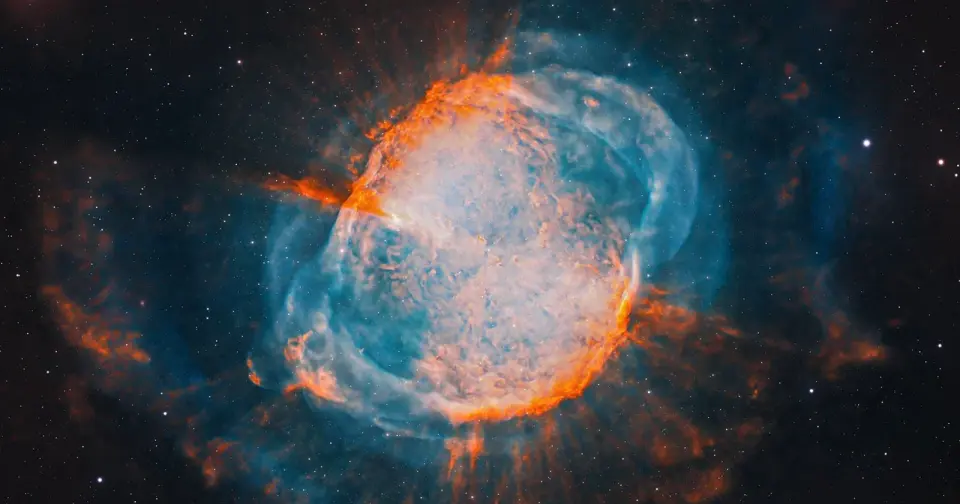
Astrophotographer Andrew McCarthy released a 30-hour exposure of the Dumbbell Nebula (Messier 27) for his 2027 cosmic calendar, using the image to illustrate the eventual death of the Sun. The nebula, located in the constellation Vulpecula, is a planetary nebula formed by a dying star similar to our Sun. McCarthy explains that the Sun will eventually expand into a red giant, shed its outer layers, and collapse into a white dwarf, mirroring the process seen in the Dumbbell Nebula. The image was captured using Hydrogen, Oxygen, and Sulfur-tuned filters to isolate trace gases, creating a 'Hubble Palette' effect that enhances contrast while maintaining visible spectrum colors. McCarthy notes that the image serves as a reminder that the solar system has an expiration date, with the Sun’s mass eventually contributing elements to form new planets.
Key points
- Andrew McCarthy captured the Dumbbell Nebula image over 30 hours across multiple nights to avoid interference from the Sun and Earth.
- The Dumbbell Nebula is a planetary nebula in Vulpecula, visible even to small backyard telescopes, and serves as a model for the Sun’s future.
- McCarthy used Hydrogen, Oxygen, and Sulfur-tuned filters to isolate trace gases, mapping them to color channels for a 'Hubble Palette' effect.
- The Sun is expected to expand into a red giant, shed its outer layers, and collapse into a white dwarf, eventually cooling into a black dwarf.
- The image is part of McCarthy’s 2027 cosmic calendar, which includes 12 images of deep space objects and celestial events.
Background
This story follows recent astronomical observations, such as the detection of Kelvin-Helmholtz waves in the Sun’s photosphere, which highlight ongoing research into solar dynamics. McCarthy’s work aligns with broader public interest in astrophotography and the visual representation of stellar evolution, as seen in earlier coverage of striking space imagery.
Why it matters
The image provides a tangible, visual representation of the Sun’s eventual fate, helping the public understand the long-term lifecycle of stars similar to our Sun. It underscores the transient nature of celestial bodies and the cyclical process of stellar death and rebirth, contributing to public education on astrophysics.
What to watch
McCarthy’s 2027 cosmic calendar, featuring the Dumbbell Nebula image, is available for purchase. The calendar includes 12 images, with the Dumbbell Nebula serving as the January cover. McCarthy is also producing two additional calendars for 2027, one focused on rockets and another featuring his cat Gregory.
Want the full story? Read the original reporting
Read on PetaPixel