Tag

Planetary Nebula

All articles tagged with #planetary nebula

Dead-star debris returns to the Galaxy, foreshadowing the Sun's distant fate
space8 days ago

Dead-star debris returns to the Galaxy, foreshadowing the Sun's distant fate

Astronomers using the new MOTHRA instrument spotted bow-shaped clumps in the Helix Nebula, showing material shed by a dying star being torn apart and reabsorbed into the interstellar medium, a vivid demonstration of stellar debris being recycled into the galaxy to seed future stars—and a reminder that our Sun will undergo a similar fate in about five billion years.

JWST Unveils Lion Nebula’s Infrared Mane in New Image
space14 days ago

JWST Unveils Lion Nebula’s Infrared Mane in New Image

NASA’s James Webb Space Telescope released a new infrared image of the Lion Nebula (NGC 2392), revealing a glowing purple gas ‘mane’ surrounding a white-dwarf core. The view, built from JWST’s NIRCam and MIRI data, shows details unseen in prior images and confirms the nebula will continue to expand, with the lion’s face potentially fading over roughly 10,000 years. The central nose-like purple spot marks the dying star’s remnant powering the nebula.

Boomerang Nebula: The Coldest Natural Spot in the Universe
space1 month ago

Boomerang Nebula: The Coldest Natural Spot in the Universe

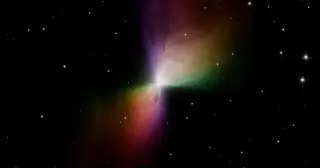
Astronomers have identified the Boomerang Nebula, a fast-expanding shell around a dying star about 5,000 light-years away, as the coldest natural object known at roughly one degree above absolute zero—colder than the cosmic microwave background of 2.7 K. The extreme chill arises from rapid gas expansion acting like a refrigerator, and the temperature was inferred from how the gas absorbs background radiation. This is a transient stage in a Sun-like star’s death, and the outer gas will warm over time; no colder natural places have been found yet.

Two Stars, One Dazzling Death: New View of the Crystal Ball Nebula
science-space2 months ago

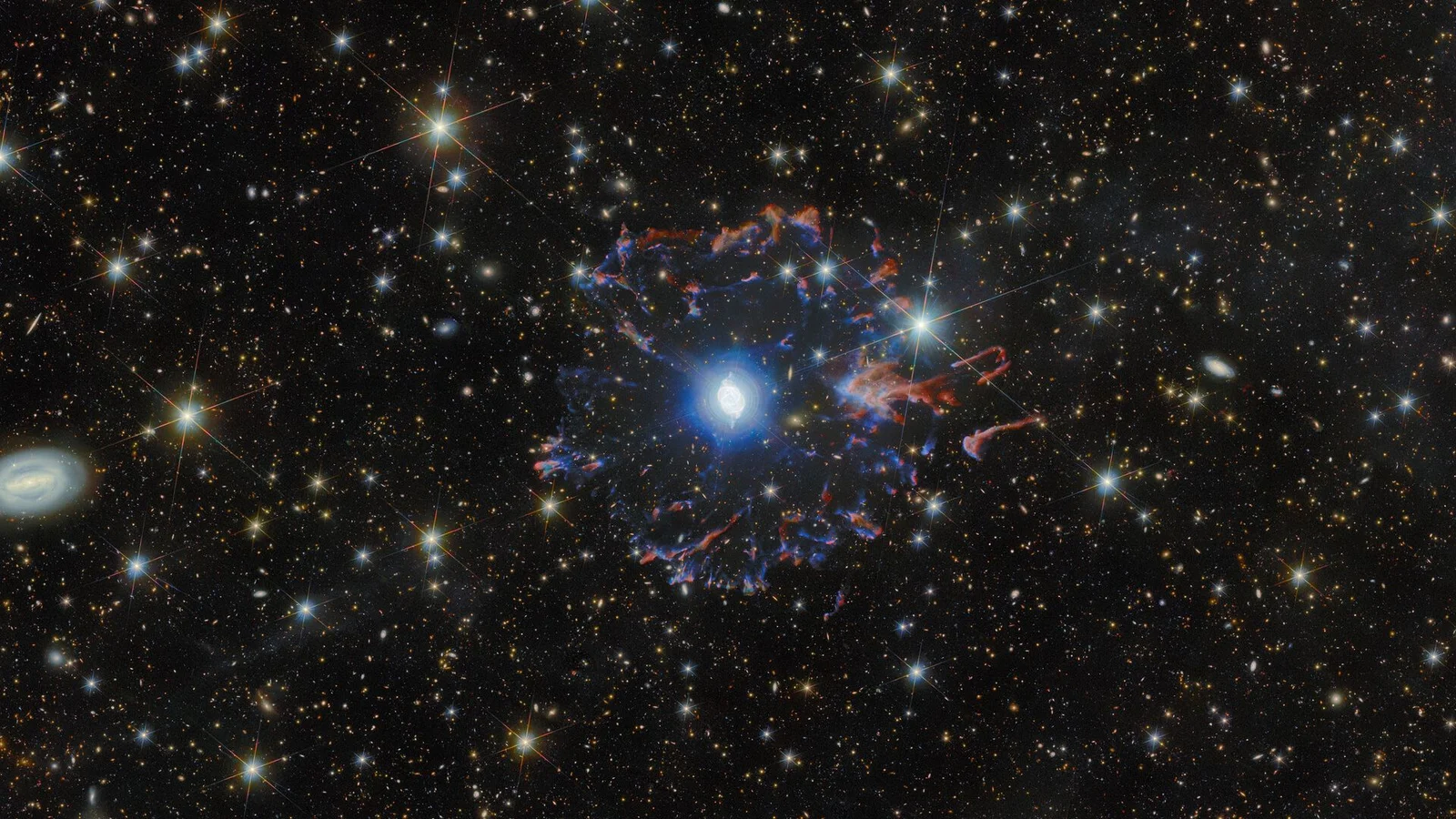
Two Stars, One Dazzling Death: New View of the Crystal Ball Nebula

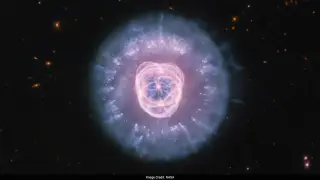
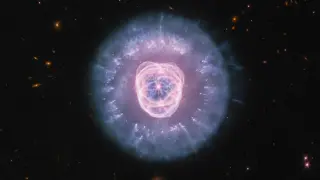
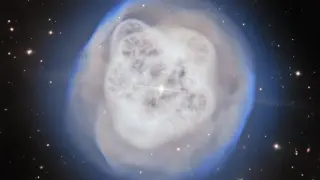
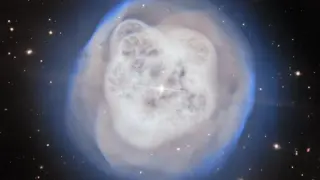
A new image of the Crystal Ball Nebula (NGC 1514) taken with Hawaii’s Gemini North telescope shows a dying star in a binary system about 1,500 light-years away; as the primary star sheds its outer layers, its orbiting companion stirs the expanding gas into intricate, cloudlike shapes, with colors tracing hot hydrogen and oxygen. Captured by the Gemini Multi-Object Spectrograph atop Maunakea, the view highlights how planetary nebulae form and evolve on short astronomical timescales, roughly 10,000 years, while astronomers monitor changes over years to learn how mass is lost and shells expand.

Helix Nebula: dying Sun, dusty disk, and surviving comets
space3 months ago

Helix Nebula: dying Sun, dusty disk, and surviving comets

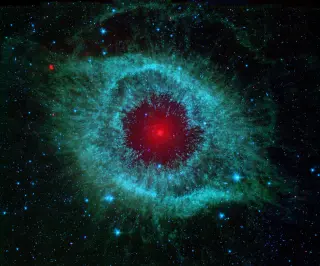
NASA's Spitzer infrared image captures the Helix nebula, a 700 light-years away planetary nebula—the glowing shell of a sun-like star—with a central white dwarf and a dusty disk likely kicked up by comets that survived the star's death; the finding shows how comets can endure and be redistributed as stars end their lives, and notes that our Sun will form a similar nebula in about five billion years.

JWST Discovers Hollow Shell of Buckytballs in Tc 1 Nebula
space4 months ago

JWST Discovers Hollow Shell of Buckytballs in Tc 1 Nebula

The James Webb Space Telescope’s Mid-Infrared Instrument images the planetary nebula Tc 1, revealing buckyballs arranged in a thin hollow shell around the central star and enabling exact chemical mapping through integral field unit spectroscopy. This builds on the 2010 Spitzer discovery led by Jan Cami, offering new clues about how these carbon-based molecules form and persist in space, and highlighting a surprising, spiral-like structure and a mysterious inverted question-mark feature in Tc 1.

Cat's Eye Nebula Revealed: a joint Hubble-Euclid view of a dying star
space5 months ago

Cat's Eye Nebula Revealed: a joint Hubble-Euclid view of a dying star

Astronomers combined Hubble’s high-resolution view of the Cat’s Eye Nebula (NGC 6543) with Euclid’s wide-field imaging to study the dying star’s final acts. The close-up reveals intricate gas bubbles, rings, jets and knots around the central star, while Euclid shows faint arcs and delicate filaments in the surrounding environment, together offering a cinematic, multi-scale portrait of a planetary nebula’s final stages.

James Webb reveals brain-like Exposed Cranium nebula in vivid infrared
space5 months ago

James Webb reveals brain-like Exposed Cranium nebula in vivid infrared

NASA’s James Webb Space Telescope captures two infrared views of the brain-shaped planetary nebula PMR 1, nicknamed the Exposed Cranium, showing a glowing outer shell and a dark central lane. The dual images (NIRCam and MIRI) reveal complex gas and dust from a dying star in the Vela constellation, illustrating the star’s final ejection before it either becomes a white dwarf or, less likely, explodes as a supernova.

JWST maps brain-like nebula PMR 1 in a dying star’s last act
astronomy6 months ago

JWST maps brain-like nebula PMR 1 in a dying star’s last act

The James Webb Space Telescope provides high‑resolution infrared views of PMR 1, the Exposed Cranium Nebula about 5,000 light‑years away in Vela. Webb’s NIRCam and MIRI imaging reveal a brain‑like structure of inner gases surrounded by a thinner hydrogen shell, with a split that may be caused by polar jets from the dying star. The central star’s nature remains uncertain: it was once considered a Wolf–Rayet type, but this is not confirmed, leaving PMR 1’s true identity—possibly a planetary nebula around a sun‑like star or a Wolf–Rayet remnant—open to interpretation.

Iron Bar Mystery Emerges at Ring Nebula's Core
science7 months ago

Iron Bar Mystery Emerges at Ring Nebula's Core

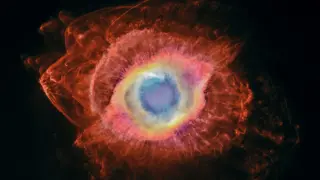
Astronomers using the WEAVE instrument on the William Herschel Telescope have found a giant, straight bar of ionized iron at the center of the Ring Nebula, a first for a nebula. The iron bar is unusually massive and not explained by a jet from the white dwarf or by iron release from dust; its 3D shape could extend beyond our line of sight, and a torn-apart planet origin is unlikely. More observations of other nebulae are needed to uncover the iron's origin.

Webb Zooms in on Helix Nebula: A Dying Star’s Dusty Curtain
space7 months ago

Webb Zooms in on Helix Nebula: A Dying Star’s Dusty Curtain

NASA’s James Webb Space Telescope captures a sharp close-up of the Helix Nebula, a planetary nebula about 650 light-years away formed when a Sun-like star shed its outer layers and left a white dwarf at its center; Webb’s infrared view reveals hot gas and cooler dust, illustrating how dying stars recycle heavier elements into the cosmos and seed future planets, with binary interactions potentially triggering novae.