
NASA Reveals Detailed Images of SpaceX Rocket’s Lunar Impact Site
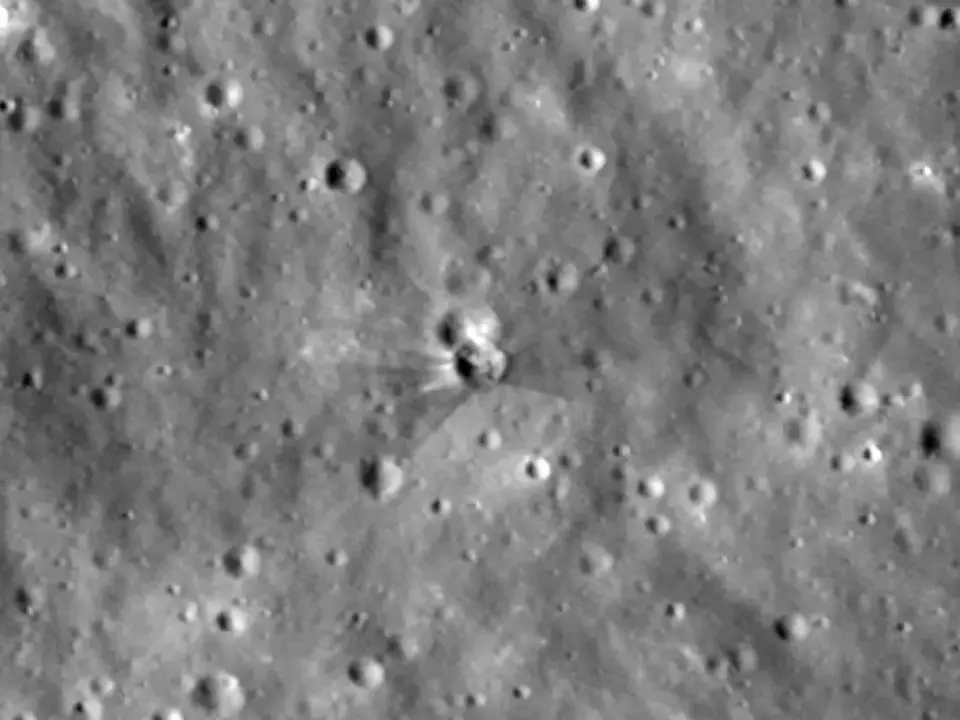
NASA’s Lunar Reconnaissance Orbiter (LRO) has released high-resolution before-and-after images of a crater formed on August 5, 2026, when a SpaceX Falcon 9 upper stage struck the Moon. The booster, which had drifted in space for over a year after a January 2025 launch, impacted the surface at approximately 5,400 mph. The resulting crater is roughly 60 feet wide and less than 10 feet deep, located at coordinates 19.4759°N, 266.7138°E. The images reveal distinct ejecta patterns, with darker rays indicating weathered surface material and brighter rays showing fresh subsurface rock. This event highlights ongoing concerns regarding space debris, though NASA describes such impacts as an accepted disposal method.
Key points
- The Falcon 9 upper stage, launched in January 2025 for the Firefly Blue Ghost 1 mission, impacted the Moon on August 5, 2026, after drifting for over a year.
- NASA’s LRO captured images between August 11 and 12, 2026, from an altitude of 60 miles, requiring precise timing and spacecraft tilting to target the impact site.
- The crater is approximately 60 feet (18 meters) wide and less than 10 feet (3 meters) deep, with distinct bright and dark ejecta rays visible in the imagery.
- South Korea’s Danuri spacecraft provided the first images of the impact site, confirming the location predicted by NASA’s Center for Near Earth Object Studies.
- The impact site is located at 19.4759°N, 266.7138°E, with an elevation of 511 meters, as determined by LRO data.
Background
This incident follows earlier reports from August 2026 regarding the anticipated impact of the SpaceX Falcon 9 upper stage. Initial observations from South Korea’s Danuri orbiter and ground-based telescopes confirmed the collision, which was described as unintentional. The event has sparked discussions about space sustainability and the risks of orbital debris, particularly as NASA advances its Artemis program to return humans to the Moon. Previous archive articles noted the booster’s trajectory and the potential for a faint flash, though Earth-based observers did not clearly detect the impact.
How outlets are covering it
NASA and the Associated Press emphasize the scientific value of the LRO images, highlighting the detailed ejecta patterns and the precision of the impact prediction. The Washington Post notes that while the crash was unintentional, NASA considers lunar impacts an 'accepted and safe' method for disposing of rocket hardware. CNN and other outlets focus on the visual evidence provided by the before-and-after images, underscoring the rarity of human-made objects impacting the Moon. There is no significant disagreement among sources regarding the facts, but the emphasis varies between the scientific analysis of the crater and the broader implications for space debris management.
Why it matters
This event underscores the growing challenge of space debris and the need for better tracking and disposal methods for orbital hardware. The detailed images provide valuable data for understanding lunar impacts and the effects of space weathering, which is crucial for future lunar missions. Additionally, the incident highlights the importance of international cooperation in tracking and predicting the trajectories of space objects, as demonstrated by the collaboration between NASA and South Korea’s Danuri mission.
What to watch
NASA will continue to analyze the LRO images to refine the crater’s dimensions and composition. The Center for Near Earth Object Studies will use this event to validate its impact prediction tools. SpaceX and other space agencies may review their debris disposal protocols to prevent future unintended impacts. The scientific community will likely publish detailed studies on the crater’s ejecta patterns and the effects of the impact on the lunar surface.
- Before-And-After Images Show Crater Carved By SpaceX Rocket That Slammed Into The Moon Patch
- NASA’s LRO Images Falcon 9 Crater on Moon, Learns New Details NASA Science (.gov)
- New images reveal what happened when a SpaceX rocket slammed into the moon CNN
- Before-and-after images show where SpaceX rocket crashed into the moon The Washington Post
- SpaceX rocket's moon crash highlights 'a tangible operational risk' of lunar settlement Space
Want the full story? Read the original reporting
Read on Patch