
Nancy Grace Roman Telescope Launches to Map Dark Universe and Hunt Exoplanets
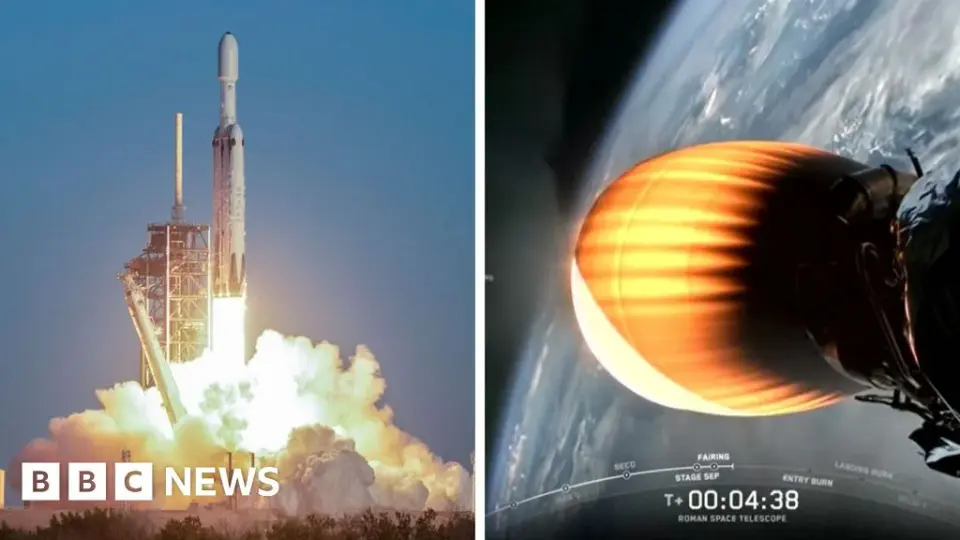
Nasa successfully launched the Nancy Grace Roman Space Telescope from Florida on August 30, 2026, marking a major milestone in astrophysics. The observatory, which will orbit one million miles from Earth, features a field of view 100 times larger than Hubble and Webb combined. Its primary mission is to investigate dark matter and dark energy while discovering up to 100,000 new exoplanets. The launch was delivered ahead of schedule and on budget, with President Trump joining a post-launch news conference to congratulate the team.
Key points
- The Nancy Grace Roman Space Telescope launched at 7:26 a.m. EDT on August 30, 2026, aboard a SpaceX Falcon Heavy rocket from Kennedy Space Center in Florida.
- Roman will travel to the L2 Lagrange point, approximately one million miles from Earth, arriving after a 100-day journey to begin operations in early 2027.
- The telescope’s 300-megapixel Wide Field Instrument has a field of view 100 times larger than both Hubble and James Webb, allowing it to survey the sky 1,000 times faster than Hubble.
- Key scientific goals include mapping dark matter and dark energy, studying black holes, and discovering tens of thousands of exoplanets, potentially up to 100,000, to assess habitability.
- The mission is expected to generate 1.4 terabytes of data daily, the highest rate for any Nasa astrophysics mission, with first images anticipated by early 2027.
- The telescope uses a 7.9-foot mirror originally built for a classified spy satellite, donated by the National Reconnaissance Office after its program was canceled.
Background
This launch follows Nasa’s previous major observatory, the James Webb Space Telescope, which launched in 2021 and also orbits near L2. The Roman telescope is named after Nancy Grace Roman, Nasa’s first chief astronomer and a key figure in approving the Hubble Space Telescope. The mission complements ground-based efforts like the Vera C. Rubin Observatory, which aims to map billions of galaxies, and addresses long-standing questions about the universe’s expansion and the nature of dark energy, including the 'Hubble Tension' discrepancy in measurements of the universe’s age.
How outlets are covering it
Nasa and BBC emphasize the telescope’s role in answering fundamental questions about the universe, such as 'Are we alone?' and the nature of dark energy. Nasa highlights the mission’s efficiency, noting it was delivered ahead of schedule and on budget, with Administrator Jared Isaacman calling it a success story. Ars Technica focuses on the political dimension, noting President Trump’s unusual participation in a post-launch news conference and his praise for Isaacman, despite earlier budget proposals that sought to cut Nasa science funding. Spaceflight Now provides technical details, such as the use of a donated spy satellite mirror and the telescope’s data output, which will exceed Hubble’s 30-year total. All sources agree on the telescope’s significance, but differ in emphasis: Nasa and BBC focus on scientific goals, Ars Technica on political dynamics, and Spaceflight Now on engineering and data capabilities.
Why it matters
The Roman telescope represents a significant advancement in our ability to study the universe, with its wide field of view and high data output enabling unprecedented surveys of dark matter, dark energy, and exoplanets. Its success could resolve long-standing questions about the universe’s expansion and the nature of dark energy, potentially challenging the standard model of cosmology. Additionally, the mission’s efficiency and political support may influence future Nasa funding and mission planning, with the next major science mission, Dragonfly to Titan, scheduled for 2028.
What to watch
Roman will undergo a 100-day journey to L2, followed by a three-to-four-month commissioning period to calibrate its instruments. First images are expected by early 2027. The telescope will begin its primary science operations, including the High-Latitude Wide-Area Survey, which will catalog over a billion galaxies, and the Galactic Bulge Time-Domain Survey, which will search for exoplanets via microlensing. Nasa anticipates Roman will operate for five years, with a goal to extend operations to 10 years.
- 'A giant leap forward': Nasa launches powerful new space telescope BBC
- NASA’s Dark Universe-Seeking Nancy Grace Roman Space Telescope Launches NASA (.gov)
- Roman Space Telescope, NASA’s next ‘great observatory,’ poised for Sunday launch Spaceflight Now
- Why it matters that President Trump just dialed into a NASA news conference Ars Technica
- A New Way of Seeing Alien Worlds The Atlantic
Want the full story? Read the original reporting
Read on BBC