
Titan: The Only Solar System World Where Humans Could Stand Without a Pressure Suit
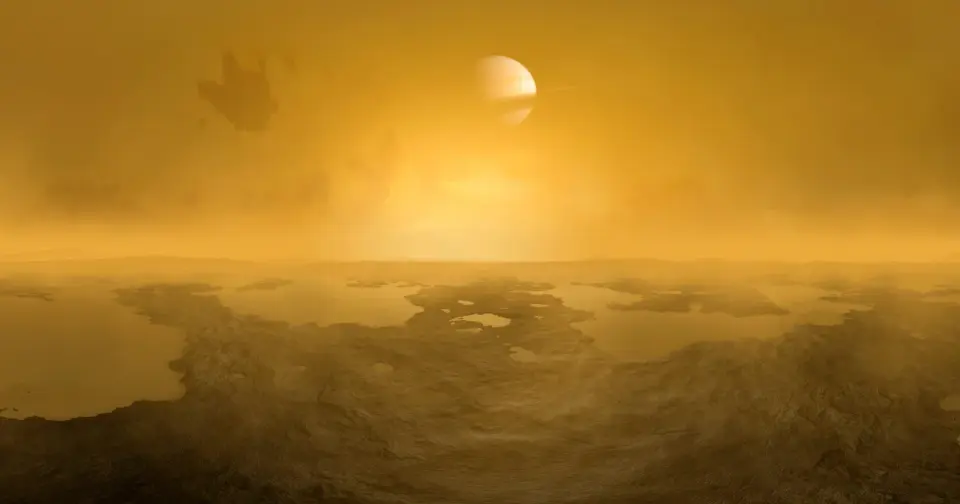
Saturn’s moon Titan is the only place beyond Earth where a human could stand without a pressure suit, thanks to an atmosphere 50% denser than Earth’s. However, the surface temperature of minus 179 degrees Celsius and lack of oxygen make it lethal without heated gear. NASA’s Dragonfly mission, launching in 2028, will investigate its methane seas and prebiotic chemistry.
Key points
- Titan’s surface pressure is 1.5 bar, 50% higher than Earth’s, eliminating the need for a pressurized suit, though oxygen and heat are still required.
- The moon’s surface temperature is approximately minus 179 degrees Celsius, causing water to freeze into rock-hard ice and methane to form liquid seas.
- NASA’s Dragonfly rotorcraft is scheduled to launch in 2028 and arrive at Titan around 2034 to study surface chemistry and potential prebiotic life.
- Titan’s seasons last 7.5 Earth years each, driven by Saturn’s 29-year orbit, causing methane lakes to evaporate and dunes to shift direction.
- A subsurface ocean of liquid water and ammonia lies 50 to 100 kilometers below the surface, maintained by antifreeze properties of salts.
Background
Previous coverage noted that Titan and Pluto share an unidentified molecular feature detected by the James Webb Space Telescope, with Dragonfly expected to help identify these chemicals in the mid-2030s. Additionally, recent studies suggest Titan is part of a broader group of outer solar system moons likely harboring subsurface oceans, inferred from gravitational and tidal data.
How outlets are covering it
Space Daily emphasizes Titan’s unique atmospheric pressure as a key advantage for future human habitation, noting that while a pressure suit is unnecessary, the extreme cold and lack of oxygen remain fatal barriers. Scientific American focuses on the physical dynamics of Titan’s methane lakes, explaining that lower gravity and liquid density would allow for surfing but make swimming difficult due to poor buoyancy. Times of India highlights the seasonal cycle, detailing how Titan’s 29-year orbit creates 7.5-year seasons that cause methane lakes to dry up and sand dunes to shift, while also noting the unresolved mystery of why methane persists in the atmosphere despite solar breakdown.
Why it matters
Titan represents the most Earth-like environment in the outer solar system for atmospheric pressure, offering a potential future site for exploration. Understanding its chemistry and seasonal cycles is critical for assessing the feasibility of long-term human presence and for identifying the building blocks of life in extreme environments.
What to watch
NASA’s Dragonfly mission will launch in 2028, arriving at Titan around 2034 to conduct a multi-site survey of the moon’s surface. The mission aims to analyze prebiotic chemistry and determine if Titan could have supported microbial life, providing data to resolve current mysteries about its atmospheric methane and surface composition.
- Saturn's moon Titan has an atmosphere thicker than Earth's and seas you could sail on, and it is the one place beyond Earth where a person could stand outside without a pressure suit, though its surface sits at about minus 179 degrees Celsius Space Daily
- Can you surf on Titan? Science has the answer Scientific American
- Saturn's moon Titan has rivers of liquid methane longer than the Nile's tributaries, but a 2025 Brown University study found that only 1.3% of those rivers form deltas — on Earth, nearly every river does, and nobody yet knows why Titan's don't Space Daily
- Titan experiences clouds, rain, rivers and changing seasons like Earth; Saturn’s 29-year journey around the Sun makes each season last more than seven Earth years timesofindia.indiatimes.com
- APOD: 2005 January 14 - Descent to Titan NASA Science (.gov)
Want the full story? Read the original reporting
Read on Space Daily