
The Case for Building All Three 30-Meter Class Telescopes
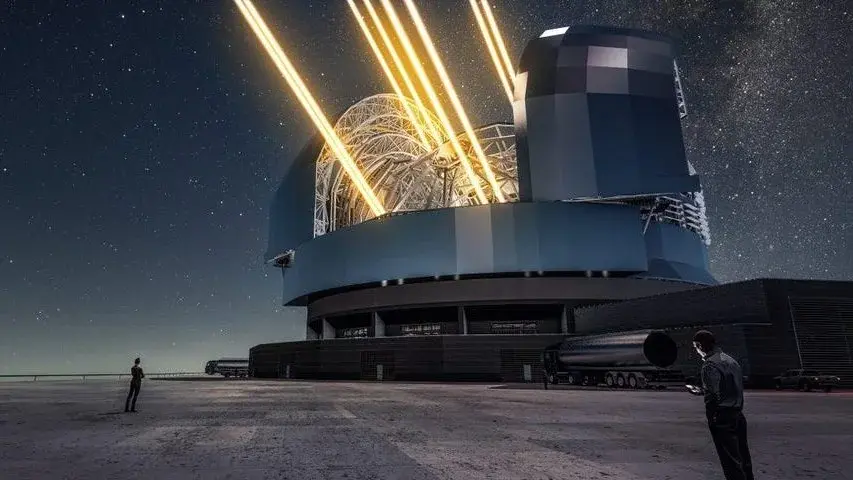
Ethan Siegel argues that the world needs all three planned 30-meter class ground-based telescopes—the ELT, GMT, and TMT—to maximize scientific discovery. Each facility offers unique advantages: the ELT provides the largest aperture and highest resolution for point sources, the GMT offers superior wide-field views and shorter wavelength capabilities, and the TMT is essential for observing the northern hemisphere. Ground-based telescopes also offer advantages over space telescopes, including no launch risks, easier maintenance, and upgradeability. While funding and site challenges persist, particularly for the TMT, building all three would create a complementary network capable of achieving scientific goals that no single telescope could accomplish alone.
Key points
- The ELT, GMT, and TMT are the three planned 30-meter class ground-based optical telescopes, each with distinct scientific strengths.
- The ELT (39m diameter) offers the largest collecting area and highest resolution for faint point sources, with mirror surface errors down to 6 nanometers.
- The GMT (25.4m diameter) has a smaller aperture but a much larger field of view, is optimized for shorter wavelengths, and features smaller, more easily upgradeable instruments.
- The TMT (30m diameter) is the only one of the three that can observe the northern celestial hemisphere, a capability lacking in the southern-hemisphere ELT and GMT.
- Ground-based telescopes have advantages over space telescopes, including no launch costs or risks, infinite repairability, and long-term upgradeability.
- The TMT faces significant challenges, including local opposition at its original Mauna Kea site and loss of US federal funding, but a potential €1B pledge from Spain for a La Palma site offers a new path forward.
Background
The current largest optical telescope is the Gran Telescopio Canarias at 10.4 meters. The next generation of 30-meter class telescopes represents a transformative leap in size and capability. The archive articles provided do not contain relevant background information for this topic.
Why it matters
The completion of all three 30-meter class telescopes would dramatically expand humanity's ability to observe the universe, enabling breakthroughs in dark matter, black hole feedback, exoplanet characterization, and galactic history. The loss of any one facility would create a significant gap in observational coverage, particularly the northern sky if the TMT is not built. The funding and site challenges for the TMT represent a critical decision point for international astronomy leadership.
What to watch
The TMT project must finalize its site decision between Mauna Kea and La Palma, with Spain's potential €1B funding making La Palma a more attractive option. The US Congress has instructed the NSF to move TMT to final design phase, but the NSF has not yet acted. The ELT and GMT are already in construction or final design phases and are expected to begin operations in the coming years.
Want the full story? Read the original reporting
Read on Big Think