
Real-Time Imaging Reveals Antiferromagnetic Skyrmion Interaction Potentials
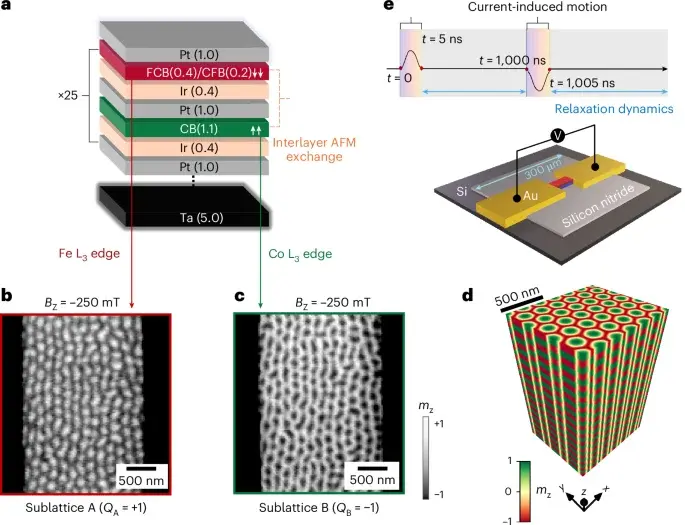
Researchers have directly visualized the nanosecond-scale dynamics of antiferromagnetic skyrmion lattices using pump-probe X-ray microscopy. By analyzing the motion of these topological spin textures in synthetic antiferromagnets, the study identifies two distinct flow regimes: an incoherent flow where mobile skyrmions scatter off pinned neighbors, and a coherent flow where the lattice moves uniformly. The team extracted a quantitative, exponentially decaying interaction potential from the recoil dynamics of skyrmions, confirming that antiferromagnetic skyrmions can achieve deterministic, ultrafast motion without the Hall effect or inertial lag that hampers ferromagnetic counterparts. This provides a critical framework for designing high-speed, non-volatile spintronic devices.
Key points
- Utilized pump-probe X-ray microscopy with 20-nm spatial and 1-ns temporal resolution to track skyrmion trajectories in real-time.
- Identified an 'incoherent flow' regime where local pinning causes spatially heterogeneous motion, leading to scattering and recoil events.
- Extracted a quantitative skyrmion-skyrmion interaction potential using an inverse method based on the Thiele equation, revealing an exponential decay profile.
- Demonstrated a 'coherent viscous-flow' regime at higher current densities where the lattice translates uniformly without detectable Hall deflection or inertial lag.
- Confirmed that angular-momentum compensation in synthetic antiferromagnets suppresses the skyrmion Hall effect, enabling rectilinear motion and robust gigahertz-speed operation.
Background
This research builds on the growing interest in spintronic devices as alternatives to complementary metal-oxide-semiconductor technology, leveraging the non-volatility and energy efficiency of skyrmions. While ferromagnetic skyrmions have advanced racetrack memories and logic gates, their practical utility is limited by stray fields and the intrinsic skyrmion Hall effect. Antiferromagnetic skyrmions have emerged as promising candidates due to their vanishing net topological charge, which suppresses the Hall effect and allows for ultrafast response. Previous studies have focused on single-skyrmion dynamics or quasi-static imaging, but real-time investigation of dense antiferromagnetic skyrmion lattices remained experimentally unexplored until this study. The work addresses the challenge of achieving reproducible dynamics in complex multiskyrmion ensembles, which is essential for scalable spintronic applications.
Why it matters
This study provides the first quantitative framework for understanding antiferromagnetic skyrmion interactions, a critical parameter for designing multiskyrmion spintronic devices. By demonstrating deterministic control of collective dynamics in both incoherent and coherent flow regimes, the research paves the way for robust, ultrafast spintronic operations. The suppression of the skyrmion Hall effect and inertial lag in antiferromagnetic systems enables higher clock frequencies and improved signal fidelity, addressing key limitations of ferromagnetic skyrmion devices. These findings are essential for advancing post-CMOS technologies, particularly in high-density memory and logic applications where nanosecond-scale precision is required.
What to watch
Future research will likely focus on optimizing synthetic antiferromagnet structures to minimize pinning potentials and enhance coherent flow regimes. Researchers may explore the integration of these skyrmion lattices into functional spintronic devices, such as racetrack memories and logic gates, to test their performance in real-world applications. Additionally, further studies could investigate the impact of thermal fluctuations and material defects on skyrmion dynamics, as well as the potential for utilizing topological spin and orbital Hall effects in antiferromagnetic systems for novel computing paradigms.
Want the full story? Read the original reporting
Read on Nature