
Atom Probe Tomography Maps Interstitial Hydrogen in Metal Alloys
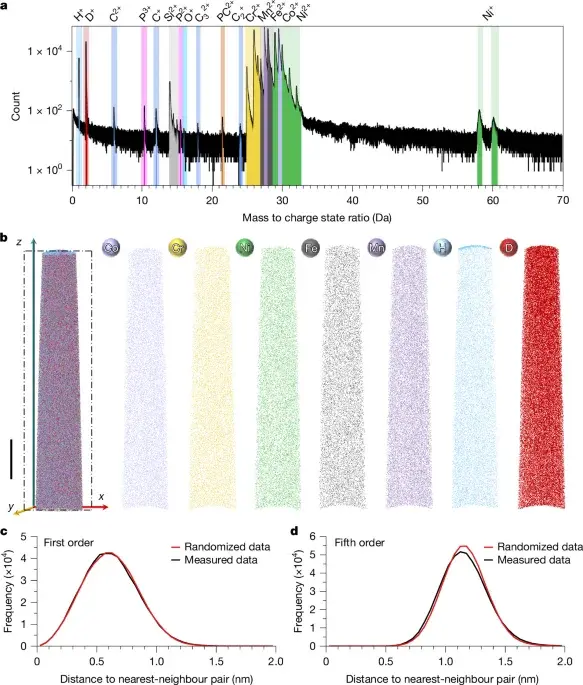
Researchers have demonstrated that atom probe tomography (APT) can distinguish interstitial hydrogen in solid solutions from defect-trapped hydrogen in metal lattices. By using deuterium as a proxy and analyzing face-centred cubic (FCC) multi-principal-element alloys, the study shows that hydrogen partitions according to local chemistry and crystal structure. This capability allows for precise nanoscale mapping of hydrogen distribution, which is critical for developing materials resistant to embrittlement and for improving hydrogen storage technologies.
Key points
- The study addresses the difficulty of detecting dilute, mobile interstitial hydrogen in metals using atom probe tomography (APT).
- Researchers used deuterium as a proxy for hydrogen to distinguish it from background protium signals in APT mass spectra.
- In single-phase CoCrNiFeMn alloys, deuterium showed a random distribution consistent with interstitial solid solution, not defect clustering.
- In dual-phase (CoCrNi)94Al3Ti3 alloys, deuterium concentrated in L12 Ni3(Al, Ti) precipitates, which have a higher hydrogen affinity than the FCC matrix.
- Density functional theory calculations confirmed that hydrogen solution energies are lower in L12 precipitates, supporting the observed partitioning.
- The method was validated in Inconel 718 superalloys, where deuterium enriched in L12 precipitates but not in D022 precipitates, matching theoretical predictions.
Background
Hydrogen behavior in materials is critical for low-carbon energy technologies, including hydrogen embrittlement in transport systems, solid-state storage, and nuclear reactor integrity. Previous APT studies focused on hydrides or defect-trapped hydrogen, but characterizing interstitial hydrogen in solid solutions remained challenging due to low solubility, high mobility, and artefacts from sample preparation. Recent advances in cryogenic transfer and deuterium charging have improved signal-to-noise ratios, enabling this new level of resolution.
Why it matters
Accurately mapping interstitial hydrogen in metals allows engineers to design alloys that resist embrittlement and improve hydrogen storage efficiency. This technique provides a direct link between atomistic predictions and experimental observation, facilitating the development of safer and more efficient materials for energy applications.
What to watch
Researchers will likely apply this APT methodology to other alloy systems and defect structures to further refine hydrogen partitioning models. The findings may guide the design of new structural alloys with optimized hydrogen resistance for industrial and energy applications.
Want the full story? Read the original reporting
Read on Nature