
BepiColombo Secures Mercury Orbit Despite Glitch, Setting Stage for December Separation
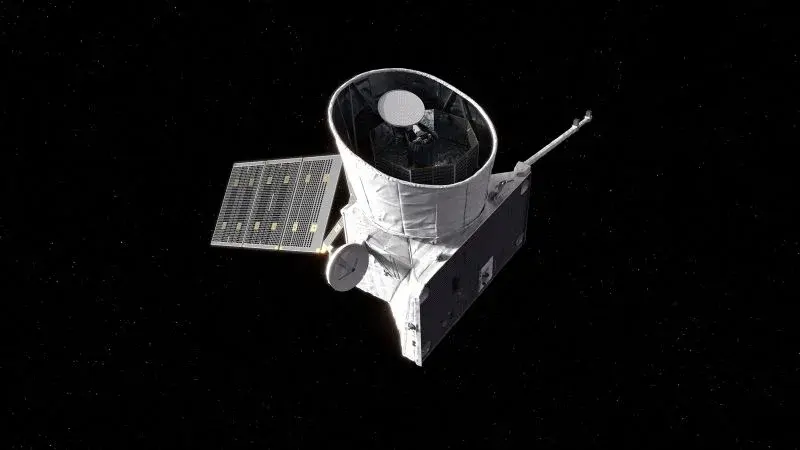
The joint European-Japanese BepiColombo spacecraft successfully entered orbit around Mercury on November 21, 2026, after an eight-year journey. Although a software glitch caused its thruster burn to end prematurely, the probe achieved a stable orbit. The mission is now preparing to separate into two distinct orbiters in December to begin scientific operations in April 2027.
Key points
- BepiColombo entered Mercury orbit on November 21, 2026, using a 'weak stability capture' technique, becoming the second spacecraft to orbit the planet after NASA's MESSENGER.
- A software glitch involving attitude guidance and thruster control interrupted the planned 37-minute burn after 28 minutes, causing the spacecraft to enter safe mode.
- The partial burn achieved only 77% of the required velocity change, placing the spacecraft in a 75-hour orbit instead of the intended 58-hour orbit.
- The spacecraft is currently safe and stable, with engineers planning additional thruster burns to adjust the trajectory before the two orbiters separate on December 9, 2026.
- The mission aims to study Mercury's interior, surface, and magnetosphere, with scientific operations scheduled to begin in April 2027.
Background
BepiColombo, a joint mission between the European Space Agency (ESA) and the Japan Aerospace Exploration Agency (JAXA), launched in October 2018. It traveled over 6 billion miles, including nine planetary flybys, to reach Mercury. The mission previously suffered an 11-month delay in 2024 due to a propulsion system fault. This is the third mission to visit Mercury, following NASA's Mariner 10 and MESSENGER. The New Yorker notes that Mercury's unique characteristics, such as its large core and magnetic field, make it a key subject for understanding planetary formation.
How outlets are covering it
CNN and CBS News emphasize the tension and technical challenges of the orbit insertion, highlighting the software glitch and the subsequent safe mode. The ESA provides a detailed technical explanation of the 'weak stability capture' technique and the multi-burn sequence. The New Yorker offers a broader scientific context, discussing Mercury's mysteries and the potential for BepiColombo to advance understanding of planetary formation and the origins of life. All sources agree on the success of the orbit insertion but differ in their focus on the technical details versus the scientific implications.
Why it matters
The successful orbit insertion of BepiColombo is a significant milestone in planetary science, as it will provide unprecedented data on Mercury's interior, surface, and magnetosphere. The mission's dual-probe design allows for comprehensive coverage of both hemispheres, addressing questions that previous missions could not. The successful navigation of the orbit insertion glitch demonstrates the adaptability and resilience of modern space missions, which often face unexpected challenges in extreme environments.
What to watch
The next major milestone is the separation of the two orbiters on December 9, 2026. The ESA's Mercury Planetary Orbiter (MPO) will release JAXA's Mercury Magnetospheric Orbiter (Mio) on December 16, 2026. MPO is expected to reach its final science orbit by March 2027, with scientific operations beginning in April 2027. Engineers will continue to perform thruster burns to adjust the trajectory and ensure the spacecraft are in the correct orbits for their respective missions.
- BepiColombo’s long-awaited arrival at Mercury isn’t going quite as planned CNN
- Spacecraft begins orbit of Mercury, with a glitch reported Reuters
- The Mystery of Mercury The New Yorker
- Spacecraft overcomes glitch to reach Mercury's orbit after 8-year journey CBS News
- BepiColombo safely in Mercury orbit despite unexpected challenge ESA
Want the full story? Read the original reporting
Read on CNN