
China Delays Chang'e-7 Launch to 2027 Amid Typhoon, Intensifying Lunar Water Race
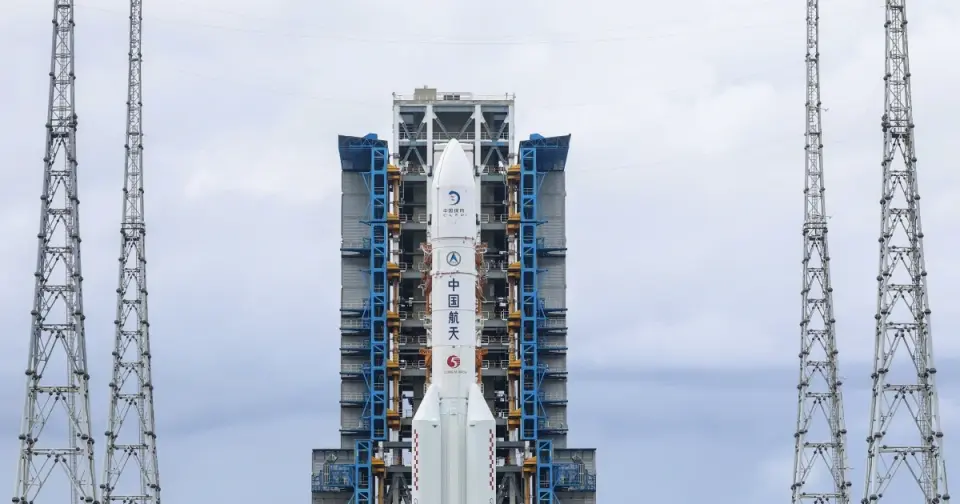
China has postponed the launch of its Chang'e-7 lunar mission to 2027 due to inclement weather, specifically Typhoon Narra, near the Wenchang launch site. Originally scheduled for late August 2026, the mission aims to be the first to land directly at the Moon's south pole to search for water ice in permanently shadowed craters. The uncrewed probe includes a lander, rover, and a novel hopping robot designed to descend into dark, cold traps. This delay impacts China's timeline for establishing a permanent lunar presence, which competes with NASA's Artemis program and a planned joint station with Russia by 2035.
Key points
- Launch delayed to 2027 due to Typhoon Narra at Hainan's Wenchang site.
- Mission targets Shackleton Crater near the lunar south pole for water ice.
- Payload includes a lander, rover, and a thruster-powered hopping probe.
- Hopper will jump up to 15 km into shadowed craters to analyze ice.
- Mission includes instruments from Thailand, Egypt, Switzerland, and Italy.
- Findings will inform China's 2030 crewed landing and 2035 research station plans.
Background
China's lunar program has consistently met its timelines, with previous missions like Chang'e-4 achieving the first far-side landing. The current push for water ice aligns with broader international efforts, including NASA's VIPER rover and India's Chandrayaan-3, to secure resources for future bases. Our archive notes that Chang'e-7 was previously expected to assess ice accessibility, marking a shift from exploration to resource evaluation. This mission is part of a broader strategy to establish a joint research station with Russia by 2035, competing with NASA's Artemis IV target of 2028 for a crewed landing.
How outlets are covering it
NBC News and ABC News emphasized the technological complexity of the 'hopping' probe and the strategic competition with NASA, noting that China's successful track record suggests high confidence in mission success. Ars Technica highlighted geopolitical implications, suggesting China might assert territorial rights or create keep-out zones, which could provoke a stronger U.S. response. Scientific American provided the critical update on the launch delay to 2027 due to weather, while also detailing the international collaboration aspect, including instruments from multiple countries and a single American component. While all outlets agree on the scientific importance of finding water, they differ in emphasis: ABC and NBC focus on the 'space race' narrative, Ars on geopolitical risks, and Scientific American on the technical and collaborative aspects.
Why it matters
The success of Chang'e-7 will determine the feasibility of long-term lunar habitation for China, potentially allowing it to surpass the U.S. in lunar exploration capabilities before 2030. The discovery of accessible water ice could reshape international space policy, as nations compete for resources essential for fuel and life support. The delay to 2027 may give NASA additional time to accelerate its Artemis program, but it also underscores the vulnerability of ambitious space missions to environmental factors. Ultimately, the mission's outcome will influence the pace of the new space race and the future of international cooperation in space exploration.
What to watch
China will monitor weather conditions at Wenchang for a 2027 launch window. Upon launch, the orbiter will spend two to three months in lunar orbit before a landing attempt near Shackleton Crater. The rover and hopper will then survey the surface, with the hopper conducting multiple jumps into shadowed craters. Data collected will inform the design of Chang'e-8, planned for 2028/2029, and the subsequent crewed landing by 2030. NASA will continue preparing Artemis IV, aiming for a 2028 crewed landing, while monitoring Chinese progress to adjust its own strategies.
- China is about to launch an ambitious moon mission to hunt for ice in one of the solar system’s coldest places NBC News
- China's bid for lunar water launches Sunday as the new space race heats up ABC News - Breaking News, Latest News and Videos
- The United States is about to wake up to the threat from China’s space program Ars Technica
- China is about to launch its most ambitious moon mission yet Scientific American
- China's Chang'e 7 moon probe will launch this weekend on the most ambitious lunar mission in history Space
Want the full story? Read the original reporting
Read on NBC News