
Curiosity’s discovery of pure sulfur unlocks viable Martian concrete
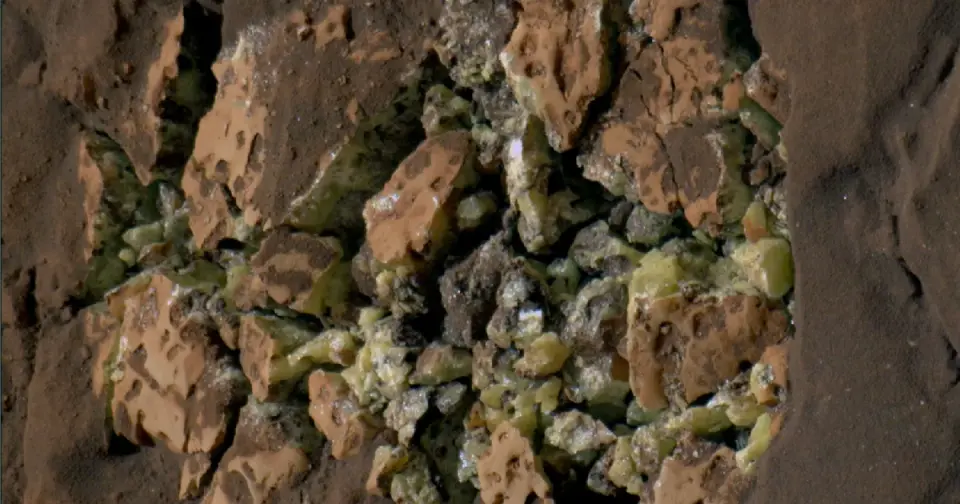
NASA’s Curiosity rover has confirmed the presence of pure, elemental sulfur on Mars, a critical ingredient for creating strong concrete using local sand. This discovery removes the final major barrier to building structures on Mars using only indigenous materials, as previous methods required pure sulfur which was previously thought to be absent. The technique involves heating sulfur to 116°C and mixing it with sifted Martian sand in a 50/50 ratio, producing a material with compressive strength comparable to modern Earth concrete. This advancement supports the feasibility of future human habitats without relying on transporting heavy building materials from Earth.
Key points
- Curiosity discovered pure elemental sulfur inside a crushed rock on May 30, 2024, in a sulfate-rich region of Mars.
- Pure sulfur is the missing ingredient for a concrete method developed by Northwestern University researchers in 2015, which uses molten sulfur as a binder.
- The optimal mixture consists of 50% molten sulfur and 50% Martian sand with grain sizes under 1 mm.
- This sulfur-based concrete achieves unconfined compressive strengths of up to 50 MPa, matching modern Earth concrete.
- Mars’s lower gravity (38% of Earth’s) allows structures to support over 2.5 times the mass of equivalent Earth structures.
- The discovery suggests pure sulfur may be widely available on Mars, potentially formed by the decompression of buried clathrates rather than active volcanism.
Background
Previous research indicated that conventional Earth-style concrete could not be made on Mars due to the lack of liquid water and the unique composition of Martian sand, which leads to weak, porous structures. A 2015 study proposed using molten sulfur as a binder, but this required pure elemental sulfur, which had not been confirmed on Mars until now. Earlier archive coverage noted alternative bio-concrete methods using yeast and gelatin, which achieved lower strengths (12 MPa) and raised concerns about durability and planetary protection. The current discovery of pure sulfur provides a more robust, high-strength alternative that relies entirely on in-situ resources.
Why it matters
This finding is a significant step toward sustainable space exploration by enabling the construction of habitats, bases, and potentially cities on Mars using local materials. It reduces the massive logistical burden of transporting building materials from Earth, making long-term human presence on Mars more economically and technically feasible. The availability of pure sulfur simplifies the production process, requiring only basic equipment like sifters and heaters, rather than complex chemical refining processes.
What to watch
Future missions will likely focus on mapping the distribution of pure sulfur deposits across Mars to identify optimal construction sites. Engineers will continue to refine the manufacturing process for sulfur-based concrete, testing its long-term durability under Martian conditions. This discovery may also influence the design of future rover and habitat missions, prioritizing locations with accessible sulfur reserves for potential construction activities.
Want the full story? Read the original reporting
Read on Big Think