
CERN's 10 Million Pounds of Steel Descends into South Dakota's Deepest Mine
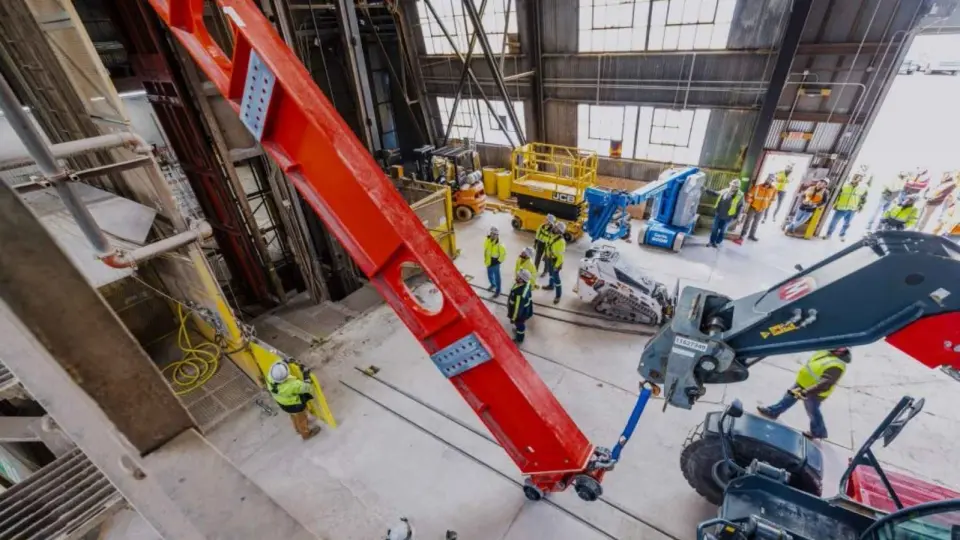
Crews are lowering 10 million pounds of structural steel into the Sanford Underground Research Facility in Lead, South Dakota, to build massive cryogenic tanks for the Deep Underground Neutrino Experiment. The steel, provided by CERN as an in-kind contribution, must fit through a 4.5-foot-wide elevator shaft to reach a depth of 4,850 feet. This logistical challenge is part of the largest U.S. Department of Energy science project, aiming to detect neutrinos by 2031.
Key points
- The Deep Underground Neutrino Experiment (DUNE) is currently receiving 10 million pounds of steel from CERN to construct two massive cryogenic tanks.
- All components must be lowered through the Ross Shaft, a 4.5-foot-wide elevator, to reach the 4,850-foot level of the former Homestake gold mine.
- The steel is being used to build frames for tanks that will hold 17,000 tons of liquid argon at minus 300 degrees Fahrenheit.
- Fermilab targets the first neutrino beam delivery from Illinois to South Dakota by 2031, a distance of 800 miles through solid earth.
- The project marks the first time CERN has invested in scientific infrastructure outside of Europe, with American labs reciprocating by building magnets for CERN's collider.
Background
The Sanford Underground Research Facility is located in the former Homestake gold mine, which operated for 125 years and produced over 40 million ounces of gold before closing in 2001. The site was chosen for its depth, which provides a natural shield against cosmic rays. In 1965, physicist Ray Davis used the mine to detect solar neutrinos, a discovery that later earned him the Nobel Prize. The current DUNE project follows this legacy, utilizing the same 4,850-foot level for its massive detectors.
How outlets are covering it
AutoNotion emphasizes the logistical absurdity and scale of the steel delivery, highlighting the 2,100 components and the tight summer deadline. SDPB focuses on the broader scientific mission of the facility, framing the work as answering fundamental questions about the universe. Mirage News and Black Hills Pioneer provide a different perspective by highlighting the NEMESIS experiment, which is also operating at the facility to study neutron backgrounds and potential dark matter signals, complementing the main DUNE project. While AutoNotion focuses on the physical construction, the other outlets highlight the diverse scientific activities happening simultaneously at the site.
Why it matters
The successful delivery and installation of this steel are critical for the DUNE experiment, which aims to understand neutrino properties and potentially detect dark matter. The project represents a major international collaboration between the U.S. and Europe, showcasing the scale of modern physics research. The logistical challenges of moving such massive components through a narrow shaft highlight the innovative engineering required for such deep underground experiments.
What to watch
Crews are scheduled to complete the steel delivery and preparation for installation by the end of summer 2026. Fermilab aims to deliver the first neutrino beam to DUNE by 2031. Meanwhile, the NEMESIS experiment will continue its measurements at different depths to understand neutron backgrounds and search for dark matter signals.
- A 43-foot steel beam weighing 15,890 pounds rides 4,850 feet down an old South Dakota gold mine standing upright in a cage 4.5 feet wide, one of roughly 2,100 pieces that have to make the same trip before summer ends Autonocion.com
- The Science Happening at the Sanford Underground Research Facility | SDPB SDPB
- NEMESIS Joins Sanford Underground Research Facility Mirage News
- Sanford Lab welcomes NEMESIS Black Hills Pioneer
Want the full story? Read the original reporting
Read on Autonocion.com