Tag

Neutrino Physics

All articles tagged with #neutrino physics

DARPA-funded team deploys historic neutrino sensors in Lake Superior before Fermilab beam ends
science10 days ago

DARPA-funded team deploys historic neutrino sensors in Lake Superior before Fermilab beam ends

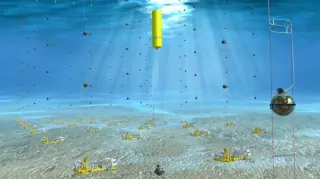
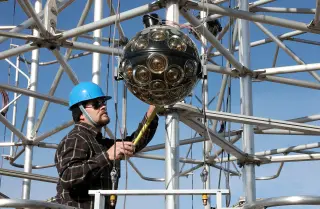
Researchers are installing the first neutrino detectors in a freshwater lake, aiming to capture data from a particle beam that will cease in February. The project, led by the University of Minnesota Duluth and sponsored by DARPA, uses sensors lowered to the bottom of Lake Superior to detect faint light emitted by neutrinos. While the primary goal is fundamental physics, the technology may have future defense applications, though officials emphasize the current focus is on broad scientific exploration.
Woods Hole Vessel Deploys First Freshwater Neutrino Detectors in Lake Superior
science12 days ago

Woods Hole Vessel Deploys First Freshwater Neutrino Detectors in Lake Superior

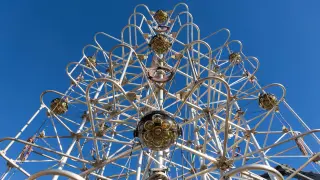
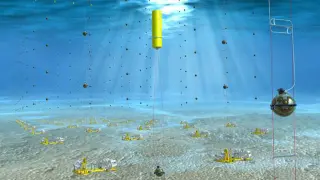
The 238-foot research vessel Neil Armstrong has arrived in Duluth, Minnesota, to install the first neutrino detectors in a freshwater lake. Led by the University of Minnesota Duluth and funded by DARPA, the project aims to detect 'ghost particles' 200 meters below the surface of Lake Superior. The sensors will monitor neutrinos from a Fermilab beam that is scheduled to shut off in February, marking a unique opportunity to study particle interactions in a new environment before the equipment is retrieved and sent to the Mediterranean.

Mediterranean Neutrino Telescope Finds No Flaws in Einstein's Relativity
science18 days ago

Mediterranean Neutrino Telescope Finds No Flaws in Einstein's Relativity

Researchers using the partially built ORCA neutrino telescope in the Mediterranean Sea have found no evidence that Lorentz invariance is violated. Despite using only a fraction of the detector’s planned size, the team established limits on potential cracks in Einstein’s relativity that rival those of much larger, longer-running experiments.

Submerged Neutrino Telescope Confirms Einstein's Relativity Limits
science18 days ago

Submerged Neutrino Telescope Confirms Einstein's Relativity Limits

A partial neutrino telescope located 1.5 miles beneath the Mediterranean Sea has confirmed that Einstein's principle of Lorentz invariance holds true. By analyzing 5,828 neutrinos over 17 months, researchers found no evidence that the laws of physics change based on direction or speed. These results set competitive limits for quantum gravity theories, matching data from much larger detectors.

Nobel Laureate Halzen’s IceCube Reveals Cosmic Neutrino Origins
science20 days ago

Nobel Laureate Halzen’s IceCube Reveals Cosmic Neutrino Origins

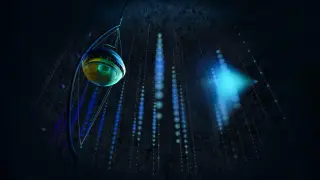
Francis Halzen won the 2026 Nobel Prize in Physics for developing the IceCube Neutrino Observatory in Antarctica. The detector, embedded in a cubic kilometer of ice, identifies high-energy neutrinos from deep space by capturing faint light flashes from particle interactions. These ghostly particles, which pass through matter almost unimpeded, offer insights into extreme cosmic environments like supermassive black holes. While IceCube detects only a few dozen such high-energy neutrinos annually, recent research suggests radio astronomy may better trace their sources than gamma-ray observations, as radio waves travel through space more easily than higher-energy light.

DUNE Construction Begins in South Dakota's Historic Homestake Mine
science23 days ago

DUNE Construction Begins in South Dakota's Historic Homestake Mine

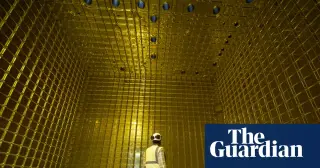
Construction of the Deep Underground Neutrino Experiment (DUNE) has commenced in the former Homestake gold mine in Lead, South Dakota. The project involves installing four massive detectors in caverns located one mile underground to study neutrinos. These ghostly particles, which pass through matter almost unnoticed, are central to solving fundamental questions about the universe, including why matter exists rather than antimatter. The detectors, made of steel and filled with 70,000 tonnes of liquid argon chilled to -200C, will analyze neutrinos from the sun, distant supernovae, and a beam sent from Fermilab in Illinois. The site, now the Sanford Underground Research Facility, previously hosted the first solar neutrino detection in the 1960s and currently hosts the Lux-Zeplin dark matter experiment.

Overlooked Heavy Neutrino May Explain Why Matter Survived the Big Bang
science1 month ago

Overlooked Heavy Neutrino May Explain Why Matter Survived the Big Bang

A new study suggests a previously ignored heavy neutrino could explain why matter dominates the universe. Researchers propose this particle altered early cosmic expansion, creating the imbalance that allowed stars and galaxies to form. The theory offers testable predictions for future gravitational wave detectors.

Francis Halzen Wins 2026 Physics Nobel for IceCube Neutrino Observatory
science1 month ago

Francis Halzen Wins 2026 Physics Nobel for IceCube Neutrino Observatory

Francis Halzen has been awarded the 2026 Nobel Prize in Physics for his foundational role in creating the IceCube Neutrino Observatory. The award recognizes his vision for using a cubic kilometer of Antarctic ice to detect high-energy neutrinos, a breakthrough that established the field of neutrino astronomy and allows scientists to trace cosmic events to their origins.

CERN's 10 Million Pounds of Steel Descends into South Dakota's Deepest Mine
science-and-technology3 months ago

CERN's 10 Million Pounds of Steel Descends into South Dakota's Deepest Mine

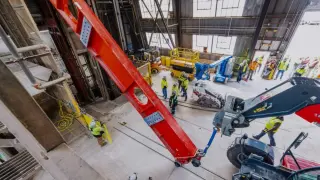
Crews are lowering 10 million pounds of structural steel into the Sanford Underground Research Facility in Lead, South Dakota, to build massive cryogenic tanks for the Deep Underground Neutrino Experiment. The steel, provided by CERN as an in-kind contribution, must fit through a 4.5-foot-wide elevator shaft to reach a depth of 4,850 feet. This logistical challenge is part of the largest U.S. Department of Energy science project, aiming to detect neutrinos by 2031.