
New MOSAIC method enables high-throughput DNA synthesis via self-assembly
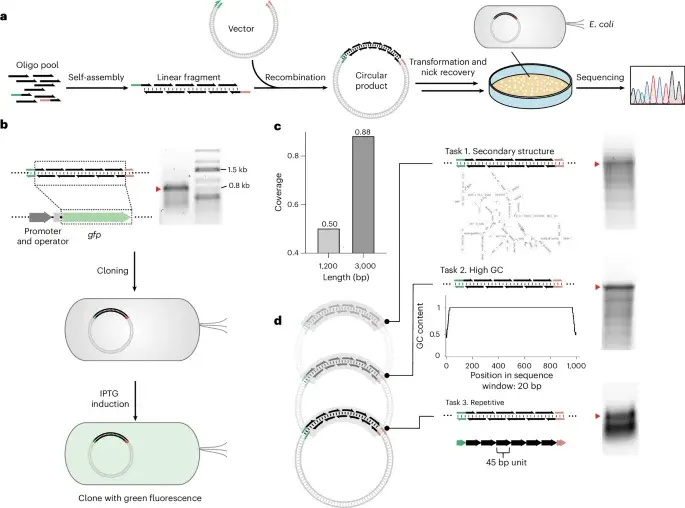
Researchers from Tsinghua University and collaborators have developed a new high-throughput gene synthesis method called Molecular Self-Assembly Induced Cloning (MOSAIC). The technique overcomes traditional bottlenecks in DNA synthesis by using the self-assembly of overlapping oligonucleotides in vitro, followed by cellular repair mechanisms in vivo. This approach allows for the parallel synthesis of over 1,000 distinct gene fragments in a single reaction, achieving near-zero misalignment. The method was validated by constructing massive variant libraries of the plastic-degrading enzyme PETase, yielding variants with higher potency than the current gold standard.
Key points
- MOSAIC couples in vitro self-assembly of overlapping DNA segments with in vivo host cell repair machineries to synthesize genes.
- The method utilizes microchip-based oligonucleotide synthesis to produce over 1,000 distinct gene fragments in a simple one-pot reaction.
- The technique achieves near-zero misalignment, with oligonucleotide synthesis errors remaining at a constant but controllable level.
- The study demonstrated the method's utility by creating variant libraries of the industrial enzyme PETase, discovering variants with higher potency than the existing benchmark.
- The approach addresses fundamental limitations in DNA synthesis that currently bottleneck synthetic biology applications.
Background
This development builds on previous advancements in synthetic biology, such as the 2026 study on self-assembled contacts for molecular electronics, which highlighted the potential of self-assembly for scalable device fabrication. Additionally, recent work on protein-foldamer architectures has shown how precise molecular interfaces can organize complex structures, a concept parallel to the orthogonal self-assembly used in MOSAIC. While earlier methods like Gibson assembly and microchip-based synthesis have improved DNA production, MOSAIC aims to solve the specific issues of molecular crosstalk and misalignment that limit high-throughput parallel synthesis.
Why it matters
The ability to synthesize large libraries of gene fragments with high accuracy and throughput is a critical step for advancing synthetic biology. By overcoming the limitations of current DNA synthesis technologies, MOSAIC could accelerate the development of new enzymes, such as improved PETase for plastic waste management, and enable more efficient protein engineering and directed evolution studies. This method has the potential to reduce the cost and time associated with gene synthesis, making it more accessible for industrial and research applications.
What to watch
The researchers have made the data and code for MOSAIC available through NCBI and GitHub, respectively, which will facilitate further validation and application of the method by other labs. Future work may focus on scaling the technique to even larger libraries and applying it to other challenging proteins or genetic constructs. The discovery of higher-potency PETase variants suggests immediate potential for industrial applications in plastic recycling and waste management.
Want the full story? Read the original reporting
Read on Nature