
NASA CHAPEA Crew Exits Houston Hangar After 378-Day Mars Simulation
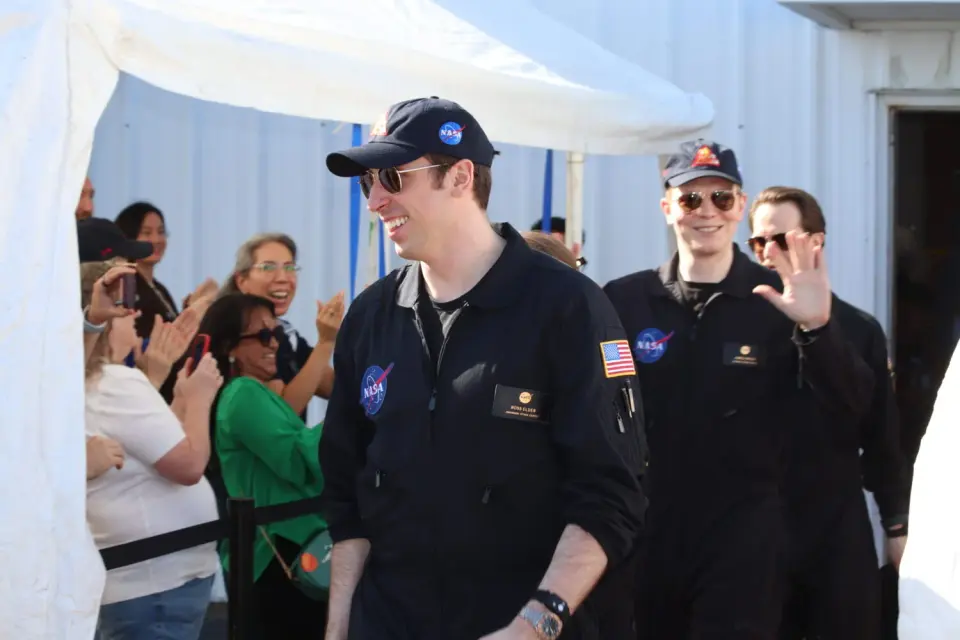
Four volunteers exited a 3D-printed habitat at NASA’s Johnson Space Center on October 31, 2026, after spending 378 days in a simulated Mars environment. The CHAPEA Mission 2 crew, led by Ross Elder, tested life-support systems, crop cultivation, and communication delays to gather data for future lunar and Martian exploration. The mission concluded with a family reunion and the start of a two-week post-mission evaluation period.
Key points
- The four crew members—Ross Elder, Ellen Ellis, Matthew Montgomery, and James Spicer—lived in a 1,700-square-foot, 3D-printed facility inside a hangar at the Johnson Space Center in Houston.
- The mission began on October 19, 2025, and ended on October 31, 2026, totaling 378 days of isolation in a space roughly the size of a three-bedroom house.
- Crew members simulated Mars conditions, including communication delays of 26 to 44 minutes and a two-week total blackout to mimic solar interference, while managing limited resources and growing crops.
- NASA Director Vanessa Wyche stated the mission provided foundational data for human exploration of the Moon and Mars, focusing on habitat maintenance, robotics, and physical exercise.
- Following their exit, the crew will undergo two weeks of post-mission evaluations with NASA scientists to collect baseline data and provide recommendations for future deep-space missions.
Background
This event follows earlier NASA initiatives focused on long-duration spaceflight, including the Artemis II mission, which sent humans further into space in April 2026. The CHAPEA program is part of a broader strategy to prepare for the NASA Moon Base, with plans to transition into a more comprehensive Moon and Mars Exploration Analog (MMEA) program as soon as August 2027. Recent scientific findings, such as the identification of a 4.1-billion-year-old Martian meteorite, underscore the ongoing interest in understanding Mars's early history and potential for human habitation.
How outlets are covering it
Houston Public Media emphasized the human element, highlighting the crew's isolation, the emotional reunion with families, and Elder's optimistic remarks about the inevitability of human Mars exploration. NASA's official media advisory focused on the scientific and operational aspects, detailing the data collection for food systems, crew time efficiency, and medical care, while inviting media to the exit ceremony. Both sources agreed on the mission's duration and the crew's roles but differed in emphasis, with Houston Public Media focusing on the personal experience and NASA on the technical outcomes.
Why it matters
The CHAPEA mission provides critical insights into the human and technical challenges of long-duration spaceflight, directly informing NASA's plans for the Moon Base and future Mars missions. The data collected will help optimize resource management, communication systems, and crew health protocols, which are essential for ensuring the safety and success of deep-space exploration. This mission also highlights the importance of simulating extreme conditions to prepare for the realities of space travel, where isolation and resource limitations are significant risks.
What to watch
The crew will spend two weeks in post-mission evaluations with NASA scientists to debrief and collect baseline data. NASA plans to transition the CHAPEA program into the Moon and Mars Exploration Analog (MMEA) program, with a potential start date as early as August 2027. This new program will focus on preparing for the NASA Moon Base and further deep-space exploration, building on the lessons learned from CHAPEA.
- They spent more than a year inside a NASA hangar in Houston simulating life on Mars. Now, they’re finally out Houston Public Media
- Four volunteers just finished a year in isolation in Houston, all in the name of space exploration KHOU
- NASA Invites Media to Crew Completion of Yearlong Mars Simulation NASA (.gov)
- 4 volunteers who lived in a Mars simulation for a year are back to the real world NPR
- Four NASA volunteers spent 378 days living like Mars astronauts Chron
Want the full story? Read the original reporting
Read on Houston Public Media