
NASA’s LDEF: A 69-Month Orbital Accident That Yielded Critical Materials Data
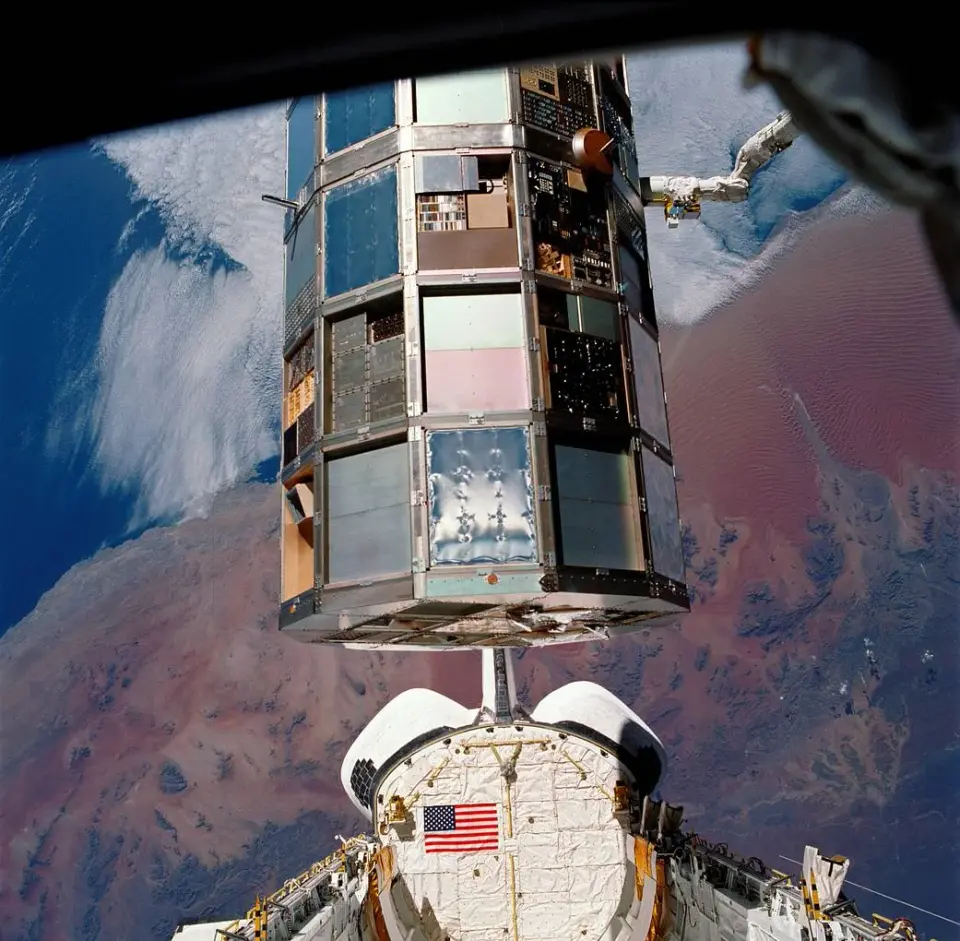
NASA’s Long Duration Exposure Facility (LDEF) was deployed in 1984 for a 10-month test but remained in orbit for 69 months due to scheduling delays and the Challenger accident. Recovered by the Space Shuttle Columbia in January 1990, the satellite provided unprecedented data on how atomic oxygen and radiation degrade materials in low Earth orbit.
Key points
- LDEF was launched in April 1984 with 57 experiments designed to study material degradation in space.
- The mission was originally planned for 10 months but extended to 69 months due to shuttle scheduling issues and the 1986 Challenger disaster.
- The facility was retrieved by Space Shuttle Columbia on January 12, 1990, after its orbit began decaying.
- The extended exposure allowed scientists to analyze the effects of atomic oxygen, micrometeoroids, and solar radiation on polymers and other materials.
- The recovered hardware contained over 10,000 test specimens, providing a unique dataset for refining models of the low Earth orbit environment.
Background
This story highlights the long-term value of physical sample return missions in space exploration. While modern satellites often rely on continuous data transmission, LDEF demonstrated that returning physical hardware allows for detailed post-flight analysis that cannot be achieved through remote sensing alone. This approach remains relevant today, as seen in recent efforts to service or recover aging satellites, such as the private rescue mission targeting NASA’s Swift observatory, which aims to extend the life of instruments that may otherwise be lost to orbital decay.
Why it matters
The LDEF mission illustrates how operational setbacks can inadvertently create valuable scientific opportunities. The extended orbital duration provided a comprehensive record of material degradation that helped engineers design more durable spacecraft for future missions. This historical precedent underscores the importance of physical sample return in understanding the complex and cumulative effects of the space environment on technology.
What to watch
The data from LDEF continues to inform materials science and spacecraft design, particularly regarding the impact of atomic oxygen on polymers. As new missions plan for long-duration exposure in low Earth orbit, the insights from LDEF remain a critical reference for predicting and mitigating material degradation.
Want the full story? Read the original reporting
Read on Space Daily