
Metasurface Boosts Quantum-Well Nonlinearity 14x for Compact Photonics
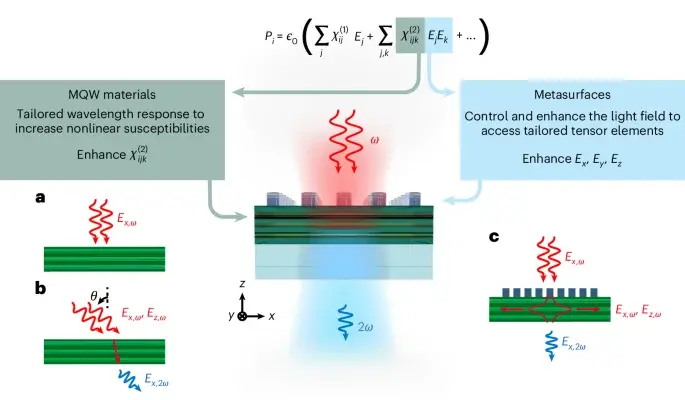
Researchers have demonstrated a new method to drastically enhance nonlinear optical responses in compact devices by combining engineered quantum wells with dielectric metasurfaces. The approach achieves an effective nonlinearity 270 times stronger than standard lithium niobate, enabling efficient frequency conversion for telecommunications and quantum computing without bulky bulk crystals.
Key points
- A team led by Pernille Undrum Fathi achieved an intrinsic second-order nonlinear susceptibility of 1.6 nm V⁻¹ at 1.57 μm using a GaAs/AlGaAs multi-quantum-well heterostructure.
- By patterning a titanium dioxide metasurface onto the material, the effective nonlinearity was boosted to approximately 14 nm V⁻¹, making the effect accessible via free-space light rather than requiring complex facet illumination.
- The design utilizes guided-mode resonances to convert incident polarization and enhance local electric fields, overcoming selection rules that previously limited second-harmonic generation in these materials.
- The resulting device is 270 times more nonlinear than lithium niobate and offers a scalable, foundry-compatible route to miniaturized nonlinear optical components for near-infrared and visible wavelengths.
Background
This development follows recent advancements in nanophotonics and quantum optics, including the demonstration of vacuum birefringence in magnetar fields and the establishment of long-distance free-space quantum links. While previous efforts focused on mid-infrared nonlinearities or bulk crystal limitations, this work addresses the challenge of miniaturizing nonlinear devices for telecommunications and quantum computing by integrating band-structure engineering with resonant metasurfaces.
How outlets are covering it
Nature presents the technical details of the co-design approach, emphasizing the shift from underutilized intrinsic material properties to a functional nanophotonic platform. Quantum Zeitgeist highlights the practical implications, noting that the metasurface enables normal-incidence excitation, which simplifies experimental setups and broadens applications. Both sources agree on the magnitude of the enhancement but differ in emphasis: Nature focuses on the physics of symmetry-broken guided-mode resonances, while Quantum Zeitgeist frames the achievement as a solution to the miniaturization and efficiency bottlenecks of conventional nonlinear optics.
Why it matters
This breakthrough provides a scalable pathway to compact, high-efficiency nonlinear optical devices, which are critical for telecommunications, quantum computing, and ultra-fast signal processing. By overcoming the limitations of bulk crystals and enabling free-space accessibility, this technology could lead to smaller, more efficient photonic components that are compatible with standard semiconductor manufacturing processes.
What to watch
Researchers plan to optimize fabrication processes and expand the design space for both the heterostructure and metasurface to achieve even larger nonlinear responses. The versatility of the metasurface approach may also enable spatial engineering of nonlinear output and extension to other processes like difference-frequency generation and entangled photon creation.
Want the full story? Read the original reporting
Read on Nature