
Copper Single-Atom Catalyst Enables Recyclable, Selective N-Demethylation Under Visible Light
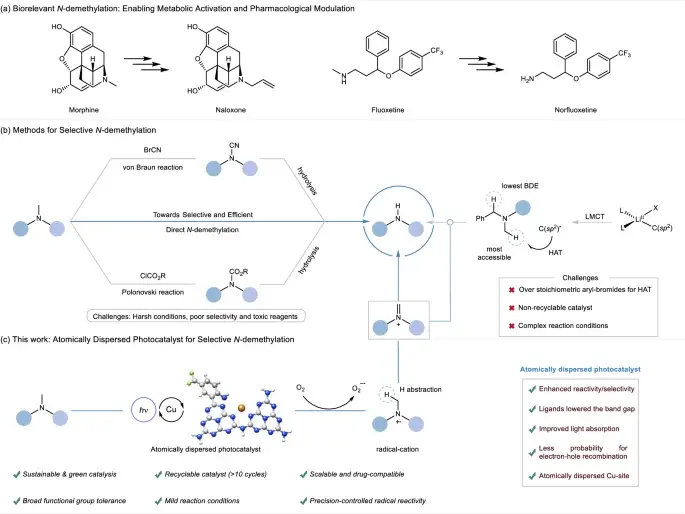
Researchers have developed a noble-metal-free, recyclable photocatalyst consisting of atomically dispersed copper sites on functionalized graphitic carbon nitride (Cu@f-gC3N4). This system enables the selective N-demethylation and N-dealkylation of tertiary amines under 390 nm light and an oxygen atmosphere. The catalyst achieves high yields for pharmaceutically relevant substrates, is scalable to 10 mmol, and retains activity over more than ten reuse cycles. Mechanistic studies confirm a photoredox pathway involving amine oxidation, superoxide formation, and hydrolysis, offering a sustainable alternative to traditional methods that rely on toxic reagents or precious metals.
Key points
- The new catalyst, Cu@f-gC3N4, features atomically dispersed copper sites confirmed by XPS, ssNMR, STEM, and EXAFS, ensuring high metal utilization and structural stability.
- Under 390 nm irradiation and oxygen atmosphere, the catalyst converts tertiary amines to secondary amines in high yields, with optimal conditions using cesium pivalate in ethanol.
- The reaction is selective for tertiary amines due to redox matching, preventing over-oxidation of the resulting secondary amines, and is scalable to 10 mmol with 71% yield.
- The catalyst retains its activity over more than ten reuse cycles, demonstrating its robustness and sustainability compared to homogeneous noble-metal systems.
- Mechanistic studies, including radical trapping and DFT calculations, support a pathway involving amine oxidation, superoxide formation, hydrogen abstraction, iminium generation, and hydrolysis.
Background
N-demethylation is a critical transformation in drug metabolism and medicinal chemistry, traditionally performed using toxic reagents or precious-metal catalysts that are difficult to recover. Previous photoredox methods, such as those using iridium or ruthenium complexes, faced limitations regarding cost, recyclability, and the need for stoichiometric additives. The development of single-atom catalysts on carbon nitride supports offers a promising alternative by combining the high activity of homogeneous catalysts with the reusability of heterogeneous systems. This work builds on earlier research into copper-based photocatalysts for other transformations, such as cycloadditions, but specifically addresses the challenge of selective amine modification in a sustainable manner.
Why it matters
This development provides a sustainable, cost-effective, and scalable method for N-demethylation, a key step in drug synthesis and metabolism studies. By using earth-abundant copper and a recyclable heterogeneous catalyst, the process reduces reliance on expensive noble metals and toxic reagents, aligning with green chemistry principles. The ability to perform late-stage amine diversification without sacrificial additives enhances the practicality of this method for medicinal chemistry and drug discovery, potentially accelerating the development of new therapeutics and improving the efficiency of existing synthetic routes.
What to watch
Future research will likely focus on expanding the substrate scope to include more complex molecular frameworks and optimizing the catalyst for industrial-scale applications. Researchers may also explore the integration of this photocatalytic system with other transformations to enable multi-step synthetic sequences. Additionally, further mechanistic studies could refine the understanding of the role of the functionalized carbon nitride support in charge separation and oxygen activation, potentially leading to the design of even more efficient single-atom catalysts for other organic transformations.
Want the full story? Read the original reporting
Read on Nature