
Soviet Venera 13 Lander Exceeds Design Limits to Capture First Color Images of Venus
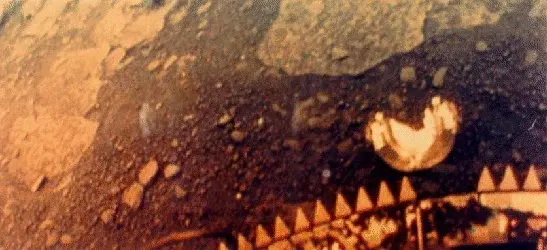
On March 1, 1982, the Soviet Venera 13 probe landed on Venus and transmitted data for 127 minutes, far exceeding its 32-minute design life. It captured the first color images of another planet's surface and performed the first in-situ soil analysis, measuring elemental composition via X-ray fluorescence. The lander operated in 465°C heat and 89 atmospheres of pressure, sending data back via a receding carrier spacecraft. No subsequent mission has matched this duration, leaving Venera 13 as the benchmark for surface operations on Venus.
Key points
- Venera 13 landed at 03:57 UTC on March 1, 1982, in Phoebe Regio at coordinates 7.55 degrees south and 303.69 degrees east.
- The lander was designed for a 32-minute surface mission but transmitted useful data for 127 minutes, nearly four times the engineering target.
- It captured the first color photographs from Venus's surface using panoramic telephotometers that scanned through color filters.
- The probe drilled into the ground and analyzed a sample using X-ray fluorescence, identifying a composition consistent with potassium-rich alkaline basalt.
- The lander survived in an environment with 465°C temperatures and 89.5 atmospheres of pressure, conditions that melt lead and crush conventional electronics.
- Data was relayed to Earth via a carrier spacecraft that passed Venus at a closest distance of 36,000 kilometers, as the lander could not transmit directly to Earth.
Background
Venera 13 followed earlier Soviet missions that provided the first surface data from Venus. Venera 7 in 1970 provided the first confirmed surface transmission, though its data was initially mistaken for noise. Venera 9 and 10 returned the first black-and-white surface photographs in 1975. Venera 11 and 12 attempted color imaging but failed due to stuck lens covers. Venera 13 succeeded in these tasks, establishing a new benchmark for surface operations. Future missions have explored alternative technologies like silicon-carbide electronics and mechanical systems to extend surface lifetimes, but Venera 13's approach of arriving cold, descending quickly, and sequencing science automatically remains a foundational model for extreme environment exploration.
Why it matters
Venera 13's success demonstrated that surface operations on Venus are possible despite extreme conditions, providing the first color visual record and chemical analysis of the planet's surface. The mission's 127-minute transmission set a record that has not been surpassed, highlighting the challenges of operating in high-temperature, high-pressure environments. The data from Venera 13, including soil composition and atmospheric measurements, remains critical for understanding Venus's geology and climate. The mission's engineering solutions, such as thermal protection and rapid data transmission, continue to inform the design of future planetary probes, particularly those targeting Venus or other harsh environments. The lack of subsequent surface missions underscores the difficulty of achieving similar results, making Venera 13 a unique and enduring benchmark in planetary exploration.
What to watch
Future Venus missions may employ advanced materials like silicon-carbide electronics and mechanical systems to extend surface operational times beyond the 127-minute record. Short-lived descent probes targeting specific chemical analyses could provide new data without requiring long-duration surface presence. Orbital radar and atmospheric studies will continue to provide regional context to complement the limited ground-truth data from Venera 13 and other landers. Engineers are also exploring new thermal management strategies to mitigate the relentless heat ingress that ultimately ended Venera 13's transmission, aiming to push the boundaries of surface operations on Venus and other extreme environments.
Want the full story? Read the original reporting
Read on Space Daily