
Webb Telescope's Discoveries Challenge Our Understanding of the Early Universe
TL;DR Summary
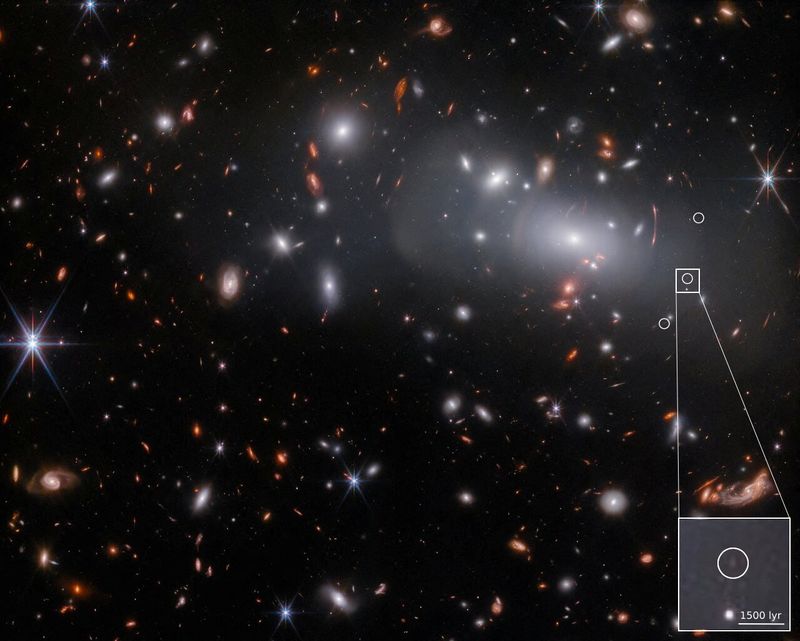
The James Webb Space Telescope has detected a highly compact galaxy that formed 13.3 billion years ago, just 510 million years after the Big Bang. The galaxy has a diameter of approximately 100 light-years and forms new stars at a rate similar to that of the Milky Way. The discovery is reshaping our understanding of the early universe and challenging our assumptions about galaxy properties. The observation was aided by gravitational lensing, and the combined power of the James Webb Space Telescope and the galaxy's magnification allowed for detailed study.
Topics:science#early-universe#galaxy-formation#gravitational-lensing#james-webb-space-telescope#science-and-technology#star-formation
- Compact galaxy's discovery shows Webb telescope's 'amazing' power Yahoo News
- James Webb Space Telescope finds tiny early galaxy packing big star-forming punch Space.com
- James Webb Space Telescope images challenge theories of how universe evolved Phys.org
- Cosmic Time Travel: Webb Unveils Physical Properties of Compact Galaxy From the Early Universe SciTechDaily
- How do we know how far away and early in the universe galaxies are? Space.com
Reading Insights
Total Reads
0
Unique Readers
12
Time Saved
3 min
vs 4 min read
Condensed
85%
617 → 90 words
Want the full story? Read the original article
Read on Yahoo News