
Why Kevlar Tethers Fail to Provide Artificial Gravity for Long-Duration Space Missions
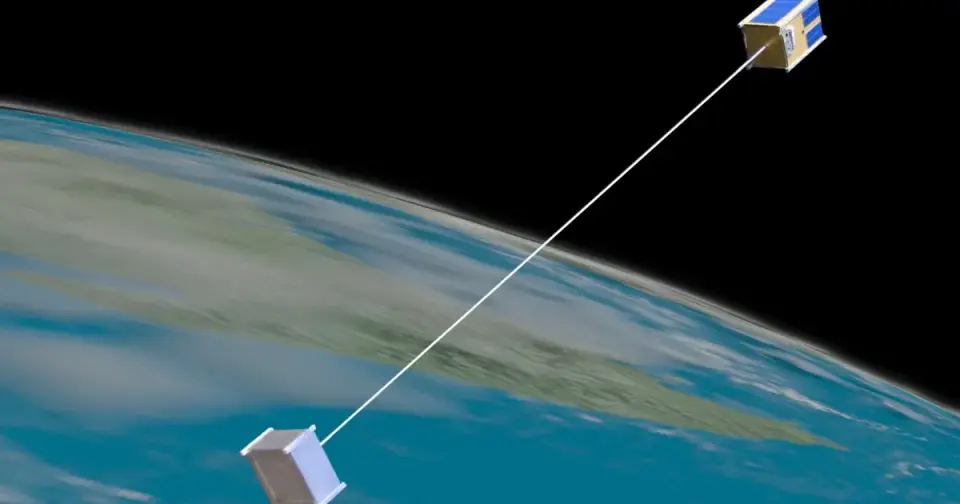
A Kevlar tether connecting two spacecraft could theoretically generate artificial gravity via rotation, but practical engineering and physiological barriers make it unfeasible for long-term human habitation. While microgravity causes severe bone and muscle loss, creating a stable, comfortable rotating system requires a tether length of at least 1.6 km to avoid nausea, which introduces insurmountable stability challenges.
Key points
- Microgravity causes significant health issues, including bone density loss of 1.5% per month and muscle atrophy of 10-20% within weeks, necessitating artificial gravity for long missions.
- Einstein’s equivalence principle suggests that acceleration can mimic gravity; a rotating tether system could provide this, but requires precise angular momentum balance.
- To achieve Earth-like gravity (1g), a 20-meter tether must spin at nearly 10 RPM, causing severe vertigo, while a 2,000-meter tether requires only 1 RPM but is too long to manage.
- A tether must be at least 1.6 km long to minimize the Coriolis effect and prevent nausea, but this length makes the system highly sensitive to internal mass movements, risking catastrophic destabilization.
- No such tether system has been built because maintaining balance in a large rotating structure is technically beyond current capabilities, despite being the lowest-cost theoretical option.
Background
Previous coverage noted that while artificial gravity is technically feasible, funding and engineering hurdles remain primary barriers. This article details specific physical constraints, such as the Coriolis effect and angular momentum, that make the Kevlar tether concept impractical despite its theoretical simplicity.
Why it matters
Understanding the physical limits of artificial gravity is crucial for planning future deep-space missions to Mars or beyond, where long-term exposure to microgravity poses severe health risks to astronauts. It highlights the gap between theoretical physics and practical engineering in space exploration.
What to watch
Research will likely continue to focus on alternative artificial gravity methods, such as rotating cylindrical stations or linear acceleration, while tether systems remain a theoretical concept due to their engineering instability.
Want the full story? Read the original reporting
Read on Big Think