
Webb Telescope Identifies Host Galaxy of Record-Breaking 10-Billion-Year-Old Radio Burst
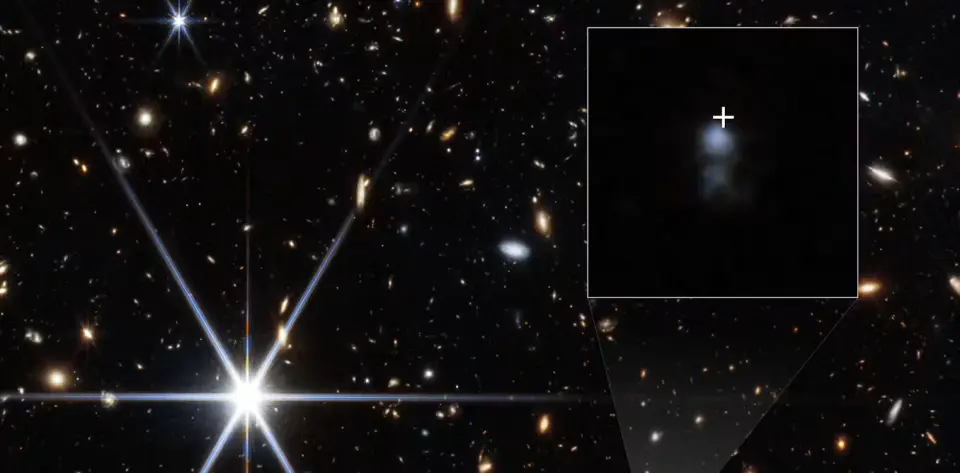
Astronomers have identified the host galaxy of FRB 20240304B, the most distant fast radio burst ever detected. The signal originated 10.6 billion years ago, when the universe was only 3 billion years old. The burst was detected by the MeerKAT telescope in South Africa and its host galaxy was confirmed by the James Webb Space Telescope. The host is a surprisingly small, young dwarf galaxy actively forming stars, which supports theories that fast radio bursts are generated by young magnetars rather than older neutron star mergers.
Key points
- The burst, designated FRB 20240304B, was detected on March 4, 2024, using the MeerTRAP system on the MeerKAT radio telescope in South Africa.
- The James Webb Space Telescope’s NIRCam and NIRSpec instruments confirmed the host galaxy’s redshift at 2.148, placing the event 10.6 billion years ago, or 3 billion years after the Big Bang.
- The host galaxy is a small dwarf galaxy with a mass of only 10 million times that of the Sun, roughly 1,000 times less massive than typical fast radio burst host galaxies.
- The galaxy is actively forming stars with a low metal content, suggesting the burst occurred during the peak of cosmic star formation, known as 'cosmic noon.'
- The discovery implies that fast radio bursts may be produced by young magnetars, as the short timescale of star formation in the host galaxy makes neutron star mergers unlikely.
Background
Fast radio bursts were first discovered in 2007 and have remained a mystery for nearly two decades. Previous detections have mostly occurred in older, more massive galaxies. This new finding extends the known timeline of fast radio bursts to the early universe, providing a new data point for studying the distribution of electrically charged matter and magnetic fields across 80% of cosmic history.
How outlets are covering it
The Conversation and NASA Science emphasize the surprise that the host galaxy is a small, young dwarf galaxy, which challenges previous expectations that fast radio bursts originate in massive, evolved galaxies. The Guardian highlights the potential for fast radio bursts to map unseen matter in the universe, noting that the signal carries an imprint of the cosmic web. Space.com focuses on the surprise of the source and the implications for the origin of fast radio bursts, noting that the discovery supports the magnetar theory. All sources agree on the significance of the discovery for understanding the early universe and the nature of fast radio bursts.
Why it matters
This discovery provides the first evidence that fast radio bursts were being produced in the early universe, during the period of peak star formation. It offers a new way to probe the distribution of matter and magnetic fields across cosmic time, potentially revealing how galaxies grow and how the space between them changes over billions of years.
What to watch
The team plans to detect more distant fast radio bursts using the MeerKAT telescope, which may identify several per year at a redshift greater than 1.0. The James Webb Space Telescope will be essential for characterizing these distant host galaxies, allowing scientists to build a larger sample of fast radio bursts across cosmic time.
- Astronomers pinpoint the origin of a 10 billion-year-old millisecond signal from space The Conversation
- Astronomers detect mysterious burst of energy from a galaxy far, far away The Guardian
- Webb Measures Distance to Farthest Fast Radio Burst, Suggesting Origin NASA Science (.gov)
- James Webb Space Telescope helps detect the most distant Fast Radio Burst ever seen — and scientists are surprised by its source Space
- Astronomers pinpoint the most distant fast radio burst ever detected Phys.org
Want the full story? Read the original reporting
Read on The Conversation