
Alberta Fossil Marks Suggest Raptor Scavenged on Tyrannosaur Relative
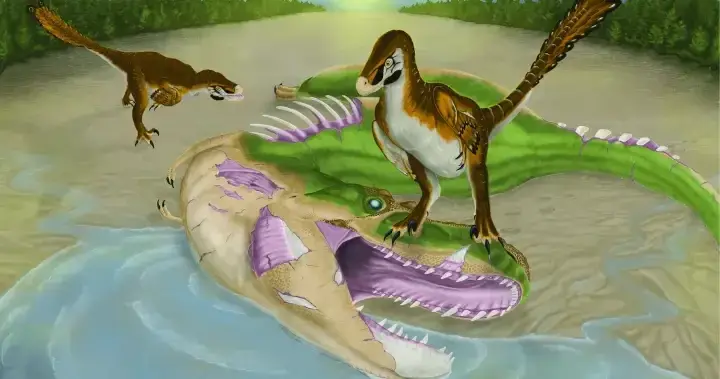
University of Alberta researchers identified bite marks on an Albertosaurus jawbone as likely evidence of a small raptor scavenging on a large apex predator. The study, published in the Journal of Paleontology, suggests this is the first documented instance of a dromaeosaurid feeding on a tyrannosaurid. While a juvenile tyrannosaur cannibalizing the carcass remains a possibility, the geometric analysis of tooth spacing favors the smaller raptor as the culprit.
Key points
- The fossil belongs to an immature Albertosaurus, estimated at 8-11 years old, found in Alberta's badlands in 2022.
- Researchers analyzed bite marks on the jawbone, comparing tooth spacing to contemporary carnivores to identify the feeder.
- The marks align with dromaeosaurids (raptors), which were significantly smaller than the Albertosaurus, suggesting scavenging rather than predation.
- No healing signs were present, indicating the marks were made around the time of the dinosaur's death.
- The study was led by master's student Joshua Doyon and supervised by Professor Philip Currie.
Background
This discovery adds to the growing body of evidence regarding complex food webs in the Late Cretaceous. While previous studies have shown dromaeosaurids feeding on herbivores and pterosaurs, this is the first clear evidence of them scavenging on tyrannosaurids. It complements earlier findings of reciprocal feeding interactions between these two groups, helping to reconstruct the ecological dynamics of prehistoric Alberta.
How outlets are covering it
Global News emphasizes the rarity of carnivore-on-carnivore evidence and highlights the possibility of cannibalism by a young Albertosaurus. La Brújula Verde provides a detailed technical breakdown, noting the geometric corrections used to rule out other candidates like troodontids and Richardoestesia, and stresses that the raptor hypothesis is the most supported but not definitive. Yahoo's coverage focuses on the cannibalism angle, suggesting a baby tyrannosaur might have eaten its relative, though it lacks the specific forensic details provided by the other sources.
Why it matters
This finding refines our understanding of prehistoric ecosystems by demonstrating that smaller predators played a role in scavenging large apex predators. It challenges the simplistic view of food chains and highlights the importance of carcass resources in the Late Cretaceous, offering new insights into the behavioral ecology of dinosaurs.
What to watch
Researchers will continue to analyze the fossil for additional clues, though the fragmentary nature of the remains limits further reconstruction. The study may prompt further investigations into other fossil sites to determine if such scavenging behavior was common among dromaeosaurids in the region.
- University of Alberta researchers find evidence raptor may have fed on apex predator Global News
- Fossil bite marks suggest first evidence of a small raptor feeding on an apex predator Phys.org
- A baby tyrannosaur possibly cannibalized its dead relative Yahoo
- A Small Dinosaur May Have Devoured a Huge Predator Related to T. rex: Tooth Marks Reveal an Unusual Scene La Brújula Verde
- A jaw-dropping discovery on the badlands University of Alberta
Want the full story? Read the original reporting
Read on Global News