
Tiny Raptor Likely Scavenged on Giant Tyrannosaur Relative, Fossil Study Shows
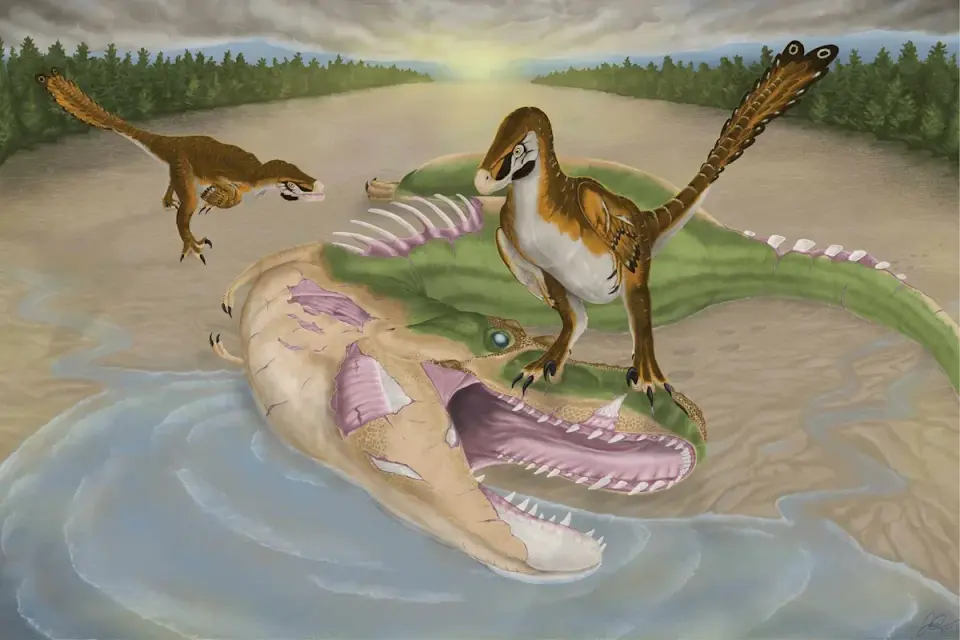
Researchers at the University of Alberta have identified bite marks on a 70-million-year-old Albertosaurus jaw as the first documented evidence of a small raptor feeding on a tyrannosaur. The study, published in the Journal of Paleontology, suggests a dromaeosaurid weighing roughly 35 to 40 pounds scavenged the carcass of the 1,175-pound apex predator. The unhealed nature of the marks indicates the interaction occurred at or shortly after the dinosaur's death, challenging previous assumptions about predator-prey dynamics in the Late Cretaceous.
Key points
- The fossil, discovered in 2022 in Saskatchewan's Red Deer River valley, was collected by the Royal Tyrrell Museum between 2022 and 2025.
- Paleontology master's student Joshua Doyon led the analysis, identifying three parallel scrapes and a groove with 28 fine lines from a single serrated tooth on the lower jaw.
- Growth lines in the limb bone suggest the Albertosaurus was between 8 and 11 years old at death, measuring approximately 20 feet long.
- The bite marks show no signs of healing, indicating they were made around the time of death or post-mortem, supporting a scavenging hypothesis.
- The fossil is now part of the Royal Tyrrell Museum's collections in Drumheller, Alberta.
Background
This finding builds on earlier coverage from October 2026, which highlighted the significance of the bite marks as the first documented instance of a dromaeosaurid feeding on a tyrannosaurid. Previous reports noted that while juvenile tyrannosaur cannibalism was a possible alternative explanation, geometric analysis of tooth spacing favored the smaller raptor as the culprit. The discovery adds to the growing body of evidence regarding predator-prey interactions in the Late Cretaceous period, specifically in the region ruled by Albertosaurus between 73 and 67 million years ago.
Why it matters
This discovery provides concrete evidence of scavenging behavior by small raptors on large apex predators, offering new insights into the ecological dynamics of the Late Cretaceous. It challenges the notion that tyrannosaurs were invulnerable and highlights the role of smaller dinosaurs in the food chain. The finding also underscores the importance of detailed fossil analysis in understanding prehistoric ecosystems and predator-prey relationships.
What to watch
Further research may explore the broader implications of this scavenging behavior on the population dynamics of both Albertosaurus and dromaeosaurids. Additional studies could investigate whether similar bite marks have been found on other tyrannosaur fossils, potentially revealing a more widespread pattern of scavenging by small raptors. The Royal Tyrrell Museum may also conduct further analyses on the specimen to uncover additional details about the circumstances of the Albertosaurus's death.
Want the full story? Read the original reporting
Read on Yahoo News Canada