
Ancient Amber Feather Reveals Flight Traits Evolved in Stages, Not All at Once
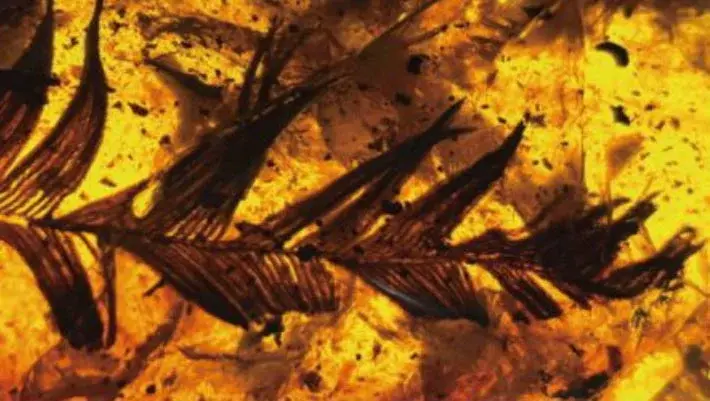
A 99-million-year-old feather preserved in Burmese amber offers the first 3D evidence that modern flight feathers evolved in distinct steps. The specimen, cataloged as ECNU A0033, resembles modern flight feathers in shape but lacks internal structures needed for aerodynamic efficiency, suggesting appearance preceded function.
Key points
- The specimen ECNU A0033, found in Cretaceous amber from Myanmar, is the longest 3D-preserved pennaceous feather ever described, measuring approximately 105 mm with an estimated total length exceeding 140 mm.
- While the feather has symmetrical vanes similar to modern flight feathers, it lacks hooklets on barbules and has an incomplete, open central shaft, indicating limited aerodynamic capability.
- Computer simulations show the feather’s open construction made it more flexible than modern solid-shaft feathers, challenging the assumption that symmetrical shape equals flight adaptation.
- The findings suggest feather evolution was modular: elongation and vane development occurred before the interlocking structures and tissue differentiation required for effective flight.
- The feather’s dark pigmentation aligns with previous evidence that muted hues were common among feathered dinosaurs, though the specific animal it belonged to remains unidentified.
Background
This discovery complements earlier findings on convergent flight evolution, such as the 2026 description of the four-winged microraptorine Norellraptor barsboldi, which showed birds and non-avian dinosaurs developed flight adaptations independently. While that study focused on skeletal anatomy, this amber specimen provides direct evidence of integumentary evolution, highlighting how soft tissue structures like feathers developed in a stepwise manner rather than as a single complex innovation.
Why it matters
This fossil provides direct physical evidence that the evolution of flight feathers was not a single leap but a gradual process where external shape advanced before internal mechanical strength. It refines our understanding of the theropod-bird transition by showing that an animal could possess a feather that looked like a modern flight feather without having the aerodynamic capabilities to fly, decoupling morphology from function in evolutionary timelines.
What to watch
Researchers will continue analyzing the melanosomes and structural details of ECNU A0033 to further refine models of feather evolution. Future studies may seek similar amber-preserved specimens to test whether other feather types followed similar modular evolutionary paths, potentially revealing more about the timeline of aerodynamic capability in early birds.
Want the full story? Read the original reporting
Read on Sci.News