
Archival X-ray data reveals 84 hidden cosmic objects that may solve astrophysics puzzles
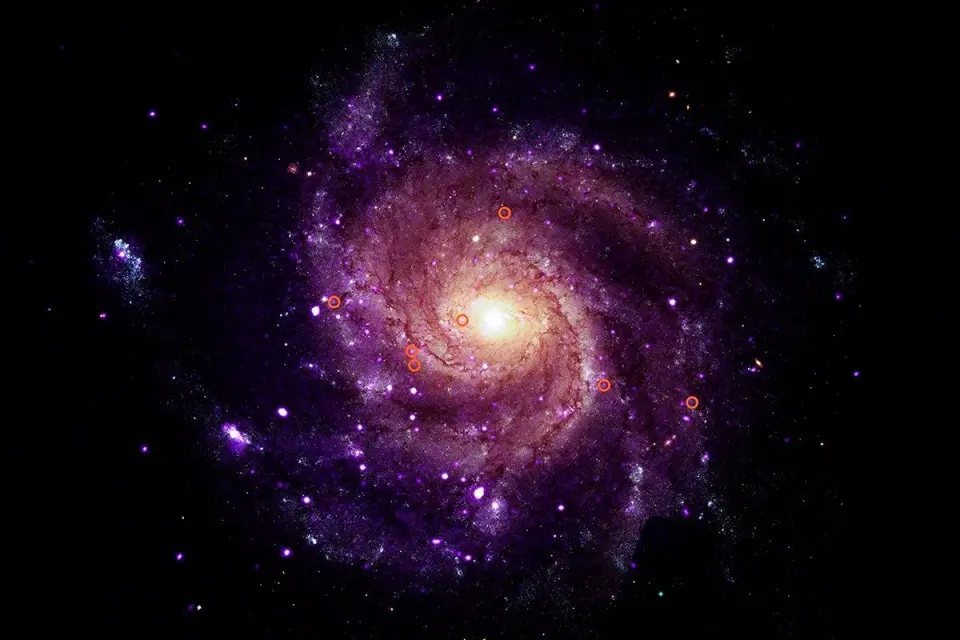
Astronomers have identified 84 new 'hypersoft X-ray sources' in six galaxies by analyzing archival data from NASA’s Chandra X-ray Observatory. These objects emit low-energy X-rays and intense ultraviolet radiation, behaving unlike any previously catalogued class. Their discovery could help resolve two major mysteries: the trigger mechanism for Type Ia supernovae and the source of radiation that ionizes diffuse galactic gas. The findings suggest that re-examining existing data can yield significant scientific breakthroughs without new telescope missions.
Key points
- Researchers found 84 hypersoft X-ray sources in six galaxies, including Andromeda and the Pinwheel galaxy, using Chandra data from 1999 to 2017.
- These objects emit unusually low-energy X-rays and high levels of ultraviolet radiation, appearing only in images taken at the lowest energy levels.
- The sources are believed to be binary systems where a compact object, such as a white dwarf or black hole, pulls material from a companion star, heating it to produce radiation.
- The discovery may explain the uncertain triggers for Type Ia supernovae, which are critical for measuring the universe's expansion.
- The intense ultraviolet output of these objects may account for the radiation that strips electrons from diffuse gas, influencing star formation in galaxies.
- Low-energy X-rays and ultraviolet radiation are typically hard to detect or are absorbed by interstellar hydrogen and helium, which is why these objects remained hidden until now.
Background
This discovery builds on recent efforts to maximize the value of existing astronomical archives. While new telescopes are being developed, researchers are increasingly finding that advanced data analysis techniques can uncover hidden phenomena in older datasets. This approach mirrors other recent scientific advancements, such as using X-ray imaging to read burnt scrolls without unrolling them, demonstrating that re-examining existing data can yield significant new insights without requiring new hardware.
Why it matters
Identifying these objects could provide a method to predict Type Ia supernovae, improving the accuracy of measurements for the universe's expansion rate. Additionally, understanding the source of ionizing radiation in galaxies helps explain how star formation is regulated. The finding also highlights the ongoing value of archival data in astronomy, suggesting that future discoveries may emerge from re-analyzing existing datasets rather than solely relying on new instruments.
What to watch
The research team plans to identify more hypersoft X-ray sources and determine the specific mechanisms powering them. Further analysis will aim to confirm whether these objects are indeed precursors to Type Ia supernovae and to quantify their contribution to the ionization of galactic gas.
Want the full story? Read the original reporting
Read on BBC Sky at Night Magazine