
Century-old fossil reveals 'unconquered' dinosaur cousin of T. rex
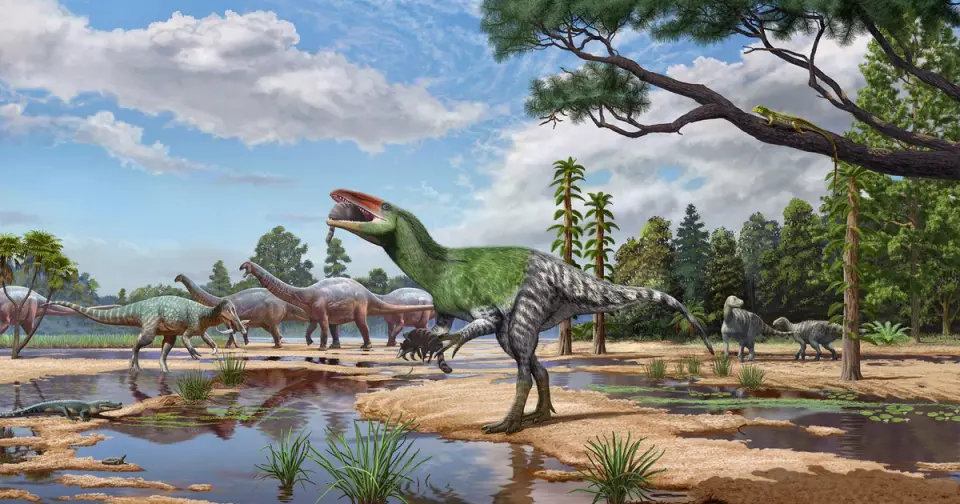
A fossil discovered in 1924 and stored in a London museum drawer for nearly a century has been identified as a new species of dinosaur named Invictibellatrix amberina. This Early Cretaceous predator, a relative of Tyrannosaurus rex, hunted with claws rather than jaws.
Key points
- The species, Invictibellatrix amberina, is a megaraptoran dinosaur that lived approximately 120 million years ago.
- The fossil, a fragment of a skull, was found on the Isle of Wight by amateur paleontologist Reginald Walter Tooley and acquired by the Natural History Museum in 1924.
- Researchers used CT scanning and 3D modeling to identify unique anatomical features, confirming it as a new species.
- The dinosaur is estimated to have been 10 to 16 feet long, with long arms and large curved claws used for hunting.
- It is the first megaraptoran fossil discovered in Europe, providing crucial data on the group's global distribution.
Background
Recent studies have redefined our understanding of Tyrannosaurus rex, confirming it was warm-blooded and likely hunted via ambush rather than high-speed chases. In contrast, the newly identified Invictibellatrix represents a different evolutionary strategy within the theropod family, relying on agility and claws rather than massive bite force. This discovery adds to a growing body of evidence that challenges previous assumptions about predator-prey dynamics in the Cretaceous period.
How outlets are covering it
While all three outlets agree on the basic identification, they differ in emphasis. CBS News highlights the dramatic potential of the dinosaur as a threat to humans, quoting lead author Dr. Cassius Morrison that humans would have been 'perfectly sized prey' for Invictibellatrix, unlike T. rex which would have ignored them. NBC News focuses on the scientific significance of the find, noting it is the first megaraptoran known from Europe and helps resolve debates about the group's evolutionary origins. BBC News provides additional ecological context, comparing the dinosaur's role in the food chain to that of a modern hyena and noting that its claws may have been 10 to 20 cm long. There is a slight discrepancy in size estimates: CBS and BBC cite 10-13 feet, while NBC estimates 16 feet based on related species.
Why it matters
This discovery demonstrates the value of historical museum collections, as many fossils remain unexamined for decades. It also fills a significant gap in the fossil record for megaraptorans in Europe, supporting the hypothesis that these dinosaurs originated in Asia and migrated across continents. The finding underscores that even well-known fossil sites like the Isle of Wight continue to yield new species after over 200 years of collecting.
What to watch
Researchers plan to use mathematical modeling to further investigate how megaraptorans spread globally and why they may have died out in northern regions. The study also suggests that many other fossils in museum drawers may yet to be identified, potentially leading to more new species discoveries in the future.
- New dinosaur species, a T. rex cousin that "would have chased us," identified from fossil found 100 years ago CBS News
- Isle of Wight fossil identified as new dinosaur species BBC
- Isle of Wight fossil Europe's first known long-clawed megaraptoran dinosaur Phys.org
- UK dinosaur fossil identified as new long-clawed predator Natural History Museum
- Fossil kept in drawer for a century sheds light on enigmatic meat-eating dinosaurs NBC News
Want the full story? Read the original reporting
Read on CBS News