
Chinese Space Station Sets New Record for Lowest Temperature at 9.7 Picokelvins
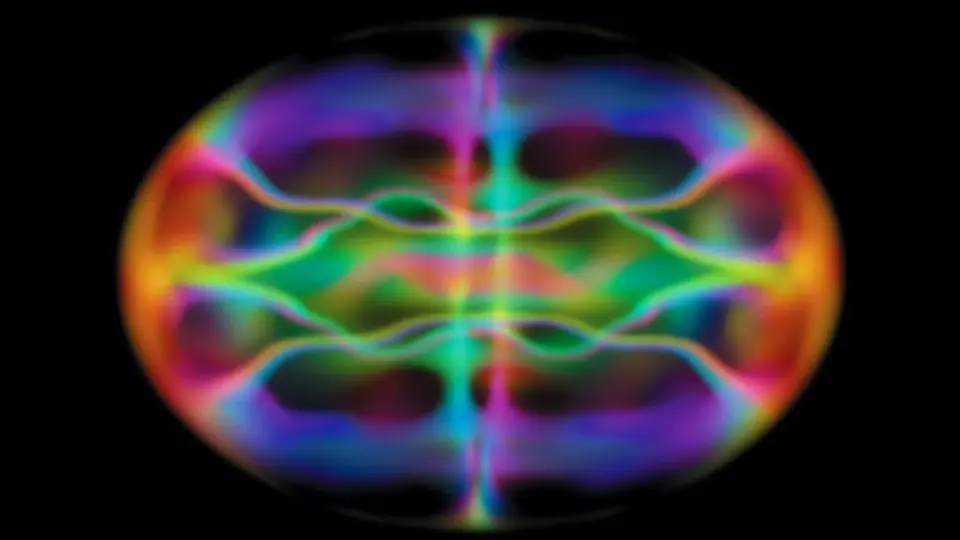
Physicists aboard China’s Tiangong space station achieved an equivalent temperature of 9.7 picokelvins, shattering the previous record by a factor of four. By utilizing microgravity to cool rubidium atoms into a Bose-Einstein condensate, the team created a quantum state that remained observable for seven seconds. This breakthrough enables more precise measurements of fundamental physics, such as the equivalence principle, by allowing scientists to study atomic behavior over longer durations than previously possible in orbit or on Earth.
Key points
- Researchers achieved 9.7 picokelvins, roughly 280 billion times colder than the cosmic background temperature of 2.7 kelvins.
- The experiment utilized approximately 20,000 rubidium-87 atoms cooled via lasers and evaporative cooling in a microgravity environment.
- The team overcame the lack of gravity in orbit by applying a magnetic field gradient to assist in removing energetic atoms during the cooling process.
- The resulting atomic cloud expanded slowly enough to be tracked for seven seconds, significantly longer than the one to two seconds typical in previous experiments.
- This extended observation window allows for more sensitive atom interferometry, potentially testing general relativity and the equivalence principle with greater precision.
Background
The pursuit of absolute zero has a long history, beginning with the first Bose-Einstein condensate created in 1995. Previous milestones include a 2018 experiment on the International Space Station and a 2021 record of 38 picokelvins achieved in Germany’s Bremen Drop Tower. While absolute zero is physically unreachable, these experiments push the limits of quantum mechanics, allowing scientists to observe matter behaving as a single quantum wave. Recent advancements in space-based cold atom physics aim to leverage the unique conditions of orbit to surpass ground-based limitations imposed by gravity.
How outlets are covering it
ScienceAlert emphasizes the magnitude of the achievement, noting the new temperature is 280 billion times colder than the universe’s background radiation. Interesting Engineering highlights the technical challenge of recreating gravity’s effects in orbit using magnetic gradients to facilitate evaporative cooling. New Atlas focuses on the practical implications of the extended observation window, noting that the slower expansion of the atomic cloud allows for more sensitive interferometry tests of fundamental physics principles. All sources agree that the experiment represents a significant leap in precision metrology and quantum simulation capabilities.
Why it matters
This record-breaking temperature enables the development of highly sensitive atom interferometers in space. These instruments can test the equivalence principle and probe exotic states of matter with unprecedented accuracy. The ability to observe quantum gases for longer periods in microgravity opens new avenues for quantum simulation and precision measurement, potentially leading to breakthroughs in our understanding of gravity and fundamental physical laws.
What to watch
Researchers plan to use this all-optical ultracold platform for future space missions to conduct quantum simulations and precision metrology. The extended observation window may allow for the construction of space-based atom Mach-Zehnder interferometers to test general relativity. Future experiments may also explore how quantum order decays in confined gases or how atoms organize in disordered environments, leveraging the unique capabilities of orbital microgravity.
- Scientists Reach a Record Temperature: 280 Billion Times Colder Than The Universe ScienceAlert
- Scientists achieve record-breaking low temperature on China's space station, paving the way for new physics experiments Phys.org
- China space experiment creates coldest temperature ever Science | AAAS
- China space station sets new record, cools atoms to 9.7 picokelvin, could help new experiments Interesting Engineering
- Space experiment shatters record for lowest temperature New Atlas
Want the full story? Read the original reporting
Read on ScienceAlert