Tag

Bose Einstein Condensate

All articles tagged with #bose einstein condensate

NASA's fridge-sized quantum lab on the ISS expands ultracold-atom research in orbit
space3 hours ago

NASA's fridge-sized quantum lab on the ISS expands ultracold-atom research in orbit

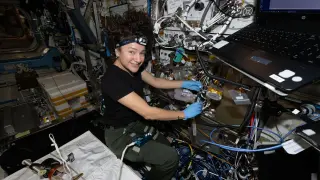
A refurbished upgrade to NASA's Cold Atom Laboratory aboard the International Space Station—about the size of a mini-fridge—lets scientists study ultracold atoms and Bose-Einstein condensates in microgravity, enabling longer observation of quantum behaviors and paving the way for future space-based quantum technologies in timing, navigation, and gravity sensing.

Entropy-Clock: Time Emerges from a Lab-Ccreated Mini‑Universe
science3 days ago

Entropy-Clock: Time Emerges from a Lab-Ccreated Mini‑Universe

A University of Birmingham team used a Bose‑Einstein condensate split into two halves to emulate a universe with no external clock. By letting entropy flow between the halves, they defined an internal clock—entropic time—that ordered events in the bright sector and could run faster, slower, or stop altogether as entropy exchange varied. The researchers also derived a Schrödinger equation using this internal time, supporting the idea that time and its arrow may emerge from internal relations and observer ignorance rather than an external time parameter.

Time blooms from inside a tiny quantum universe
science3 days ago

Time blooms from inside a tiny quantum universe

A Birmingham physicist created a nearly isolated Bose-Einstein condensate of ultracold rubidium atoms, split it into two halves, and showed that time can emerge from entropy exchange within the system—the entropic time—acting as an internal clock that speeds up, slows down, or stops as the halves exchange or cease entropy. The experiment, tied to ideas in quantum cosmology and the Wheeler–DeWitt equation, provides the first lab-based demonstration that relational time can arise from within a closed quantum system and even reproduces a Schrödinger-like description using this internal time.

NASA Extends Quantum Frontier: Bose-Einstein Condensates in Orbit
space-and-spaceflight10 days ago

NASA Extends Quantum Frontier: Bose-Einstein Condensates in Orbit

NASA has upgraded its Cold Atom Lab on the International Space Station to further study Bose-Einstein condensates in microgravity, enabling larger quantum states to be probed for longer times and advancing quantum technologies by leveraging ultracold atoms to measure time, gravity, and motion with unparalleled precision.

Time Emerges from Entropy: Lab Mini-Universe Redefines Temporal Reality
science21 days ago

Time Emerges from Entropy: Lab Mini-Universe Redefines Temporal Reality

Physicist Giovanni Barontini built a lab-sized ‘mini-universe’ by cooling ~24,000 rubidium atoms into a Bose-Einstein condensate and trapping them in a two-region optical setup. The atoms’ movement between a bright (observed) and a dark (unobserved) sector creates entropy exchange that defines an internal, emergent time—time that flows due to entropy rather than an external clock—offering experimental insight into time in quantum gravity and cyclic cosmology.

Neutrino laser concept aims to harness ghost particles
science2 months ago

Neutrino laser concept aims to harness ghost particles

US researchers propose a 'neutrino laser'—a compact device that could emit coherent bursts of neutrinos by cooling radioactive atoms into a Bose-Einstein condensate and triggering synchronized decay via superradiance. If realized, it could transform neutrino research and enable new applications from underground communication to medical imaging, but the concept is still theoretical and faces significant technical hurdles.

Scientists Discover Fifth State of Matter with Bose-Einstein Condensate
science6 months ago

Scientists Discover Fifth State of Matter with Bose-Einstein Condensate

Scientists at Columbia University have successfully created a Bose-Einstein condensate from sodium-cesium molecules at ultra-cold temperatures using innovative microwave shielding techniques, marking a significant advancement in quantum physics and opening new avenues for research into quantum states and materials.

Scientists Achieve Breakthrough in Fifth State of Matter
science6 months ago

Scientists Achieve Breakthrough in Fifth State of Matter

Scientists at Columbia University have created a molecular sodium-cesium Bose-Einstein condensate (BEC) that is dipolar and lasts for two seconds, opening new possibilities for exploring exotic states of matter and quantum physics applications. This breakthrough was achieved using microwave fields to control interactions at ultracold temperatures near absolute zero, potentially leading to advances in quantum chemistry and the study of novel quantum phases.

MIT Physicists Propose First-Ever Neutrino Laser for Ghost Particle Research
science10 months ago

MIT Physicists Propose First-Ever Neutrino Laser for Ghost Particle Research

MIT physicists propose a novel concept for a 'neutrino laser' that uses super-cooled radioactive atoms in a Bose-Einstein condensate to produce a coherent, amplified burst of neutrinos, potentially revolutionizing communication and medical technology. They plan to test this idea with tabletop experiments, aiming to harness superradiance to accelerate neutrino production.

"Quantum Breakthrough Achieved in Fifth State of Matter"
science-and-technology2 years ago

"Quantum Breakthrough Achieved in Fifth State of Matter"

Scientists from Columbia University have created a dipolar Bose-Einstein condensate (BEC) using molecular sodium-cesium, which lasts for two seconds and is only five nanoKelvin above absolute zero. This breakthrough, achieved with the help of two microwave fields, opens the door to numerous applications in exotic matter and quantum chemistry, marking a significant advancement in the study of quantum physics.

Coldest US Lab Achieves Exotic Quantum State with Molecules
science-and-technology2 years ago

Coldest US Lab Achieves Exotic Quantum State with Molecules

Researchers at Columbia University have created a Bose-Einstein Condensate (BEC) using sodium-cesium molecules cooled to five nanoKelvin, stable for two seconds. This breakthrough opens new avenues for exploring quantum phenomena and simulating complex materials' quantum properties, marking a significant advancement in quantum physics and ultracold molecule research.