
Earth's Core: A Sun-Temp Solid Iron Ball Forged by Crushing Pressure
TL;DR
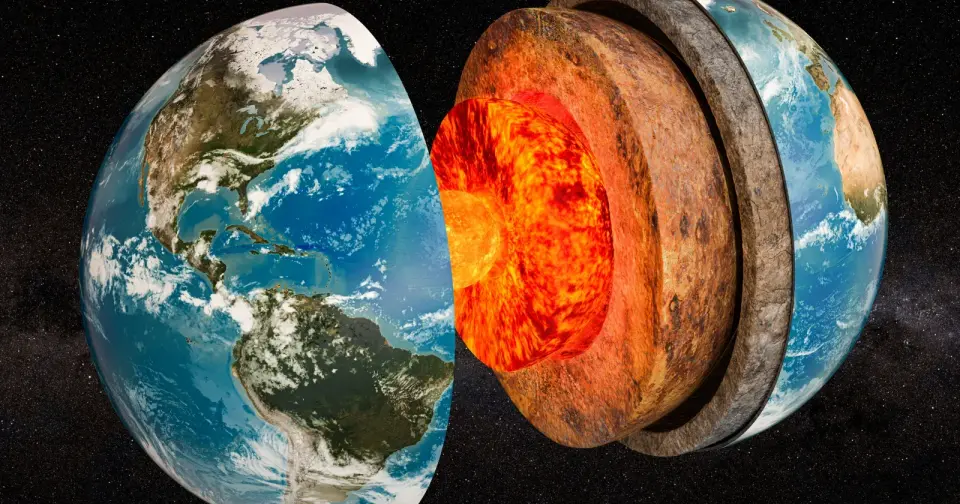
Earth’s inner core is a solid iron-rich sphere kept solid not by coolness but by the planet’s crushing pressure, which raises iron’s melting point above the extreme temperatures at the boundary; seismic data and high-pressure experiments place the inner-core boundary at about 5,150 km deep with temperatures roughly in the thousands of kelvin (about 5,400–6,230 K), similar to the Sun’s surface in scale, while the outer core remains liquid. The core is likely an iron-nickel alloy with lighter elements, and the evidence comes from seismology, PREM models, and laboratory experiments rather than any core samples.
- Earth’s inner core is an iron-rich ball as hot as the surface of the Sun, kept solid only because the crushing pressure of the entire planet raises the temperature at which iron can melt Space Daily
- Earth’s inner core is not rock but a sphere of solid iron-rich metal, smaller than the Moon yet probably more massive. As the planet gradually loses heat, liquid metal freezes onto its surface, expanding it by roughly a millimetre each year. Space Daily
- Academia Sinica - Research Findings | Earth’s mantle locally heats up our planet’s core sinica.edu.tw
Want the full story? Read the original reporting
Read on Space Daily