Tag

Inner Core

All articles tagged with #inner core

Mysterious Core Reversal: Eastward Flow Detected Beneath the Pacific
science18 days ago

Mysterious Core Reversal: Eastward Flow Detected Beneath the Pacific

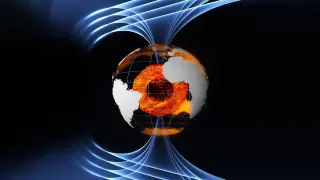
Researchers using ESA Swarm and CryoSat data have traced a dramatic shift in a broad region of molten iron beneath the equatorial Pacific from westward to eastward flow around 2010, challenging the view of a stable outer-core circulation and potentially linking to inner-core changes; the eastward flow has weakened since 2020, and scientists will monitor to determine if this is a temporary fluctuation, part of a cycle, or a new long-term state, with implications for Earth's magnetic field generation (the geodynamo).

Earth's Inner Core May Be Dominated by Superionic Hydrogen
science23 days ago

Earth's Inner Core May Be Dominated by Superionic Hydrogen

New modeling suggests the inner core could host abundant superionic hydrogen—hydrogen that flows like a liquid and conducts electricity—with the hexagonal close-packed (HCP) phase likely more stable than body-centered cubic (BCC) under core conditions. Partitioning of hydrogen is driven mainly by temperature rather than pressure, creating a radial gradient that concentrates hydrogen toward the inner-core boundary where it re-partitions into a liquid that enriches the outer core. This ongoing exchange, plus inner-core growth, could provide chemical buoyancy to power the geodynamo, while other light elements like oxygen and carbon likely further shape the core's composition and evolution.

Earth's Inner Core May Run on Superionic Hydrogen, Study Finds
science23 days ago

Earth's Inner Core May Run on Superionic Hydrogen, Study Finds

New modeling suggests Earth's inner core contains abundant superionic hydrogen, predominantly in a stable hexagonal close-packed iron-hydrogen phase, with a less stable BCC form only under extreme conditions before melting. A radial hydrogen gradient drives ongoing exchange between the inner and outer core, contributing chemical buoyancy that powers the geodynamo, and the inner core is growing at about 1 millimeter per year; future work will consider other light elements like oxygen and carbon to refine core composition and evolution.

Earth's Core: A Sun-Temp Solid Iron Ball Forged by Crushing Pressure
science1 month ago

Earth's Core: A Sun-Temp Solid Iron Ball Forged by Crushing Pressure

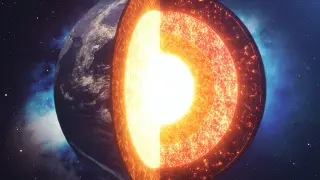
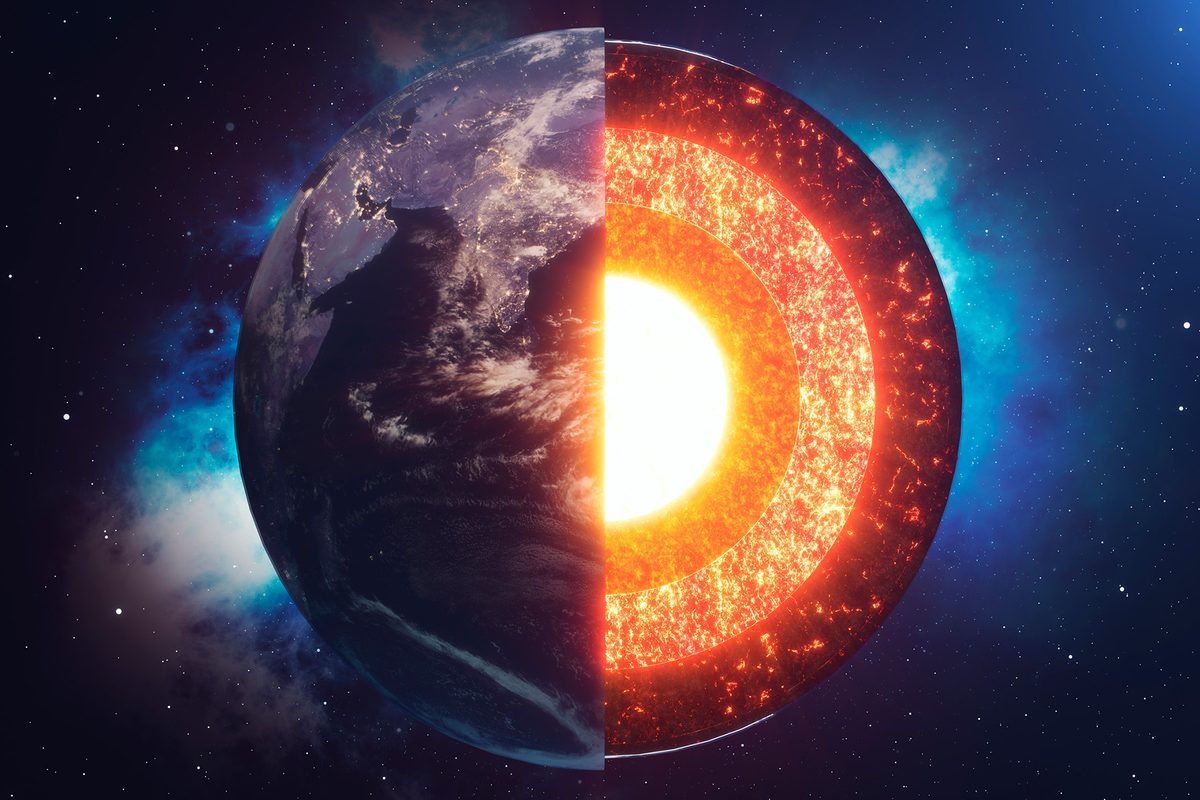
Earth’s inner core is a solid iron-rich sphere kept solid not by coolness but by the planet’s crushing pressure, which raises iron’s melting point above the extreme temperatures at the boundary; seismic data and high-pressure experiments place the inner-core boundary at about 5,150 km deep with temperatures roughly in the thousands of kelvin (about 5,400–6,230 K), similar to the Sun’s surface in scale, while the outer core remains liquid. The core is likely an iron-nickel alloy with lighter elements, and the evidence comes from seismology, PREM models, and laboratory experiments rather than any core samples.

Earth's Solid Iron Heart Expands Quietly as the Planet Cools
science1 month ago

Earth's Solid Iron Heart Expands Quietly as the Planet Cools

Earth’s center is a solid iron-rich inner core, smaller in radius than the Moon but likely more massive; as the planet loses heat, liquid iron crystallizes at the inner-core boundary and adds to the core by about a millimeter per year, a slow growth that helps drive convection in the liquid outer core and fuels Earth’s magnetic field. The inner core’s exact composition, age, and growth rate are still debated and inferred from seismic data and high-pressure experiments rather than direct samples.

Earth’s inner core slows and drifts backward in a 70-year seismic rhythm
science1 month ago

Earth’s inner core slows and drifts backward in a 70-year seismic rhythm

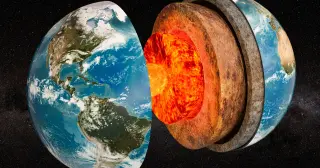
Seismic data indicate Earth's solid inner core, long spinning slightly faster than the surface, slowed to match the surface around 2009–2010 and has since fallen behind, effectively drifting backward relative to the rest of the planet. The motion is a relative one (to the mantle) and likely part of a ~70-year oscillation that also influences length of day and the magnetic field; the evidence is indirect and debated, with ongoing work to confirm the oscillation model over the coming decade.