Tag

High Pressure

All articles tagged with #high pressure

Lab Replays Neptune’s Diamond Rain to Sharpen Fusion Power Prospects
science4 days ago

Lab Replays Neptune’s Diamond Rain to Sharpen Fusion Power Prospects

Lawrence Livermore researchers used laser-driven shocks on tiny diamond samples to reproduce the extreme pressures and temperatures found deep in Neptune and Uranus, melting diamond while recording its atomic structure, temperature, density and reflectivity. The work suggests slower initial shocks could improve fuel compressibility and boost energy yield in inertial confinement fusion, offering new atomic-scale benchmarks for modeling ice-giant atmospheres and guiding fusion experiments.

Diamond Melts into Metallic Liquid Carbon at Sun-Heat Temperatures Under Planetary Pressures
science7 days ago

Diamond Melts into Metallic Liquid Carbon at Sun-Heat Temperatures Under Planetary Pressures

Scientists at LLNL’s Omega laser facility squeezed synthetic diamonds to about one terapascal and temperatures around 7,300 kelvin, watching the crystal lattice vanish as the diamond melted into a dense, metallic liquid carbon with no intermediate phase. The result pins the melting temperature at ~7,300 K at 1 TPa, resolving a roughly 20-year discrepancy with simulations and confirming diamond’s melt into an electrically conducting carbon fluid under extreme conditions.

Diamond melts under extreme pressure, defying expected phase changes
science11 days ago

Diamond melts under extreme pressure, defying expected phase changes

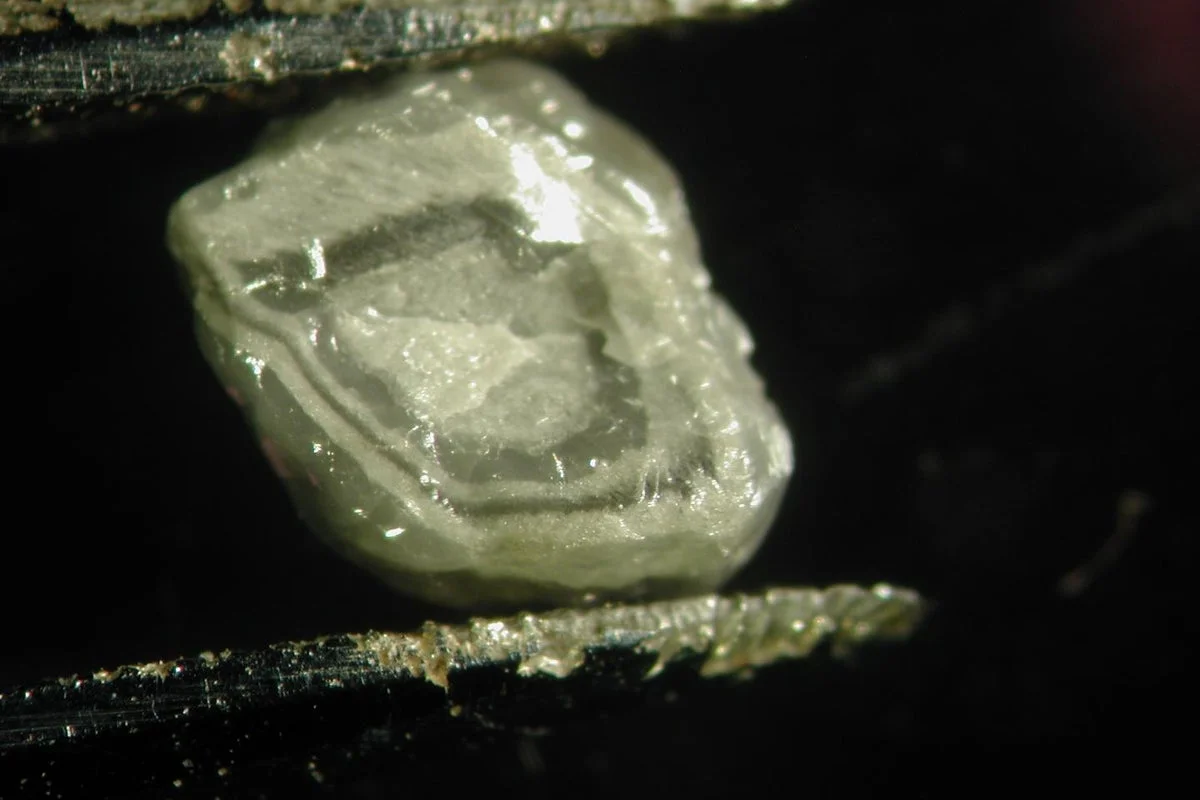
Scientists used the OMEGA laser to shock tiny diamond samples to 0.6–1.8 terapascals, heating them to about 7,300 kelvin. They observed diamond melting directly into liquid carbon without forming the predicted BC8 phase, with the crystal lattice persisting until melting and a surprising density reversal where solid diamond becomes less dense than its liquid. The findings resolve earlier temperature discrepancies, align with theory, and have implications for inertial confinement fusion models and the study of planetary interiors.

Pressure Unveils 2D Van der Waals Heavy-Fermion Superconductivity in CeSiI
science27 days ago

Pressure Unveils 2D Van der Waals Heavy-Fermion Superconductivity in CeSiI

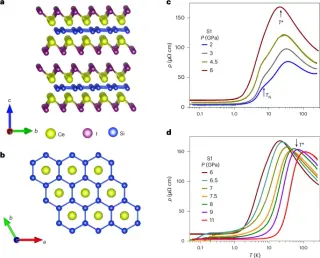
A study on CeSiI, a two‑dimensional van der Waals heavy‑fermion metal, maps its temperature–pressure phase diagram: the Kondo coherence temperature T* drops non‑monotonically with pressure to form a V shape, while antiferromagnetic order is suppressed and a superconducting dome with Tc ≈ 240 mK emerges. The superconductivity sits near magnetic instability and features a large upper critical field, suggesting unconventional pairing. Normal-state transport shows non‑Fermi‑liquid behavior and a diverging effective mass near a quantum critical point, positioning CeSiI as a platform to explore the interplay of strong correlations, Kondo hybridization, magnetism, and unconventional superconductivity in a quasi‑2D system.

Earth's Core: A Sun-Temp Solid Iron Ball Forged by Crushing Pressure
science1 month ago

Earth's Core: A Sun-Temp Solid Iron Ball Forged by Crushing Pressure

Earth’s inner core is a solid iron-rich sphere kept solid not by coolness but by the planet’s crushing pressure, which raises iron’s melting point above the extreme temperatures at the boundary; seismic data and high-pressure experiments place the inner-core boundary at about 5,150 km deep with temperatures roughly in the thousands of kelvin (about 5,400–6,230 K), similar to the Sun’s surface in scale, while the outer core remains liquid. The core is likely an iron-nickel alloy with lighter elements, and the evidence comes from seismology, PREM models, and laboratory experiments rather than any core samples.

Gold Reveals Hidden Reactivity Under Extreme Pressure
science4 months ago

Gold Reveals Hidden Reactivity Under Extreme Pressure

In a high‑pressure lab, researchers formed gold hydride by compressing hydrogen with thin gold foil inside a diamond‑anvil cell and heating with X‑ray pulses, creating the first solid compound made of gold and hydrogen in the lab. The result challenges gold’s reputation as inert, shows how extreme conditions can trigger new chemistry, and provides a model system for studying dense hydrogen relevant to planetary interiors and fusion research.

Lab-made hexagonal diamond edges past regular diamond in hardness
science5 months ago

Lab-made hexagonal diamond edges past regular diamond in hardness

Chinese researchers report synthesizing millimetre-sized bulk hexagonal diamond from oriented graphite under about 20 GPa and 1,300–1,900°C, with diffraction confirming a pure hexagonal carbon phase. They measured a hardness around 114 GPa, slightly higher than typical natural cubic diamond (~110 GPa), and highlight high thermal stability, addressing long-standing debate over hexagonal diamond and suggesting potential for advanced technological uses.

Lab-Forge Confirms Hexagonal Diamond, Ending a Half-Century Controversy
physics-and-chemistry5 months ago

Lab-Forge Confirms Hexagonal Diamond, Ending a Half-Century Controversy

Chinese researchers report the synthesis of a millimeter-sized, phase-pure hexagonal diamond by compressing graphite at 20 GPa and temperatures up to 1,900°C, with X-ray and atomic-scale imaging confirming a hexagonal crystal structure; the diamond is slightly harder and more oxidation-resistant than cubic diamonds, suggesting the long-sought material exists and could have practical uses, though the hardness gain is not the often-cited 50%.

Strongest evidence yet that hexagonal diamond is real and potentially harder than cubic diamond
science5 months ago

Strongest evidence yet that hexagonal diamond is real and potentially harder than cubic diamond

Chinese researchers report millimeter-sized samples of hexagonal diamond (lonsdaleite) produced by compressing graphite at ~20 GPa and 1300–1900 °C, with X-ray diffraction peaks that conclusively confirm the hexagonal structure; tests show the material is stiffer, more oxidation resistant, and slightly harder than conventional cubic diamond, marking the strongest evidence to date in decades-long debates and offering potential uses in tools, thermal management, and quantum sensing.

Gold Becomes Reactive Under Megabar Pressures, Forms Stable Hydride
science6 months ago

Gold Becomes Reactive Under Megabar Pressures, Forms Stable Hydride

Researchers compressed gold in a hydrogen-rich environment to megabar pressures (>110 GPa) using a diamond anvil cell and, with ultrafast diffraction from the European XFEL, observed hydrogen incorporation into gold to form a stable gold hydride. The result shows gold’s noble behavior can break down under extreme planetary-core-like conditions, potentially altering models of gas giant interiors and suggesting new metallic hydride materials. The hydride persists only under high pressure; releasing pressure causes hydrogen to escape and gold to revert to its original state.

Gold Breaks Its Inert Label: A Gold-Hydrogen Compound Forms Under Planetary-Core Pressures
science7 months ago

Gold Breaks Its Inert Label: A Gold-Hydrogen Compound Forms Under Planetary-Core Pressures

Under pressures above ~40 GPa and temperatures above ~2,200 K, gold forms a solid gold hydride (Au2Hx) with hydrogen diffusing freely in a hexagonal gold lattice in a superionic state. The compound is reversible, reverting to metallic gold when cooled to ambient conditions, and represents the first confirmed binary solid of gold and hydrogen. This discovery challenges gold’s reputation as chemically inert, with implications for high‑pressure physics, planetary interior modeling, and fusion diagnostics, and was observed using a diamond anvil cell and an X-ray free-electron laser.