
New Metamaterials Mimic Biological Networks to Achieve Tunable Strength and Impact Resistance
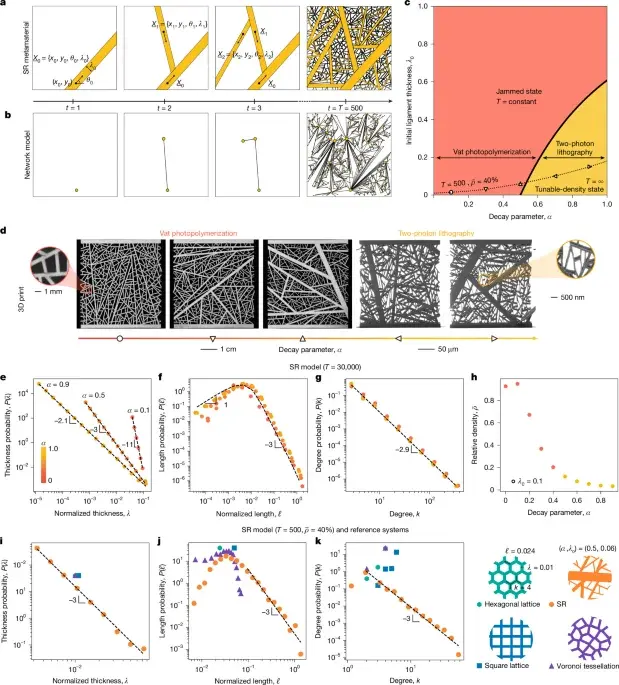
Researchers have introduced 'scale-rich' metamaterials that break the traditional single-scale design limit by embedding broad structural heterogeneity into mechanical materials. Governed by only two parameters, these materials span orders of magnitude in ligament length, thickness, and connectivity, similar to biological systems like dragonfly wings or spider webs. This design allows for highly tunable elastic anisotropy, delocalized deformation, and superior energy absorption under dynamic impact, outperforming traditional single-scale lattices in stability and resilience.
Key points
- Scale-rich networks use a two-parameter model to generate structures with power-law distributions in length, thickness, and connectivity, unlike homogeneous unit cells.
- Experimental results show these materials avoid catastrophic failure modes like compaction bands seen in square or hexagonal lattices, leading to more stable load-bearing.
- Under dynamic impact, scale-rich materials achieve the highest specific energy dissipation while minimizing peak force compared to reference architectures.
- The framework enables programmable elastic-wave control, allowing for the creation of acoustic lenses with a wide range of effective refractive indices.
- The design can be extended to three dimensions and used to protect fragile payloads by diverting stress pathways, reducing internal stress by up to 4.9 times compared to standard lattices.
Background
This development builds on previous research into architected materials, which typically rely on uniform unit cells or narrow distributions of features. While earlier studies, such as those on salt marsh platforms, highlighted the importance of structural stability under extreme conditions, this new work focuses on engineered microstructures. It contrasts with the homogeneity of crystalline solids and traditional metamaterials, drawing instead from network science principles observed in biological and social systems to create materials with multifunctional, scale-dependent properties.
Why it matters
This research provides a universal framework for engineering multifunctional materials that can adapt to complex loading conditions. By moving beyond single-scale constraints, these materials offer significant improvements in protective gear, packaging, and adaptive load-bearing structures. The ability to tune anisotropy and energy absorption through simple parameters could lead to more efficient and resilient infrastructure, as well as new applications in acoustic and elastic wave control, such as subwavelength imaging and energy harvesting.
What to watch
Researchers plan to extend the scale-rich framework to three-dimensional structures using plates and beams, which are expected to exhibit similar anisotropy trends and power-law distributions. Further studies will explore the use of these materials in network science, where physical link lengths and thicknesses introduce new phenomena not present in abstract network models. Additionally, the team aims to optimize the 'checkerboarding' approach to further minimize deformation localization and enhance material robustness.
Want the full story? Read the original reporting
Read on Nature