
New Simulations Suggest Comets Failed to Deliver Life's Building Blocks to Earth
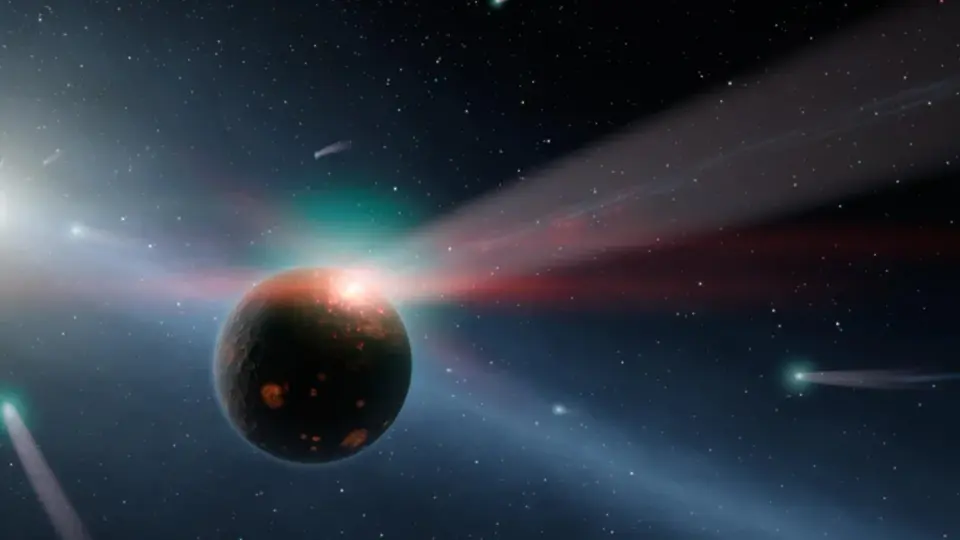
A new study published in Scientific Reports challenges the long-held theory that comets delivered the organic molecules necessary for life on Earth. Led by Richard Anslow of the University of Cambridge, researchers ran 100,000 simulations focusing on hydrogen cyanide (HCN), a key prebiotic feedstock found in comets. The results indicate that cometary impacts were too fast and steep, causing HCN to vaporize upon entry. While comets carry these molecules, the study suggests they could not deliver them in sufficient quantities to seed life, pointing instead to endogenous synthesis or asteroid delivery as more likely sources.
Key points
- Researchers at the University of Cambridge published a study in Scientific Reports analyzing the viability of cometary delivery of prebiotic molecules to Earth.
- The study focused on hydrogen cyanide (HCN), identified as the only feedstock molecule found in sufficient abundance in solar system comets to be prebiotically relevant.
- Simulations revealed that 54% of comet impacts failed to deliver any significant amount of HCN due to atmospheric destruction, impact heat, or dilution in oceans.
- Even in the 46% of cases where HCN survived, the quantities were insufficient to support prebiotic chemistry, described by lead author Richard Anslow as a 'one-in-a-million' occurrence.
- The research suggests that endogenous synthesis within Earth's atmosphere or delivery via asteroids may be more plausible sources for life's building blocks than comets.
- Mars is identified as a more favorable target for cometary delivery due to its thinner atmosphere and lower impact velocities, though the researchers caution this remains unlikely.
Background
The hypothesis that comets seeded Earth with life's ingredients has been a prominent theory for over a century, supported by findings from missions like ESA's Rosetta, which detected glycine and phosphorus on comet 67P/Churyumov-Gerasimenko. Recent coverage of meteor showers, such as the Orionids linked to Halley's Comet, highlights the ongoing interest in cometary debris, but this new study shifts the focus to the survivability of organic molecules during impact rather than their presence in space.
How outlets are covering it
Gizmodo emphasizes the 'romantic' nature of the cometary delivery theory, quoting Anslow's description of comets as a 'get out of jail free card' for life's origins. ScienceAlert provides specific statistical data from the simulations, noting that 54% of scenarios resulted in zero successful delivery, while 46% offered only fleeting opportunities. Universe Today highlights the technical reasons for failure, including the rapid decline of cometary bombardment after Earth's first 500 million years and the destruction of small comets by tidal forces. Mashable contextualizes the findings within the broader debate, noting that while comets carry HCN, asteroids or endogenous processes may be more likely sources, and mentions that previous studies overestimated HCN survivability. All sources agree that the cometary delivery hypothesis is significantly weakened by the new data, though they differ in emphasis on the specific mechanisms of failure, such as atmospheric filtering versus impact velocity.
Why it matters
This study refines our understanding of the origin of life by challenging a widely accepted hypothesis. It suggests that the chemical precursors for life may have been synthesized on Earth or delivered by asteroids rather than comets, influencing future research directions in astrobiology and the search for extraterrestrial life, particularly on Mars where conditions might have been more favorable for cometary delivery.
What to watch
Researchers will likely continue to investigate alternative sources for prebiotic molecules, such as asteroid impacts and endogenous atmospheric synthesis. Further studies may explore the specific conditions under which HCN could survive impact, potentially focusing on different planetary environments or time periods in Earth's history. The findings may also influence the design of future space missions aimed at analyzing cometary and asteroidal materials for signs of prebiotic chemistry.
- Comets Probably Didn’t Bring Life’s Building Blocks to Earth Gizmodo
- Comets probably didn't seed life on Earth after all, new study suggests Phys.org
- Scientists Ran 100,000 Simulations of Comets Striking Earth. The Results Are a Surprise. ScienceAlert
- Ancient Comets Carried Organic Compounds, But They Didn't Survive Crashing Into Earth Universe Today
- Did comets bring life to Earth? New Cambridge study weighs in Mashable
Want the full story? Read the original reporting
Read on Gizmodo