Tag

Comets

All articles tagged with #comets

Comet PanSTARRS Could Shine Bright Enough to See Naked Eye This Month
space2 days ago

Comet PanSTARRS Could Shine Bright Enough to See Naked Eye This Month

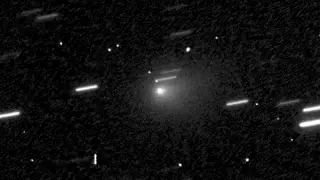
Comet C/2025 R3 (PanSTARRS) is brightening in April and could become visible to the naked eye in the predawn sky this month, potentially reaching around magnitude 4 as it nears perihelion on April 20 and Earth on April 27. For Northern Hemisphere viewers, it will pass near the Great Square of Pegasus and drift toward Pisces from mid‑April, with a new Moon on April 17 helping dark skies; however visibility is uncertain and depends on the comet’s activity, so binoculars may be needed for a good glimpse.

April 2026 Stargazing Gear Guide: Cameras, Binoculars, and Telescopes for Lyrids and Comets
space13 days ago

April 2026 Stargazing Gear Guide: Cameras, Binoculars, and Telescopes for Lyrids and Comets

Live Science’s April 2026 stargazing gear guide suggests the best cameras, binoculars, and telescopes to enjoy this month’s sky events, including the Full Pink Moon, the Lyrid meteor shower, and two bright comets (C/2026 A1 MAPS and C/2025 R3 PanSTARRS). It highlights a dark-sky window around the new moon on April 17 for deep-sky observing and astro-photography, and offers practical gear picks and tips for lunar, planetary, and galaxy observing.

Hubble records comet’s spin flip as jets reverse its rotation
space15 days ago

Hubble records comet’s spin flip as jets reverse its rotation

NASA’s Hubble Space Telescope tracked comet 41P/Tuttle–Giacobini–Kresák and observed its rotation reverse due to jets of gas and dust, with the spin slowing between 2017 observations and then flipping to a much faster rate (about 14 hours) by December 2017. Scientist David Jewitt explains that uneven jets act like tiny thrusters, reversing the comet’s spin, an unprecedented finding that may signal structural changes or breakup; the results were published in The Astronomical Journal.

Comet MAPS Could Light Up Twilight If It Survives Solar Pass
science29 days ago

Comet MAPS Could Light Up Twilight If It Survives Solar Pass

Comet MAPS (C/2026 A1), a Kreutz sungrazer discovered in Chile, is heading for its perihelion near the Sun on April 4 at about 99,000 miles (160,000 km) away. It could be torn apart by solar heat and gravity, but if it survives it could glow as brightly as Venus in twilight; however, viewing will be tricky—best about 30 minutes after sunset, with the Northern Hemisphere facing limited visibility and a long tail potentially visible for several days.

3I/Atlas Reveals Methanol-Rich Signature as It Leaves the Solar System
space1 month ago

3I/Atlas Reveals Methanol-Rich Signature as It Leaves the Solar System

Observations of interstellar comet 3I/Atlas show its coma is unusually rich in methanol—up to four times typical levels—along with carbon dioxide and other organics, suggesting formation in a colder or chemically distinct environment. The study, based on ALMA data, indicates methanol (and other gases) may be released from both the nucleus and sublimating icy grains in a hyperactive comet, supporting a natural origin. As it travels away from the Sun at about 60 km/s, 3I/Atlas reinforces that more interstellar visitors are likely to be found with advancing detection capability.

JUICE Captures 120 Images of Interstellar Comet 3I/Atlas as It Recedes
space-and-spaceflight1 month ago

JUICE Captures 120 Images of Interstellar Comet 3I/Atlas as It Recedes

ESA’s JUICE mission photographed interstellar comet 3I/Atlas in more than 120 JANUS images on November 6, 2025, a week after its closest approach to the Sun. The shots show a bright coma and a long tail, and scientists are analyzing the data (with results expected in late March). 3I/Atlas, discovered June 2025 by ATLAS, is only the third known interstellar visitor, and as it drifts away from the Sun, JUICE continues its deep-space observations on its way to Jupiter (arrival in 2031).

Comet Wierzchos Nears Earth on Feb. 17 — A Tough Telescopic Look
space1 month ago

Comet Wierzchos Nears Earth on Feb. 17 — A Tough Telescopic Look

Comet C/2024 E1 (Wierzchos) will pass about 94 million miles (151 million km) from Earth on February 17, its closest approach yet; at magnitude around +8.2 it won’t be visible to the naked eye, but may be spotted with binoculars under dark skies. For U.S. viewers, it will sit low in the southwestern sky at sunset in the southern Grus constellation before fading as it moves away from the Sun. The comet brightened after its January 20 perihelion near the Sun, but is expected to dim over the coming weeks as it recedes farther from Earth.

City-Sized Green Comet Eyes Interstellar Exit
space1 month ago

City-Sized Green Comet Eyes Interstellar Exit

Comet C/2024 E1 (Wierzchoś) is brightening as it nears its closest approach to Earth and is on a hyperbolic trajectory that will likely eject it from the solar system, making it another interstellar visitor like 3I/ATLAS. JWST detected significant CO2 in its coma and initial estimates put the nucleus around 13.7 km, thoughSize estimates vary. It passed perihelion earlier in January and will be about 151 million km from Earth on Feb. 17; the emerald iceball will not be naked-eye visible but can be observed with a telescope. Once sent on its interstellar journey, it will drift through the Milky Way for millions to billions of years.

New Sungrazing Comet Could Glow in Daylight if It Survives Its Close Sun Pass
space2 months ago

New Sungrazing Comet Could Glow in Daylight if It Survives Its Close Sun Pass

Discovered C/2026 A1 (MAPS) is a Kreutz sungrazing comet that will swing within about 0.5 million miles of the Sun at perihelion on April 4; if it survives the solar blast, it could become bright enough to be seen with the naked eye—even in daylight—if it survives the solar encounter; observers in the Southern Hemisphere are best placed to view, while those in the north may see it low on the western horizon at sunset; most sungrazers disintegrate near perihelion, so brightness is uncertain, and even if it breaks up it could remain visible with a telescope in late March; another potential bright comet, C/2025 PanSTARRS, may follow later in April.

Comet MAPS: A Potential Naked-Eye Visitor for Spring
space2 months ago

Comet MAPS: A Potential Naked-Eye Visitor for Spring

Astronomers are buzzing about Comet C/2026 A1 (MAPS), a Kreutz sungrazer discovered in Chile that could become a bright naked-eye comet if it survives its extreme Sun approach at perihelion in early April. Its current magnitude is faint, and experts split on whether it will survive and brighten; by early March we should have a clearer forecast. If MAPS performs, it could grace the western evening sky in mid-April after sunset, but many Kreutz comets disintegrate near perihelion. The MAPS name honors the team that developed its discovery program.