
Spain’s ‘Mystery Meteor’ Revealed as Airplane Contrail During Perseid Peak
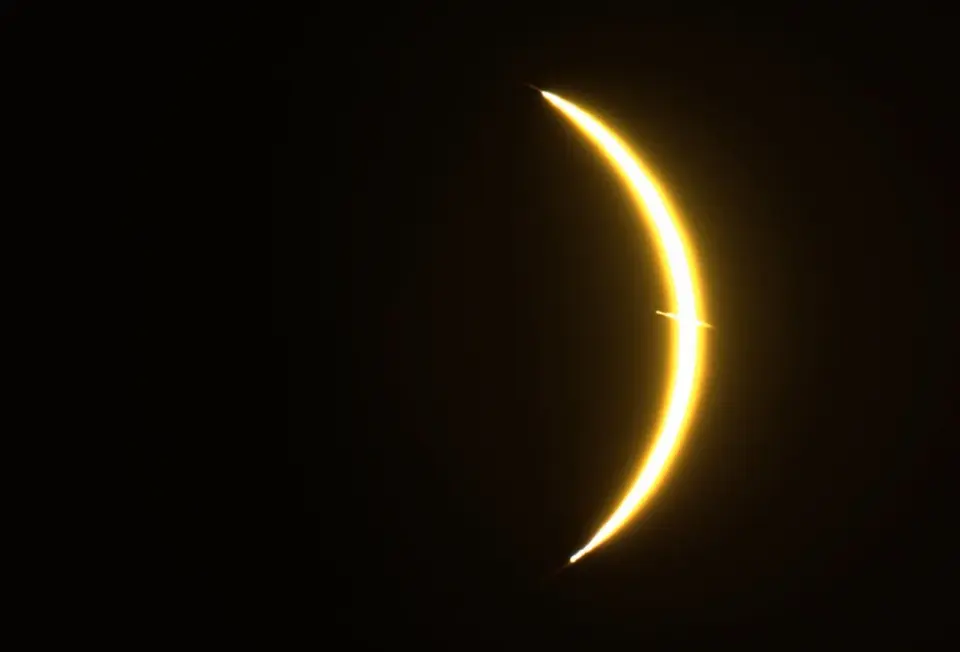
A video captured in Spain during the 2026 Perseid meteor shower peak initially appeared to show a mysterious object crossing a partially eclipsed Sun. Analysis by NASA’s Astronomy Picture of the Day (APOD) identified the object as an airplane contrail, not a meteor. The footage, recorded on August 12, 2026, coincided with the shower’s peak and a total solar eclipse. While the Perseids were exceptionally visible due to a New Moon, this specific event was a terrestrial artifact. The shower, originating from Comet 109P/Swift-Tuttle, remained active through August 24, 2026, with peak activity on August 12-13.
Key points
- A video recorded in Spain on August 12, 2026, at 20:28 local time, showed an object crossing a partially eclipsed Sun, initially mistaken for a meteor.
- NASA’s APOD analysis determined the object was an airplane contrail, identified via flight database cross-referencing, rather than a Perseid meteor.
- The Perseid meteor shower peaked on August 12-13, 2026, coinciding with a New Moon and a total solar eclipse, providing exceptionally dark skies for observation.
- The Perseids originate from debris left by Comet 109P/Swift-Tuttle, which has a 133-year orbital period and a nucleus approximately 26 kilometers across.
- The shower remained active through August 24, 2026, with meteors entering Earth’s atmosphere at approximately 59 km/s.
Background
The 2026 Perseid meteor shower was anticipated to be particularly favorable for observation due to the New Moon occurring on August 12, 2026, which minimized lunar interference. This timing coincided with a total solar eclipse, whose path of totality crossed parts of northern Russia, Greenland, Iceland, northern Spain, and a small part of Portugal. The eclipse’s New Moon phase ensured dark skies for meteor viewing shortly after the eclipse. Previous coverage noted the widespread photography of the August 12 solar eclipse across Europe and Greenland, highlighting the astronomical significance of the date. The Perseids, associated with Comet 109P/Swift-Tuttle, are known for bright trails and fireballs, with the International Meteor Organization listing the shower as active from July 17 through August 24, 2026.
How outlets are covering it
NASA’s APOD focused on the specific incident of the 'mystery meteor' in Spain, emphasizing the importance of cross-referencing flight data to distinguish between celestial and terrestrial phenomena. PTTL.gr highlighted the broader context of the 2026 Perseids, noting the exceptional observing conditions due to the New Moon and the multi-night composition from the Czech Republic that visually demonstrated the radiant point in Perseus. Anadolu Ajansı provided photographic evidence of the Perseid meteor shower observed over Bilovec near Ostrava, Czech Republic, on August 11, 2026, confirming the shower’s visibility in Europe. While NASA focused on a single misidentified event, PTTL.gr and Anadolu Ajansı emphasized the successful observation of the Perseids under favorable conditions, with PTTL.gr noting the perspective effect of the radiant and Anadolu Ajansı providing visual confirmation of the shower’s activity.
Why it matters
The incident underscores the importance of verifying astronomical observations, particularly during high-profile events like meteor showers and solar eclipses. Misidentifying terrestrial objects as meteors can lead to misinformation, but cross-referencing with flight databases provides a reliable method for verification. The 2026 Perseids, enhanced by the New Moon and solar eclipse, offered a unique opportunity for observation, highlighting the interplay between astronomical events and their impact on visibility. The event also serves as a reminder that even during peak meteor activity, not all bright objects in the sky are meteors, and careful analysis is required to distinguish between natural and human-made phenomena.
What to watch
The Perseid meteor shower remains active through August 24, 2026, although activity is expected to decline after the peak. Observers are advised to use dark, open locations and allow approximately 30 minutes for eyes to adapt to darkness. The International Meteor Organization noted possible encounters with older sections of the Swift-Tuttle debris stream, though no certainty of unusually strong activity exists. Future observations of the Perseids will continue to benefit from the dark skies provided by the New Moon, with the radiant point in Perseus rising higher in the sky as the night progresses.
- APOD: 2026 August 19 - The Case of the Mysterious Maybe Meteor NASA Science (.gov)
- NASA’s striking Perseids 2026 image reveals their radiant in Perseus PTTL.gr
- Perseid meteor shower in Czech Republic Anadolu Ajansı
Want the full story? Read the original reporting
Read on NASA Science (.gov)