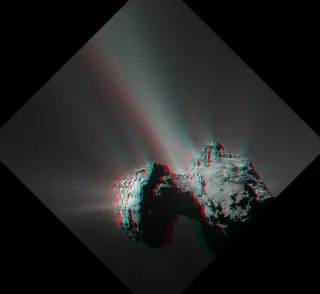
NASA's Astronomy Picture of the Day features a 3D stereo anaglyph of Comet 67P, created from images taken by the Rosetta spacecraft in 2015. The visualization highlights the comet's active surface and jets near its closest approach to the Sun.
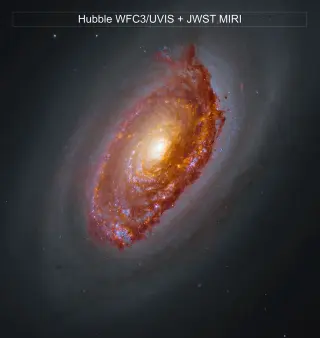
NASA's Astronomy Picture of the Day features new composite images of the spiral galaxy Messier 64, also known as the Black Eye Galaxy. The images combine data from the Hubble Space Telescope and the James Webb Space Telescope to reveal how dust and gas interact within the galaxy. Webb's Mid-Infrared Instrument detects dust that absorbs and re-emits light from newborn stars, while Hubble highlights star-forming regions. The images confirm that M64's inner and outer gas regions counter-rotate, a phenomenon likely caused by a past merger with a smaller galaxy. This observation supports the theory that spiral galaxies, including the Milky Way, experience mergers rather than evolving in isolation.
NASA’s Astronomy Picture of the Day highlights a new James Webb Space Telescope image of a dust pillar in the Carina Nebula, located 7,500 light-years away. The image reveals a compact cluster of approximately 70 young stars, estimated to be 1.3 million years old, including a massive star 19 times the mass of the Sun. Stellar winds and radiation from the nearby Eta Carinae system shape the pillar, while internal star formation excavates its head, creating a 'treasure chest' appearance.
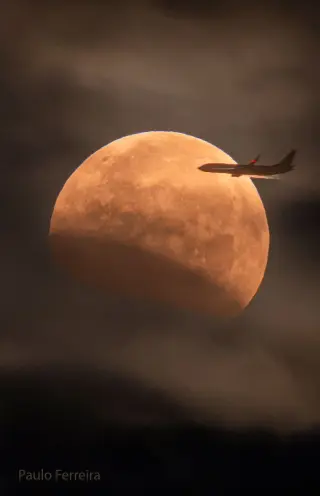
NASA’s Astronomy Picture of the Day featured an image of the August 2026 lunar eclipse taken from an airplane in Portugal, highlighting how easily visible these events are to the naked eye.
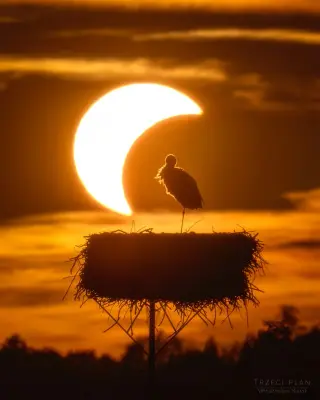
NASA’s Astronomy Picture of the Day features a stork in Poland reacting to the recent total solar eclipse. The image captures the bird during the partial phase, illustrating how animals mimic nighttime behaviors during totality, such as silence and sleep-like postures, before resuming normal activity as sunlight returns.
NASA's Astronomy Picture of the Day highlights a stork in Poland resting during the partial phase of the August 2026 total solar eclipse. The feature explains how animals mimic nighttime behaviors during totality, including birds sleeping and nocturnal sounds emerging, before returning to normal activity as sunlight returns.
NASA's Astronomy Picture of the Day highlights a photograph taken from an airplane in Portugal, showing the September 1, 2026 penumbral lunar eclipse. The image illustrates that lunar eclipses are visible to anyone on the Earth's night side without special equipment, though the specific shot required a clear view from the aircraft's right side.
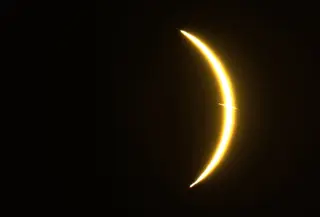
A video captured in Spain during the 2026 Perseid meteor shower peak initially appeared to show a mysterious object crossing a partially eclipsed Sun. Analysis by NASA’s Astronomy Picture of the Day (APOD) identified the object as an airplane contrail, not a meteor. The footage, recorded on August 12, 2026, coincided with the shower’s peak and a total solar eclipse. While the Perseids were exceptionally visible due to a New Moon, this specific event was a terrestrial artifact. The shower, originating from Comet 109P/Swift-Tuttle, remained active through August 24, 2026, with peak activity on August 12-13.
NASA’s Astronomy Picture of the Day featured the Dark Doodad Nebula and globular cluster NGC 4372 on July 31, 2026. The image, credited to Alessandro Cipolat Bares, shows the dusty nebula in the constellation Musca, with the star cluster appearing near its southern tip. The nebula is a molecular cloud about 700 light-years away, while the cluster is a background object 20,000 light-years distant. The name 'Dark Doodad' was coined by Dennis di Cicco in 1986.
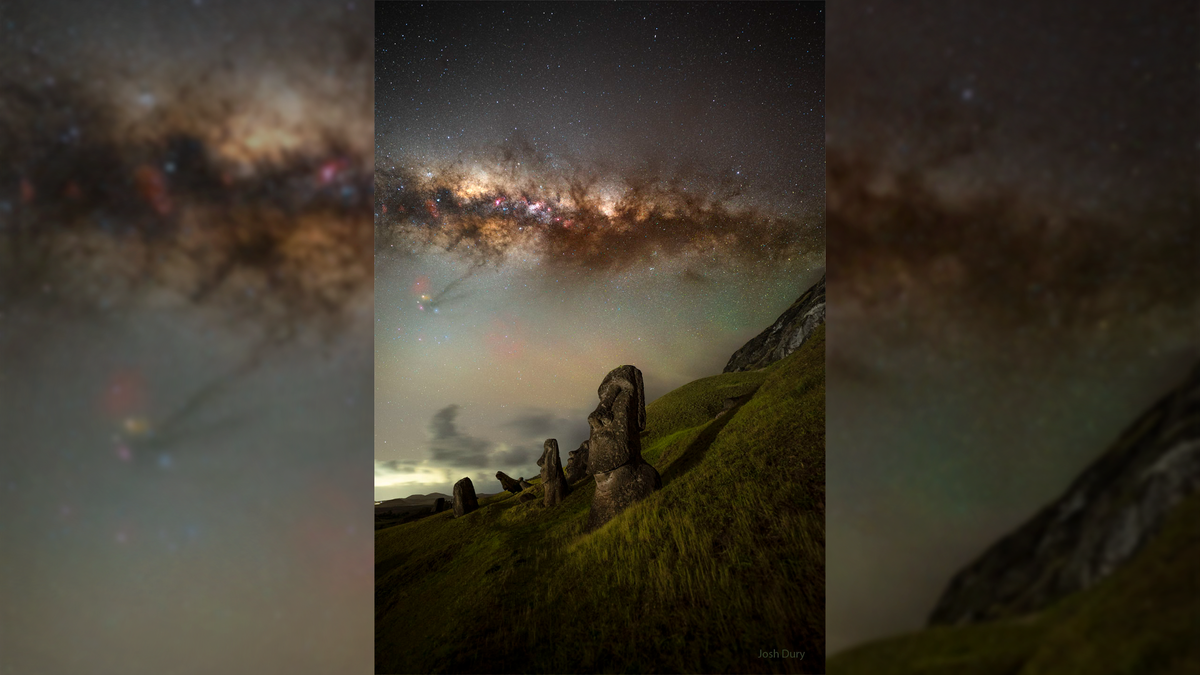
Photographer Josh Dury captured a stunning image of the Milky Way over Easter Island's Moai statues during an annular solar eclipse visit. The photo, titled "Aringa Ora O Te Tupuna" (The Living Face of the Ancestors), was selected as NASA's Astronomy Photo of the Day. Dury, known for his astrophotography, dedicated the image to the islanders and their ancestors, highlighting the cultural and scientific significance of the Rapa Nui people.