
Voyager 1 Crosses 16 Billion-Mile Threshold as Public Marks Milestone with Morse Code
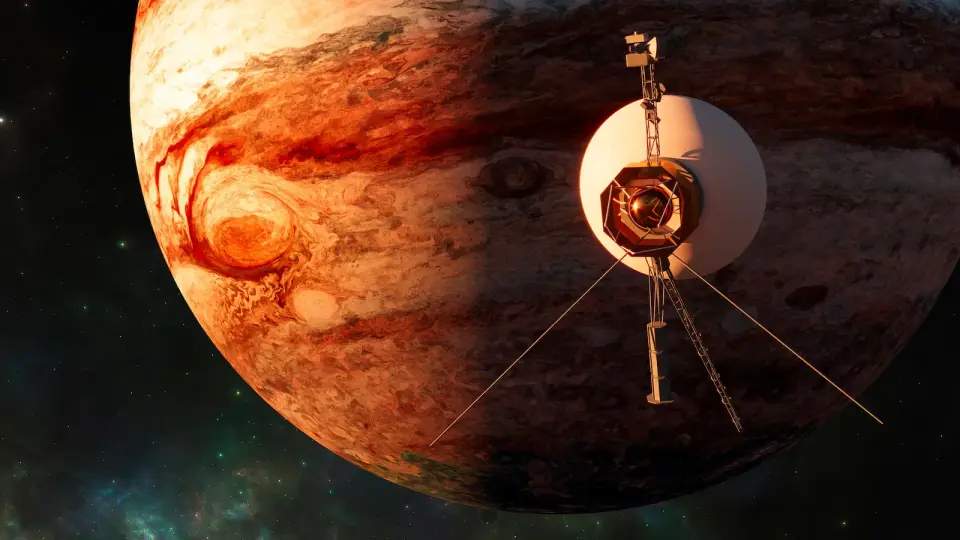
NASA’s Voyager 1 probe will reach a distance of one light-day from Earth on November 18, 2026, becoming the first human-made object to travel this far. The spacecraft, launched in 1977, is now over 16 billion miles away and traveling at 38,000 mph. While its camera was shut down in 1990, it continues to transmit data on magnetic fields and plasma waves. NASA is inviting the public to celebrate by flashing the probe’s call sign in Morse code, marking a symbolic moment before the mission’s 50th anniversary next year.
Key points
- Voyager 1 will reach one light-day from Earth on November 18 at 5:16 a.m. ET, a distance of approximately 16.09 billion miles.
- The probe, launched in September 1977, was originally designed for a five-year mission but has operated for nearly 50 years.
- NASA is hosting a 'Shine Bright for Voyager' event, asking the public to flash the call sign V-G-R in Morse code on Tuesday night.
- The spacecraft currently has only two active science instruments: one for magnetic fields and another for plasma waves, due to dwindling power.
- Voyager 1 carries a gold-plated record with greetings in 55 languages, music, and images, intended as a message to potential extraterrestrial life.
Background
Voyager 1 entered interstellar space in 2012 and overtook Pioneer 10 as the most distant human-made object in 1998. In October 2026, NASA briefly lost contact with the probe but re-established communication 48 hours later. The agency has shut down several instruments over the years to conserve power, including the Low-energy Charged Particles experiment earlier this year. The probe’s plutonium power source is expected to last into the 2030s, after which it will continue drifting through space without power.
How outlets are covering it
ABC News emphasizes the cultural and historical significance of Voyager 1’s imagery, noting its role in transforming public understanding of the solar system. NPR highlights the public engagement aspect, detailing the Morse code tribute and the specific timing of the milestone. Space.com provides technical context, noting that Voyager 1 is currently in the constellation Ophiuchus and that its twin, Voyager 2, will not reach the light-day mark until 2035. Live Science focuses on the scientific legacy, particularly the 1979 Jupiter flyby and the discovery of volcanic activity on Io, while noting that the camera was turned off in 1990.
Why it matters
This milestone underscores the durability of early space technology and the enduring value of long-term scientific missions. It also highlights the challenges of maintaining communication with distant spacecraft as power and propellant dwindle. The event serves as a symbolic bridge to the 50th anniversary of the Voyager missions in 2027, reinforcing public interest in space exploration and the legacy of 1970s-era technology.
What to watch
NASA will continue to monitor Voyager 1’s data as it moves further into interstellar space. The agency plans to celebrate the 50th anniversary of the Voyager missions in August and September 2027. Voyager 2 is expected to reach the one-light-day mark in 2035. Both probes are projected to run out of power in the 2030s, after which they will continue drifting through space indefinitely.
- A NASA probe from the '70s is still talking, and Wednesday it will be a light-day away ABC News - Breaking News, Latest News and Videos
- Far from home. Voyager 1 is now farther than anything man has sent into space NPR
- NASA's interstellar Voyager 1 probe is about to reach 1 light-day from Earth after nearly 50 years in space Space
- NASA's Voyager 1 probe poised to achieve mega-distance milestone Reuters
- NASA's Voyager 1 mission forever changed our view of Jupiter (photos) Live Science
Want the full story? Read the original reporting
Read on ABC News - Breaking News, Latest News and Videos